
The hardest part of building a productive developer stack isn’t finding tools—it’s avoiding tools you don’t actually need.
Bypass the hype with this curated guide to developer and AI tools, tailored to fit your actual daily workflow.
Droven.io’s best tech tools for developers in 2026 include AI coding tools such as Cursor, GitHub Copilot, Claude Code, and OpenAI Codex, along with essential tools for version control, API testing, debugging, and cloud development. The right choice depends on your coding workflow, project needs, budget, and level of AI assistance.
Droven.io serves as an AI and tech publication rather than a software vendor or development suite.
This guide focuses on the actual Droven.io Best Tech Tools for Developers topic:which developer tools are worth knowing in 2026, where AI coding assistants and agents make the biggest impact, and how to build a practical toolkit without over-subscribing. For a broader tool comparison, see our full guide to the best AI tools for developers.
What Is Droven.io?
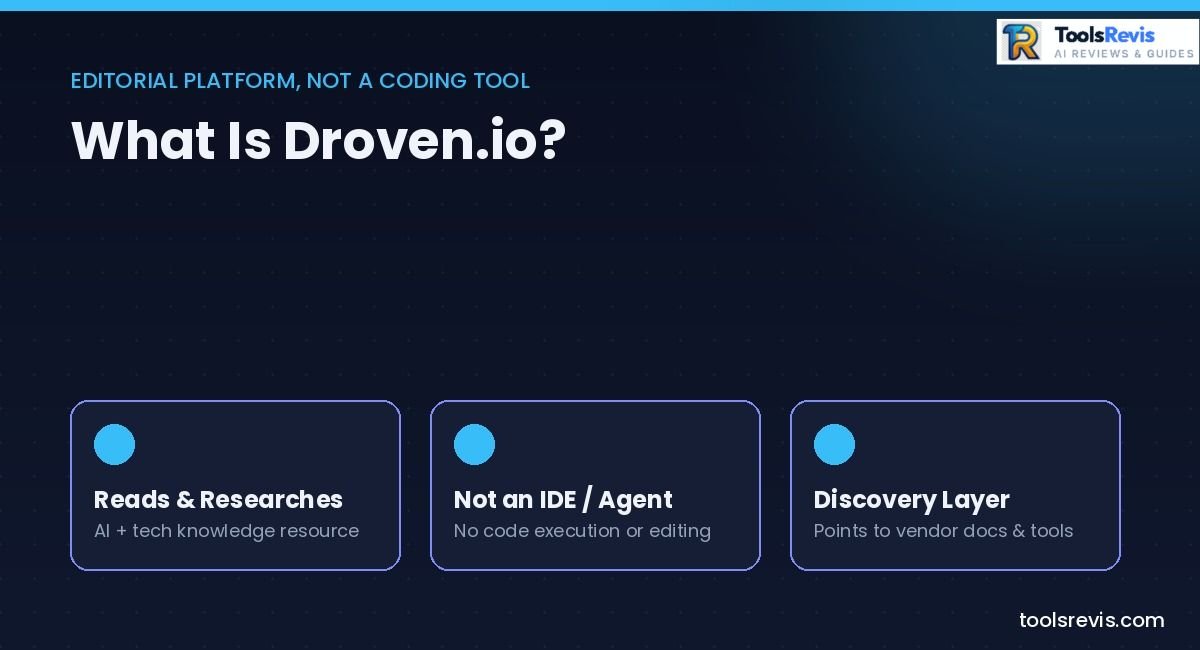
Droven.io is an editorial AI and technology knowledge platform that publishes information about technology topics; it is not a coding tool, IDE, AI coding assistant, or software development platform. Droven.io positions itself, on its own site, as a content-focused resource covering AI, automation, emerging technology, software development, cloud computing, cybersecurity, and related subjects.
This distinction matters because the name can easily create confusion. Someone searching what is Droven.io might expect a downloadable application, developer dashboard, API, or AI coding environment. Based on its public positioning, that isn’t its main focus.
Instead, Droven.io is more relevant to developers who want to:
- Understand AI and emerging technology trends
- Research developer tools before choosing one
- Learn about automation and software-related topics
- Get broader context around changing technology
- Discover topics worth researching further through official documentation
Is Droven.io a Coding Tool?
No, Droven.io is not a coding tool in the usual sense. It does not function like an IDE, code editor, AI coding assistant, version-control platform, or developer framework.
The easiest way to see the distinction is simple:
- Droven.io: A place to read and research technology topics
- Cursor or GitHub Copilot: Tools that actively assist with coding
- GitHub: A collaborative code-hosting service built around version management.
- Postman: An industry-standard platform for building, debugging, and testing APIs.
If you are wondering whether Droven.io is built for writing code: the accurate answer is no. It may cover coding, AI, automation, and developer technology editorially, but reading about a tool is different from using that tool directly.
Who Is Droven.io Relevant For?
Droven.io is most relevant for developers and technical readers who want broader context around AI and technology—not someone looking for a direct coding environment.
It comes in handy for exploring topics like:
- Should I use an AI coding assistant or an autonomous coding agent?
- Which new AI or automation trends are worth paying attention to?
- What technology should I investigate before changing my workflow?
- How does a new development trend affect the wider industry?
However, for product-specific decisions involving pricing, usage limits, security, APIs, or technical implementation, developers should still check official documentation and current vendor information.
The key takeaway: Droven.io can help with technology discovery and understanding, while actual developer tools are the software you use to write, test, deploy, debug, and manage code.
Droven.io Best Tech Tools for Developers: Which Tools Do Developers Actually Need?
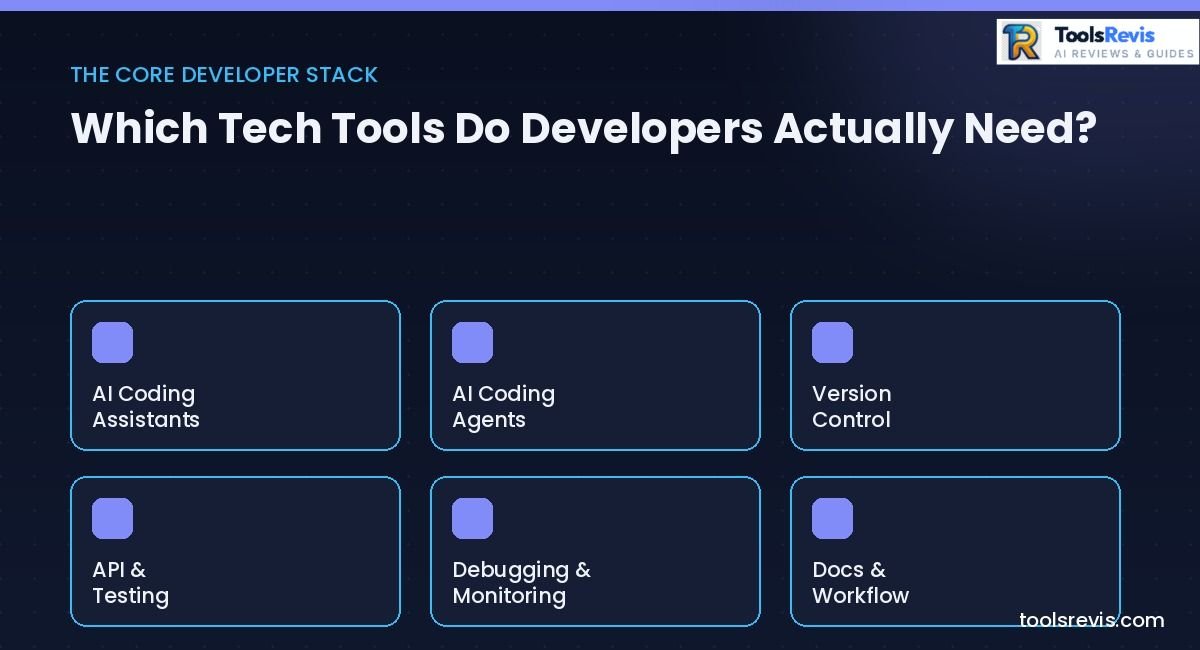
The most valuable developer tools prioritize workflow efficiency: AI assistants for coding and comprehension, version control systems for teamwork, robust debugging suites for code quality, and documentation platforms to eliminate repetitive tasks. Instead of overloading your stack with dozens of options, focusing on 5 to 6 core tools is usually all it takes.
A practical developer stack often includes:
- AI coding assistants for suggestions, explanations, and code generation
- AI coding agents for larger, multi-step development tasks
- Version control tools such as Git and GitHub
- API and testing tools for finding problems before production
- Debugging and monitoring tools for diagnosing issues
- Documentation and workflow tools for reducing context switching
Crucially, the top developer tools in 2026 are defined by their actual utility rather than their popularity. A solo developer building a web application may need an AI-first editor, Git, Postman, and a cloud platform. A large engineering team may prioritize GitHub integration, security controls, code review, CI/CD, and shared documentation.
Research into current developer AI adoption also shows that specialized AI tools have become widely used, but different products fit different workflows.
AI Coding Assistants
AI coding assistants help developers write, explain, edit, and understand code while keeping the developer actively involved in the workflow. They are especially useful for repetitive coding, navigating unfamiliar codebases, generating boilerplate, explaining errors, and speeding up everyday development tasks.
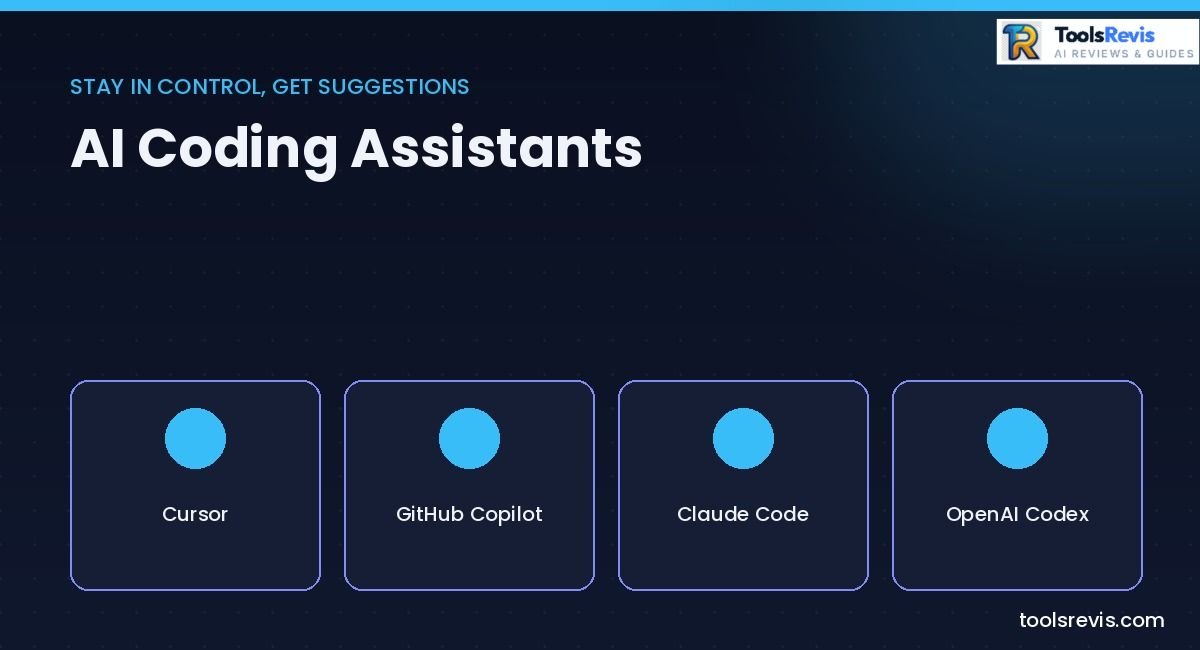
Among the most important options are:
- Cursor — An AI-focused coding environment designed around codebase context, conversational editing, and agentic development workflows. It is a strong option for developers who want AI deeply integrated into their editor.
- GitHub Copilot — An AI development tool that works across supported IDEs and GitHub workflows. It can assist with code completion, chat, edits, and increasingly agent-driven tasks, making it particularly relevant for developers and teams already using GitHub. GitHub also continues to expand Copilot’s AI model and agent capabilities.
- Claude Code — A coding-focused AI tool built around understanding repositories and helping with more complex development tasks. It is particularly relevant to developers who prefer working close to the terminal and want AI assistance across a larger codebase.
- OpenAI Codex — An AI coding agent environment designed for software development tasks that can involve understanding code, making changes, and working through multi-step problems. Its practical value largely relies on the level of agent autonomy your current process requires.
The Cursor vs GitHub Copilot decision usually comes down to workflow rather than a universal winner. Cursor is centered on an AI-native editor experience, while GitHub Copilot is often easier to integrate into an existing IDE and GitHub-based workflow.
If you’re also comparing coding agents, our Windsurf vs Cursor comparison.
AI Coding Agents
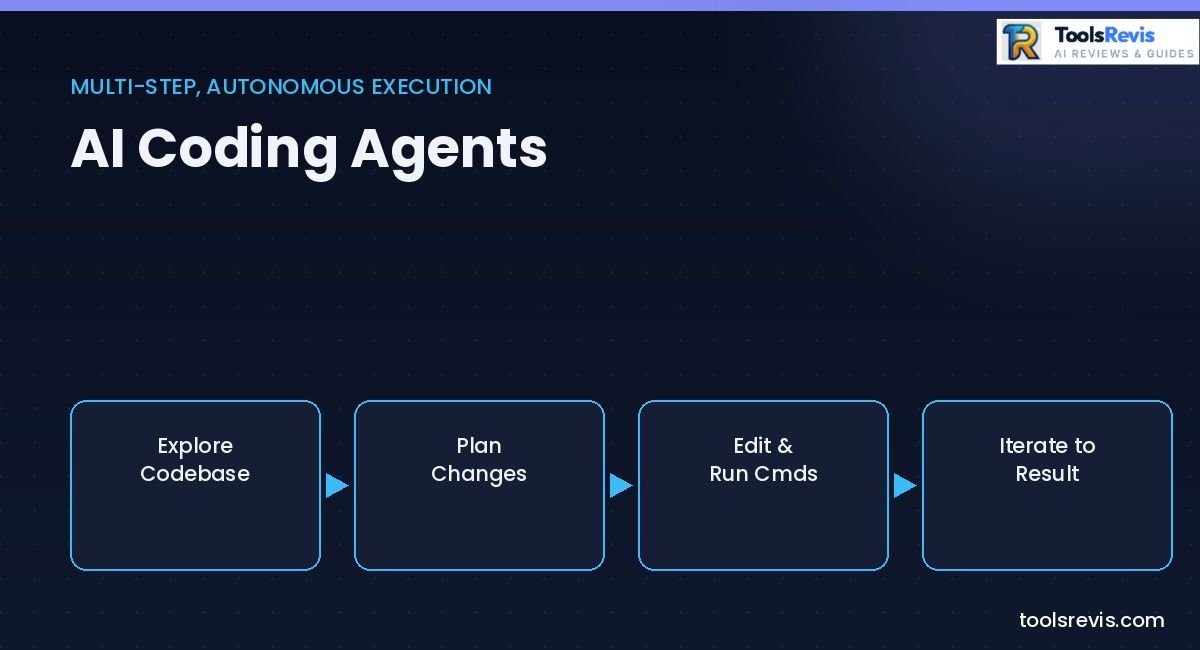
AI coding agents go beyond suggesting code: they can work through multi-step tasks by exploring a codebase, editing files, running commands, and iterating toward a result within their available permissions.
This is the core assistant-vs-agent distinction covered later in the decision section below.
In practice, the boundary is becoming less strict because many coding assistants now include agent modes. GitHub Copilot, for example, supports agent-driven workflows alongside traditional in-editor assistance.
Claude Code is a notable choice for repository-aware and terminal-oriented workflows. Developers can use it for investigating code, making coordinated changes, and working through development tasks without relying entirely on a graphical editor. If that workflow matches your setup, explore ready-to-use Claude Code templates.
OpenAI Codex is another important option for delegated coding tasks and agentic software development. The key question is not simply which agent generates better code—it is whether you can clearly define the task, safely control its access, and efficiently review its output.
GitHub Copilot also has agent-specific capabilities for developers who want to extend AI beyond autocomplete and chat. You can learn more about GitHub Copilot’s agent mode.
Practical recommendation: Use an agent for clearly scoped, reviewable work—not as an excuse to skip understanding your own code. The more autonomous the task, the more important testing, diffs, and human review become.
Developer Productivity Tools
Developer productivity tools reduce the time lost between writing code, testing it, finding problems, collaborating with others, and documenting decisions. The best stack minimizes unnecessary context switching instead of adding another dashboard for every task.
A useful productivity stack can include:
Coding and Workflow
- Git and GitHub remain the backbone of version control — branching strategies (trunk-based vs feature branches) and pull-request review culture matter more than which client you use.
- An IDE or editor that matches your language: VS Code for broad language support, JetBrains IDEs for Java/Kotlin/Python-heavy teams, or an AI-native editor like Cursor if AI is central to your workflow.
- Task and issue tracking (Jira, Linear, GitHub Issues) that connects directly to your commits and pull requests.
Debugging and Testing
- Browser developer tools for frontend debugging.
- API testing: Postman remains the default, but Insomnia and Bruno are lighter open-source alternatives worth trying if you want offline-first or Git-versioned collections.
- Unit and integration testing frameworks suited to your language (Jest/Vitest for JS, pytest for Python, JUnit for Java).
- CI/CD systems such as GitHub Actions (tightly integrated with GitHub), GitLab CI (built-in for GitLab users), or CircleCI/Jenkins for larger, more customizable pipelines.
- Cloud/deployment platforms: Vercel or Netlify for frontend-heavy projects, Railway or Render for quick full-stack deploys, AWS for larger or enterprise-scale infrastructure.
The goal is not to automate every step. Good tooling should make failures easier to reproduce and fixes easier to verify.
Documentation and Knowledge Sharing
Documentation tools are often underrated because developers only notice their value when context is missing. Useful documentation can include:
- Setup instructions
- Architecture decisions
- API references
- Known issues and troubleshooting steps
- Code comments where they genuinely clarify intent
Integrated tools can also reduce the toggle tax—the time lost jumping between an editor, browser, chat application, documentation system, and separate AI interface. This is one reason IDE-integrated AI and connected development workflows can be more useful than adding multiple standalone subscriptions.
Beginners exploring more guided development environments can also compare options through our Replit AI review.
The practical takeaway: A strong developer stack does not mean owning every popular tool. Start with one reliable editor, version control, testing, documentation, and—if it genuinely saves time—one AI assistant or agent. Add more tools only when you can identify the specific problem they solve.
Best AI Coding Tools for Developers in 2026
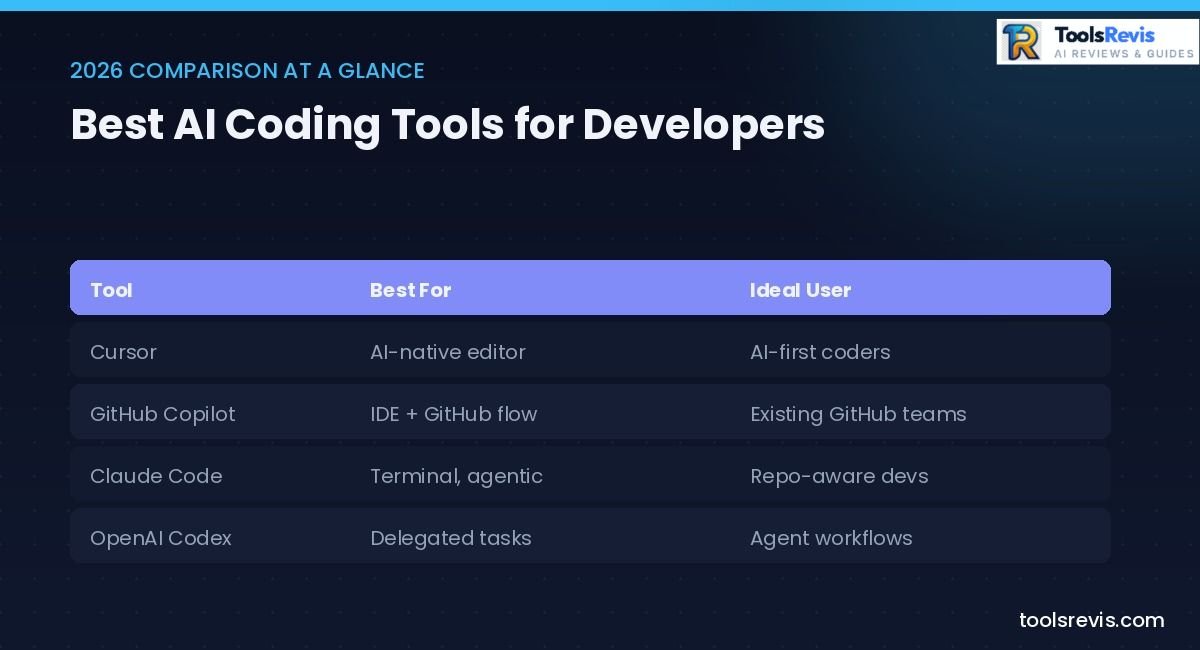
The best AI coding tools in 2026 depend on how you work: Cursor is strong for an AI-native editor workflow, GitHub Copilot fits developers and teams already using GitHub and established IDEs, Claude Code suits terminal-based agentic work, and OpenAI Codex is designed for delegated coding tasks and agent workflows.
There is no universal winner. The most useful comparison looks at workflow, main strength, ideal user, and pricing model rather than simply asking which tool produces the most code.
| Tool | Best For | Main Strength | Ideal User | Pricing Model |
| Cursor | AI-first coding workflow | Deep AI integration inside an AI-native editor | Developers who want AI central to daily coding | Free Hobby tier; paid individual, team, and Enterprise plans |
| GitHub Copilot | IDE and GitHub workflows | Broad ecosystem integration, code completion, chat, agents, and code review | Individual developers and teams already using GitHub | Free; Pro $10/mo; Pro+ $39/mo; Max $100/mo; Business $19/seat; Enterprise $39/seat (AI Credits billing, verify at github.com/features/copilot/plans) |
| Claude Code | Terminal-based development | Repository-aware, agentic workflows | Developers comfortable working through the terminal | Access and pricing depend on the applicable Claude plan or service arrangement |
| OpenAI Codex | Delegated coding tasks | Agentic software development and multi-step task execution | Developers and teams using autonomous or semi-autonomous workflows | Availability and pricing depend on the applicable OpenAI plan or team setup |
Pricing and usage models change frequently, especially as providers move toward credits and usage-based billing. Cursor currently offers a free Hobby plan alongside paid individual, team, and Enterprise options, while GitHub Copilot offers free and paid plans for individuals plus Business and Enterprise options.
Cursor: Best for an AI-Native Coding Experience
Cursor is a strong choice for developers who want AI deeply integrated into the coding environment rather than added as a separate assistant.
Its workflow is built around AI-assisted editing, agent requests, codebase context, model access, and cloud-agent capabilities. This makes Cursor particularly appealing if you regularly use AI to explore repositories, make coordinated edits, and work through implementation tasks.
Cursor’s current pricing includes a free Hobby plan, with paid plans such as Pro and higher-usage options. Team and Enterprise offerings add administration, privacy, security, and collaboration features.
Best for: Developers who want an AI-first environment and regularly use agentic coding workflows.
For a deeper breakdown of its features and limitations, see our in-depth Cursor AI review.
Cursor’s current plan names and prices change often — verify the latest tiers at cursor.com/pricing before subscribing.
GitHub Copilot: Best for Existing Developer Workflows
GitHub Copilot is a strong choice for developers who want AI assistance across their existing IDE, command-line, and GitHub workflow instead of moving to a completely new editor.
GitHub Copilot supports code completion, editing, chat, agents, model selection on eligible plans, and GitHub-connected workflows. This broader ecosystem is one of its main advantages for teams already managing repositories, pull requests, and collaboration through GitHub.
GitHub currently offers a free plan, individual paid plans including Pro, Pro+, and Max, plus Business and Enterprise plans. Usage for some AI features is measured through GitHub AI Credits, so developers should consider both subscription price and expected usage when comparing plans.
Best for: Developers and teams already invested in GitHub and supported IDEs.
For a detailed feature-by-feature evaluation, see our full GitHub Copilot review.
Claude Code: Best for Terminal-Based Agentic Workflows
Claude Code is best suited to developers who prefer repository-aware AI assistance and agentic development workflows close to the terminal.
Rather than focusing primarily on autocomplete, this style of tool is useful for larger development tasks that require understanding multiple files, investigating a codebase, planning changes, and iterating on implementation.
The main advantage is workflow depth. Developers can give the tool a broader task and then review the resulting changes instead of manually prompting for every individual function.
However, this also creates a trade-off: more autonomous workflows require stronger review practices. You should still inspect diffs, run tests, verify security-sensitive changes, and avoid assuming generated code understands undocumented business requirements.
Best for: Developers who work comfortably in the terminal and want AI help with larger, multi-step coding tasks.
You can explore Claude Code’s terminal-based workflow for a closer look at this approach.
OpenAI Codex: Best for Delegated Coding Tasks
OpenAI Codex is designed for software development workflows where AI can take on broader coding tasks instead of only providing inline suggestions.
This makes it particularly relevant for developers exploring agentic development. A well-defined task can potentially involve understanding the codebase, making changes, and progressing through multiple implementation steps before the developer reviews the result.
The biggest consideration is task clarity. AI agents generally perform better when:
- The goal is clearly defined
- The repository context is accessible
- Tests provide useful feedback
- Permissions are appropriately controlled
- The final output receives human review
OpenAI has also introduced flexible and usage-based approaches for Codex in team environments, which means pricing should be checked against the current plan and usage model before making a purchasing decision.
Codex is included inside ChatGPT plans rather than sold separately — see openai.com/chatgpt/pricing for current tiers.
Best for: Developers and teams experimenting with delegated, agent-driven software development tasks.
Cursor vs GitHub Copilot: Which Is Better?
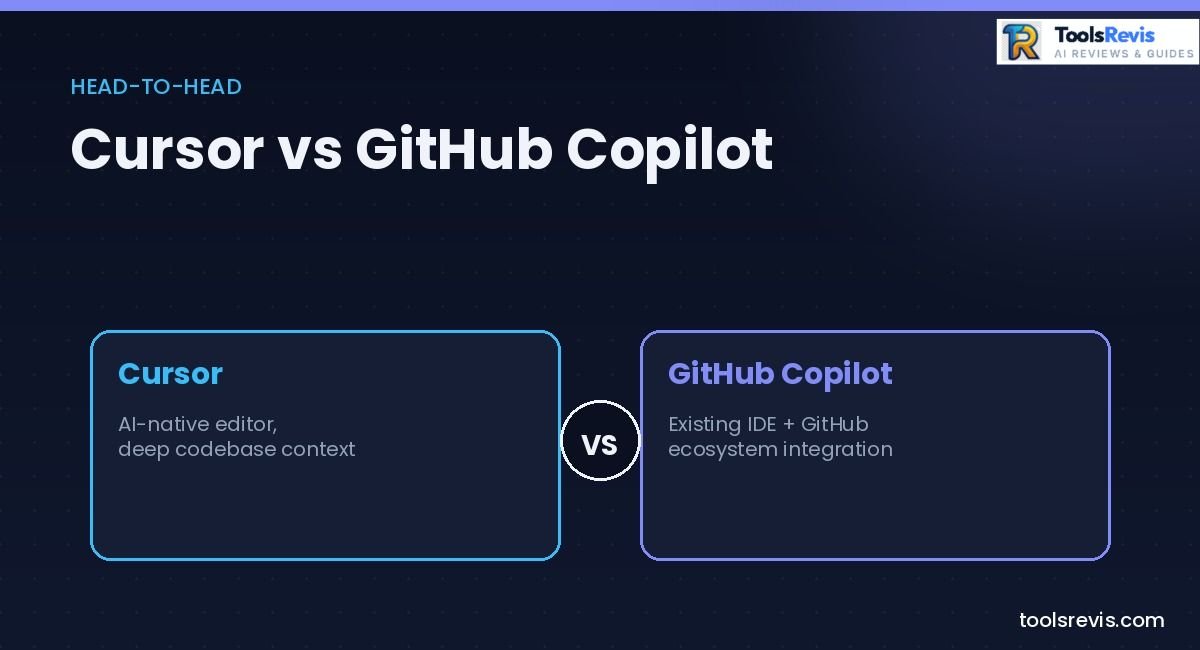
For an AI-native editor experience, Cursor is often the better fit; for developers who want AI integrated into their existing IDE and GitHub ecosystem, GitHub Copilot is usually the more natural choice.
Pricing structures differ too — Cursor uses subscription tiers with usage limits, while Copilot combines seat pricing with AI Credits — so compare total expected usage, not just the sticker price.
If you’re deciding specifically between AI coding environments and agents, read our detailed Cursor vs Codex comparison. You can also explore how Cursor compares to Kimi K3 and our Windsurf AI review.
Bottom line: The best AI coding tools in 2026 are the ones that reduce repetitive work without creating a new layer of tool management. Test the free or limited-access option first, measure whether it genuinely saves time, and only pay for higher usage when the workflow benefit is clear.
Droven.io Software Development Tips
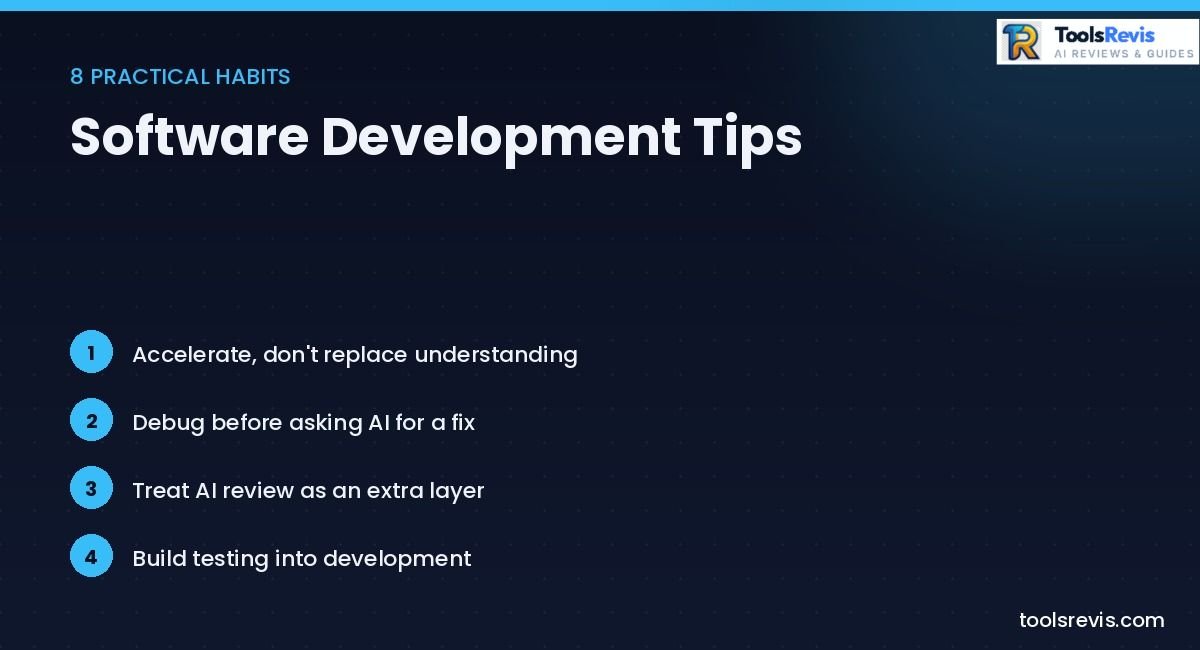
The most useful software development tips in 2026 focus on using AI to accelerate repetitive work while maintaining strong habits around debugging, code review, testing, documentation, and workflow management. AI can make developers faster, but reliable software still depends on how well the output is reviewed and verified.
The following tips apply regardless of which AI tool you use.
1. Use AI to Accelerate Work, Not Replace Understanding
AI-assisted development works best when you understand the problem before asking the tool to solve it.
Use an AI coding assistant or agent for tasks such as:
- Explaining unfamiliar code
- Generating repetitive boilerplate
- Suggesting implementation approaches
- Refactoring clearly scoped code
- Creating initial test cases
- Summarizing large code changes
Avoid blindly accepting generated code, especially when working with security, authentication, databases, or critical business logic.
A better workflow is:
Understand the task → Ask AI for assistance → Review the output → Test it → Verify the final behavior
This approach gives you the speed benefits of AI without losing control of the codebase.
2. Debug the Problem Before Asking AI for a Fix
Good debugging starts with reproducing and understanding the problem, not immediately generating a solution.
Before using an AI tool, collect useful context:
- The exact error message
- Steps that reproduce the problem
- Relevant code
- Expected behavior
- Actual behavior
- Recent changes that may have caused the issue
Giving an AI assistant vague information such as “my code doesn’t work” usually produces generic answers. Providing a reproducible problem gives the tool a much better chance of identifying the real issue.
AI can help explain stack traces and suggest debugging paths, but you should still confirm the root cause yourself.
3. Treat AI Code Review as an Extra Layer, Not the Final Approval
AI can improve code review by identifying potential issues and summarizing changes, but it should not replace human review for important production code.
AI-assisted code review can help developers:
- Spot obvious bugs
- Identify inconsistent patterns
- Suggest missing tests
- Explain complex changes
- Summarize pull requests
- Flag potential edge cases
However, an AI reviewer may misunderstand project-specific requirements or miss problems that require business and architectural context.
For a detailed look at this workflow, see GitHub Copilot for code review.
The strongest review process combines automated checks, AI assistance, and human judgment:
Automated tests → Static analysis → AI review → Human review → Final verification
4. Build Testing Into Development Instead of Adding It Later
Testing is most effective when it is part of the development workflow from the beginning rather than a final step before deployment.
At a minimum, developers should think about:
- Unit tests for isolated logic
- Integration tests for connected components
- End-to-end tests for critical user flows
- Regression tests for previously fixed bugs
AI can help create test scaffolding and suggest edge cases, but generated tests should not automatically be trusted. Poor tests can create false confidence by passing without testing meaningful behavior.
A useful question is:
What could realistically break if this code changes?
Your tests should focus on answering that question rather than simply increasing a coverage percentage.
5. Write Documentation While Context Is Fresh
Documentation is easier and more accurate when written during development instead of reconstructed weeks later.
You do not need documentation for every obvious line of code. Focus on information that another developer would struggle to understand without context:
- Why a technical decision was made
- How to configure the project
- Important dependencies
- API behavior
- Known limitations
- Deployment requirements
- Unusual business logic
AI can help turn rough notes into documentation, summarize changes, and create first drafts. However, the developer should verify that the final documentation matches the actual system.
Outdated documentation is often worse than missing documentation because it creates false assumptions.
6. Reduce Context Switching in Your Workflow
Developer productivity often improves more from reducing unnecessary context switching than from adding another tool.
Constantly moving between:
- Your editor
- AI chat
- Documentation
- Issue trackers
- Browser tabs
- API tools
- Team communication
can interrupt concentration and increase the time required to complete even simple tasks.
Before adding a new tool, ask:
Does this remove an existing step, or does it create another place I need to check?
Integrated tools can be valuable because they keep coding, testing, version control, and AI assistance closer to the workflow where the work actually happens.
7. Review Your Tool Stack Regularly
Developer tools can slowly create their own productivity problem. Multiple subscriptions, overlapping AI assistants, duplicate documentation platforms, and disconnected automation tools can become difficult to manage.
Every few months, review your stack and ask:
- Which tools do I use every week?
- Which tools solve the same problem?
- Which subscriptions are no longer worth the cost?
- Where do I lose the most time?
- Can one integrated tool replace several separate ones?
The goal is not to use the largest collection of developer tools. The goal is to create a workflow with fewer unnecessary steps.
8. Treat Automation as a Tool, Not a Replacement
Automate repetitive, low-risk tasks first — boilerplate, test scaffolding, PR summaries, dependency updates. Keep mandatory human review for anything touching authentication, payments, database migrations, or production infrastructure. A simple check:
Generate → Review → Test → Verify → Deploy — skip a step and you lose most of the benefit of automating in the first place.
A Practical Software Development Workflow
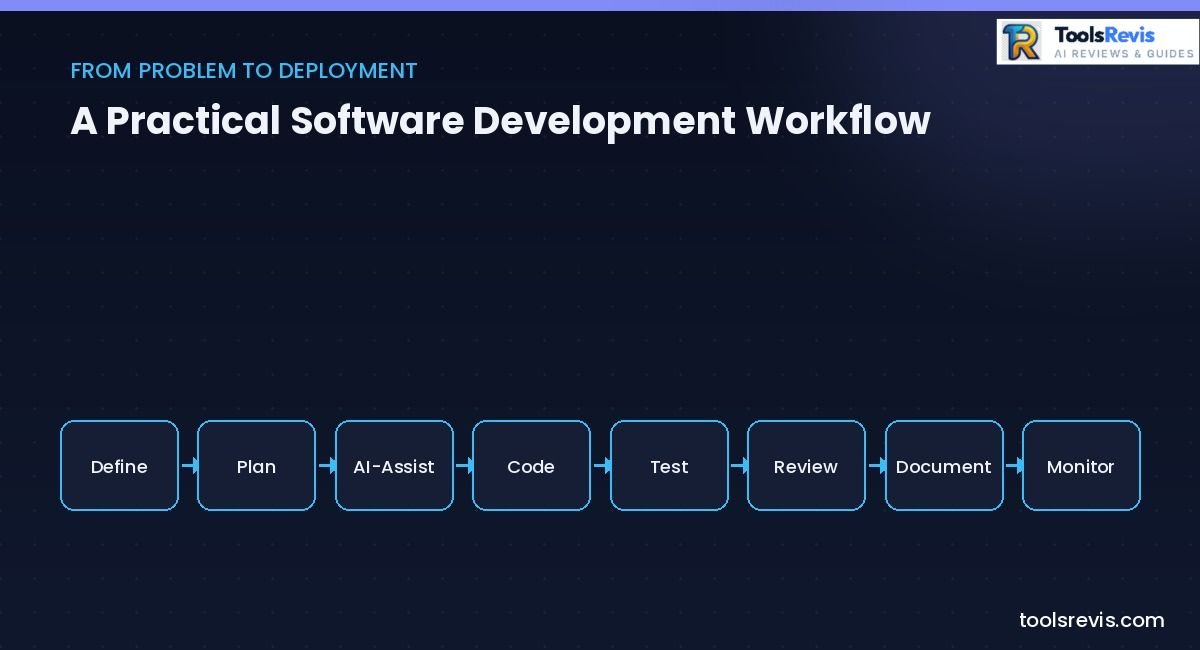
A simple, reliable workflow for many developers looks like this:
- Define the problem clearly
- Plan the implementation
- Use AI for repetitive or exploratory work
- Write and review the code
- Test expected behavior and edge cases
- Use automated and human code review
- Document important decisions
- Monitor and improve after deployment
The key takeaway: AI-assisted development can significantly speed up software work, but the strongest developers use AI as part of a disciplined workflow. Code still needs to be understood, reviewed, tested, and maintained after the AI has generated it.
How to Choose the Right Tech Tool as a Developer
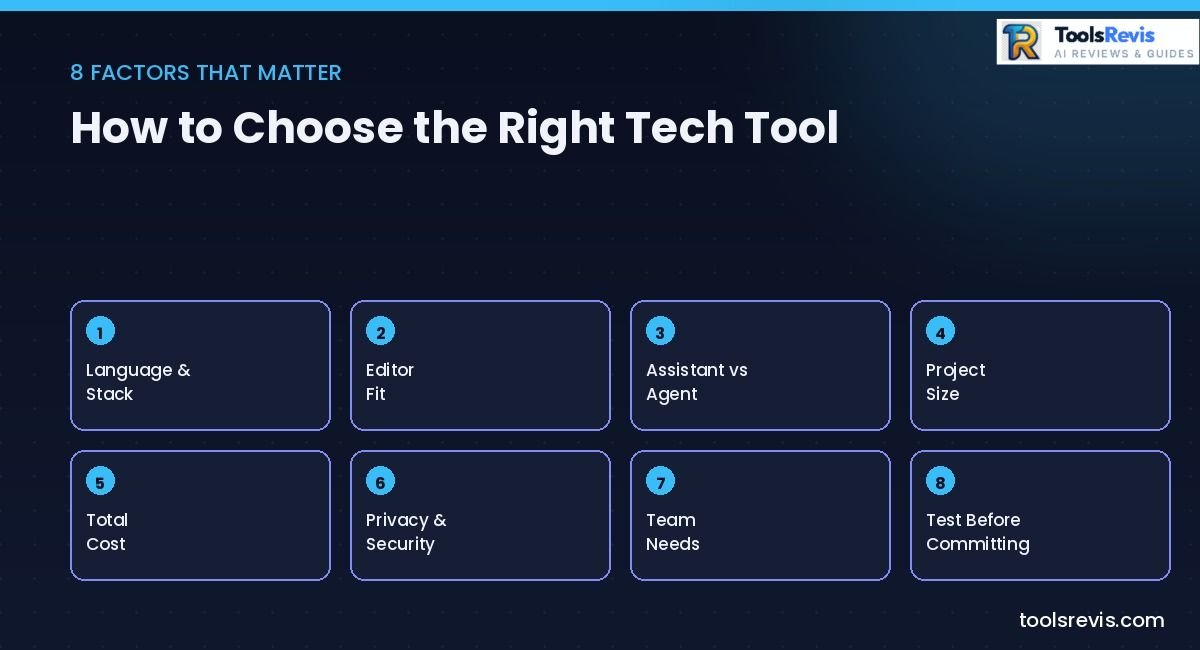
The best way to choose a developer tool is to match it to your programming language, editor, project size, workflow, budget, privacy requirements, and level of AI autonomy you actually need. A tool that works exceptionally well for one developer can be unnecessary or inefficient for another.
Instead of asking only “What is the best developer tool?”, use a more useful question: “What problem do I need this tool to solve?”
1. Start With Your Programming Language and Stack
Your programming language and existing technology stack should be the first filter when choosing a developer tool.
Check whether the tool properly supports your environment, including:
- Programming languages
- Frameworks
- IDE or editor
- Build tools
- Testing framework
- Package manager
- Deployment environment
For example, a tool that works extremely well with a JavaScript-heavy workflow may not provide the same experience for a developer working primarily with another language or specialized environment.
Compatibility should come before popularity.
2. Consider Your IDE or Editor
Choose tools that fit naturally into the editor where you already do most of your work.
If you spend most of your day in VS Code, IntelliJ IDEA, another JetBrains IDE, or an AI-native editor, switching environments only makes sense when the productivity benefits clearly justify it.
This is especially important for AI coding tools. An assistant that can access relevant project context directly from your development environment may be more useful than repeatedly copying code into a separate chat interface.
For example, developers using IntelliJ can explore using GitHub Copilot inside IntelliJ rather than changing their entire development environment simply to access AI assistance.
3. Decide Whether You Need an Assistant or an Agent
Choose an AI coding assistant when you want continuous help with coding, and choose an agent when you want the AI to take on broader, multi-step development tasks.
An assistant is generally useful for:
- Code completion
- Explanations
- Small edits
- Refactoring
- Documentation
- Quick debugging help
An agent is more appropriate for:
- Multi-file changes
- Repository exploration
- Larger implementation tasks
- Running tools or commands
- Iterative debugging
- Delegated development work
The difference matters because greater autonomy also means greater responsibility for review.
If you prefer to remain closely involved in every change, an assistant may be the better fit. If you frequently have well-defined tasks that can be delegated and reviewed afterward, an agent may save more time.
4. Match the Tool to Your Project Size
The larger and more complex the project, the more important context handling, collaboration, testing, security, and integration become.
A solo developer working on a small project may only need:
- An editor
- Git
- An AI assistant
- Testing tools
- Basic deployment tooling
A startup team may additionally need:
- Shared repositories
- CI/CD
- Issue tracking
- Team documentation
- Code review
- Monitoring
An enterprise environment may require even more attention to:
- Access control
- Security
- Privacy
- Administration
- Compliance
- Auditability
- Centralized billing
Don’t pay for enterprise capabilities if you’re never going to use them.
5. Compare the Total Cost, Not Just the Subscription
The cheapest developer tool is not always the lowest-cost option, because usage limits, additional credits, switching costs, and time spent managing multiple tools can change the real cost.
When comparing paid and free developer tools, consider:
| Question | Why It Matters |
| Is there a useful free tier? | Lets you test the workflow before paying |
| What are the usage limits? | Prevents unexpected interruptions |
| Does it require extra credits? | Important for high-volume AI usage |
| Does it replace another tool? | May reduce your total software cost |
| Does your team need it? | Team features can change the pricing calculation |
| Will you actually use the advanced features? | Avoids paying for unnecessary functionality |
For example, when evaluating GitHub Copilot, don’t look only at the headline subscription price. Review the current plan allowances and AI Credit system as well. You can check current GitHub Copilot pricing before making a decision.
Students and eligible users should also check whether they qualify for GitHub Copilot’s free plan for students.
For Claude users comparing higher usage levels, Claude Pro vs Max plans can help illustrate why the right plan depends on actual workload rather than simply choosing the most expensive option.
6. Check Privacy and Security Requirements
Privacy and security should be deciding factors whenever a tool can access private source code, customer information, credentials, or internal documentation.
Before connecting an AI tool to a private repository, check:
- What data the service receives
- How submitted data is handled
- Available privacy controls
- Organization-level administration
- Data retention policies
- Security documentation
- Whether sensitive information can be excluded
Never paste passwords, API keys, private credentials, or confidential customer information into an AI tool simply to make troubleshooting easier.
For teams, security requirements may be more important than small differences in coding assistance quality.
7. Think About Individual vs Team Needs
Individual developers can optimize for personal productivity, while teams should prioritize consistency, collaboration, security, and administration.
For a solo developer, the ideal tool may simply be the one that makes coding faster and reduces repetitive work.
For a team, ask additional questions:
- Can everyone use the same workflow?
- Does it integrate with the team’s repository?
- Can administrators manage access?
- Are security controls sufficient?
- Can developers review AI-generated changes consistently?
- Does the tool fit existing CI/CD and code-review processes?
A tool that makes one developer extremely productive may create friction if the rest of the team cannot integrate it into their workflow.
A Simple Decision Matrix
| Developer Type | Prioritize | Typical Tool Strategy |
| Solo developer | Speed, simplicity, cost | Editor + Git + AI assistant/agent + testing |
| Beginner developer | Learning, documentation, ease of use | Editor + Git + beginner-friendly AI assistance |
| Startup team | Collaboration, speed, integration | Shared repository + CI/CD + AI + documentation |
| Enterprise team | Security, administration, compliance | Managed development platform + controlled AI tools |
For best tools for beginner developers, simplicity is usually more valuable than having the most advanced feature set. A beginner should first become comfortable with an editor, Git, debugging, testing, and basic development workflows before adding multiple AI agents.
8. Test Before You Commit
The safest way to choose a developer tool is to test it against your actual workflow before paying for a long-term subscription or deploying it across a team.
Don’t judge a tool only from its feature list. Try realistic tasks such as:
- Fixing a bug in your own project
- Explaining an unfamiliar file
- Refactoring existing code
- Generating tests
- Working with your repository
- Handling a real documentation task
Then compare the time saved against the time spent correcting or reviewing the output.
The best developer tool is the one that reliably solves your problem with less total effort—not necessarily the one with the longest feature list.
Not Sure Which AI Tool Fits Your Workflow?
Use our free AI Tool Finder to compare your needs and discover tools that fit your development workflow.
Find the Right AI Tool →Droven.io vs Other Developer Resources
Droven.io functions as an editorial resource, not a direct alternative to coding platforms like Cursor or GitHub Copilot. Use it to understand the landscape and discover tools worth investigating — then verify pricing, security, and technical details against each vendor’s own documentation before adopting anything.
Are AI Coding Tools Worth It?
Yes, for most developers — they save time on boilerplate, debugging, and documentation. But they can hallucinate APIs, miss security issues, or misunderstand business logic. The rule: the higher the risk of the task (auth, payments, migrations), the more human review it needs. Test a free tier against your real workflow before paying for a higher plan.
Conclusion
The best tech tools for developers in 2026 are not necessarily the most popular ones—they are the tools that fit your coding workflow, project requirements, budget, and level of automation. AI coding assistants and agents can improve productivity, but they work best alongside strong programming, debugging, testing, and code-review practices.
Droven.io can serve as an editorial resource for discovering and understanding AI and developer tools, while dedicated platforms such as Cursor, GitHub Copilot, Claude Code, and Codex handle the actual development workflow. Before choosing a tool, compare its capabilities, limitations, pricing, and fit with your existing stack.
The goal is simple: choose developer tools based on how you work, not simply because everyone else is using them.
Frequently Asked Questions
1. What is Droven.io?
Droven.io is an editorial AI and technology platform that covers topics such as artificial intelligence, automation, software development, cloud computing, and cybersecurity. It is better understood as a technology information resource rather than a coding tool or developer software product.
2. Which Tech Tools Do Developers Actually Need?
The best tech tools for developers depend on the workflow, but common choices include AI coding assistants, AI coding agents, Git and GitHub for version control, API testing tools, IDEs, debugging tools, and cloud platforms. The right combination matters more than simply choosing the most popular tools.
3. What are the best AI coding tools in 2026?
The best AI coding tools in 2026 include Cursor, GitHub Copilot, Claude Code, and OpenAI Codex. Each has a different workflow, so developers should compare editor integration, agent capabilities, code quality, supported workflows, privacy requirements, and pricing before choosing one.
4. Which AI coding assistant is best for developers?
There is no single best AI coding assistant for every developer. GitHub Copilot is a strong choice for developers who want broad IDE and GitHub integration, while Cursor is designed around an AI-first coding environment. Claude Code and Codex are particularly useful when developers want more agent-style workflows.
5. Are AI coding tools worth it?
Yes, AI coding tools can be worth using when they reduce repetitive work, speed up debugging, help explore unfamiliar code, or assist with documentation and testing. They should still be treated as development assistants because generated code can contain incorrect assumptions, bugs, security issues, or hallucinated APIs.
6. What tools should beginner developers learn first?
Beginner developers should first learn their programming language, a capable code editor or IDE, Git and GitHub, basic debugging and testing, and command-line fundamentals. An AI coding assistant can then be added to support learning and productivity rather than replacing an understanding of the underlying code.
7. How many developer tools does a team actually need?
A development team usually needs fewer tools than it initially appears. A practical stack can cover coding, version control, issue tracking, communication, testing, documentation, deployment, and monitoring. Adding another tool should solve a clear workflow problem instead of creating more subscriptions, integrations, and context switching.
8. Are free developer tools good enough, or should I pay?
Free developer tools can be enough for learning, personal projects, and many smaller workflows. Paying becomes more useful when a tool provides meaningful improvements in usage limits, automation, collaboration, support, or productivity. Developers should compare the actual value gained against the recurring cost rather than paying simply for premium branding.
Read Next
Ready to explore more developer tools? Start with our broader developer-tools guide, then compare specific AI coding platforms:

I’m Umair Ahmad, founder of ToolsRevis. I personally test every AI tool we cover — signing up, running real workflows, checking pricing tiers, and comparing outputs — before writing a single word. My goal: cut through AI marketing hype with honest, hands-on verdicts.
Let’s achieve more together!