
The better pick depends on your own tasks, not on a general winner. Model names and plans changed in 2026, so older comparisons may be wrong.
This article compares the two consumer chat apps, ChatGPT from OpenAI and Claude from Anthropic. It also compares their coding tools, Codex and Claude Code. Gemini and Grok are not covered here and get a separate page.
The facts are current to October 26, 2026. Plans, prices, and model lineups have changed several times this year. Claims from third-party guides, user discussions, or secondary reports are marked (Reported).
Claims without a mark come from OpenAI’s or Anthropic’s own pages. We did not run hands-on tests, so treat every quality judgment as someone else’s opinion, and check anything you plan to pay for on the vendor’s current page. You will see how the two compare on models, price, coding, writing, research, images, agents, privacy, and limits. You will also get a short self-test to run before you subscribe.
ChatGPT vs Claude at a glance
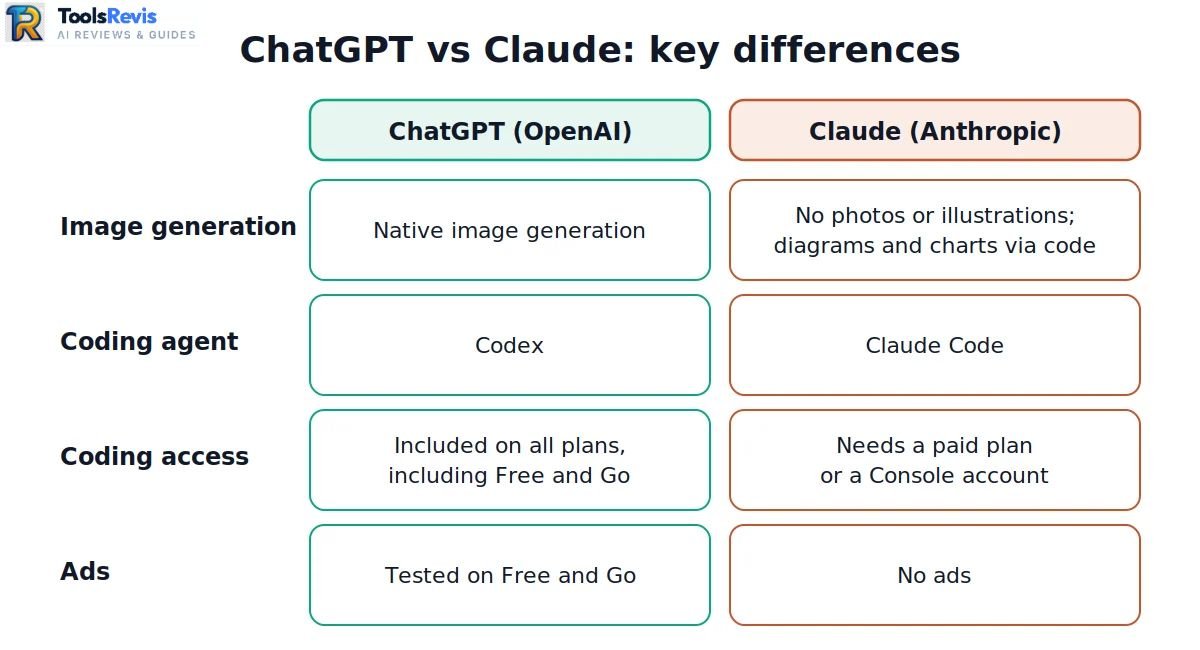
ChatGPT, made by OpenAI, and Claude, made by Anthropic, are both general-purpose AI assistants with free and paid plans. The main differences are in the extras: ChatGPT generates images natively, while Claude does not, and each pairs with its own coding agent, Codex or Claude Code.
Side-by-side comparison table
| Feature | ChatGPT (OpenAI) | Claude (Anthropic) |
|---|---|---|
| Maker | OpenAI | Anthropic |
| Current models | GPT-6 Astra, plus GPT-6 Sol and GPT-6 Luna . Which models appear in the chat app depends on your plan . | Anthropic’s model lineup includes Claude Fable 5.1 as well as the 5.5 suite: Opus, Sonnet, and Haiku. |
| Free and paid entry | Free $0, Go $8/month, Plus $20/month, as of January 2026 | Free; Pro $20/month, or $17/month billed annually |
| Coding tool | Codex, including Codex CLI. It is included across ChatGPT plans, including Free and Go, with usage limits that vary by plan. | Claude Code. It needs a paid Claude plan or a Console account, and the Free plan does not include it. |
| Image generation | Native image generation through GPT Image | No native photo or illustration generation. It builds diagrams, charts, and interactive visuals with HTML and SVG. |
| Voice | Voice mode comes with separate usage caps for both the Free plan and the Go subscription | Voice mode in the Claude app |
| Web search | Web search is a supported tool for GPT-6 models in the API. In-app behavior is not tested by us. | Web search can be turned on in Claude |
| Ads | Ads tested on Free and Go. Plus, Pro, Business, and Enterprise are ad-free (as of January 2026). | Anthropic says Claude products carry no ads (February 2026) |
| Context window | GPT-6 Astra: 1.05M tokens in the API. Chat-app limits are not verified. | Fable 5.1, Opus 5.5, Sonnet 5.5, Haiku 5.5: 1M tokens in the API. claude.ai chat limits are not verified. |
A context window is the amount of text a model can process at once. API figures describe what developers get, and the chat apps may allow less.
Claude vs ChatGPT: Standout Features and Differences
These are the differences that have a source behind them:
- Image generation: ChatGPT can generate images natively with GPT Image . Anthropic’s help center says Claude does not generate photos or illustrations the way image tools do. Claude can still build diagrams, charts, and interactive visuals inside a chat.
- Coding agents: Each assistant has its own agent, Codex for ChatGPT and Claude Code for Claude. While Claude Code isn’t available on the free tier of Claude, OpenAI provides Codex access across all ChatGPT plans, including Free and Go.
- Ads: OpenAI began testing ads on ChatGPT Free and Go. Anthropic has said Claude will stay ad-free.
What “ChatGPT” and “Claude” actually mean in 2026
In this article, “ChatGPT” refers to OpenAI’s GPT-6 models (Astra, Sol, and Luna), and “Claude” refers to Anthropic’s Fable 5.1, Opus 5.5, Sonnet 5.5, and Haiku 5.5. Some older comparisons use superseded names, so check the model name in any article before trusting it.
| Product | Models compared | Source label |
|---|---|---|
| ChatGPT (OpenAI) | GPT-6 Astra, GPT-6 Sol, GPT-6 Luna | Astra: Official. Sol and Luna: Reported |
| Claude (Anthropic) | Claude Fable 5.1, Opus 5.5, Sonnet 5.5, Haiku 5.5 | Official |
If you searched for GPT-4o, GPT-5.4, or Opus 4.7, those are older than the lineups below. Comparisons built on them may no longer match what you can use today.
ChatGPT models (Astra, Sol, Luna) and where each is available
GPT-6 Astra is OpenAI’s flagship model in its API documentation. OpenAI lists it for complex reasoning and coding, with a 1.05M-token context window and an April 30, 2026 knowledge cutoff. Secondary sources say it launched in early September 2026 (Reported).
GPT-6 Sol sits in the middle as a balanced option, while GPT-6 Luna is the quick, budget-friendly one. According to reports, both were launched simultaneously on September 22, 2026. The names can confuse readers, because “Sol” was the top tier in the earlier GPT-5.6 family. “Terra” also belongs to GPT-5.6, not GPT-6.
Where each model appears in ChatGPT is not settled, because sources disagree:
- One report says Sol and Luna reached Plus, Pro, Business, Enterprise, and Edu plans on September 22, and that Free and Go users get Luna in the desktop app .
- Another says Astra rolled out to Plus, Pro, Business, and Enterprise .
- A third says Sol and Luna can be picked in ChatGPT Work and Codex, but are not ordinary chat models .
Since the reports disagree, check the model picker in your own account to see what you can actually use. Some sources also mention a “GPT-6.1 Sol.” Some earlier reports used the name GPT-6.1 Sol; OpenAI’s current documentation now lists GPT-6.1 Sol, so check the official model page for its latest availability and pricing.
Claude models (Fable, Opus, Sonnet, Haiku)
Anthropic’s models table lists four current Claude models, each with a 1M-token context window and a June 2026 knowledge cutoff. They differ mainly in capability, speed, and cost:
- Claude Fable 5.1 is Anthropic’s top model. It is built for long-running coding, multistep research, and agentic work.
- Claude Opus 5.5 is described as a flagship for demanding reasoning, coding, and long-horizon agentic work. It was reported as released on September 22, 2026 .
- Claude Sonnet 5.5 is the upgraded Sonnet-class model, reported to be over 30% faster than Sonnet 5. It was reported as shipping on September 28, 2026 .
- Claude Haiku 5.5 is the small, fast, low-cost model for high-volume work. Pages written before early October may still list Haiku 4.5 as Anthropic’s small model.
Which of these models appear in the Claude app on each plan was not verified here, so check the model picker before you pay.
ChatGPT vs Claude for coding: Codex vs Claude Code
Codex is OpenAI’s coding agent, and Claude Code is Anthropic’s. Both run in a terminal, read project instruction files, connect to MCP servers, and support subagents. The practical split is plan access: Codex comes with every ChatGPT plan, including Free and Go, while Claude Code needs a paid Claude plan or a Console account.
Both tools are examples of agentic coding, meaning an AI that plans and carries out multi-step tasks in your project instead of only suggesting snippets. Codex CLI is OpenAI’s coding agent that runs locally in your terminal. Claude Code is Anthropic’s agentic coding tool.
| Codex (OpenAI) | Claude Code (Anthropic) | |
|---|---|---|
| Launch command | codex | claude |
| Plan access | Included across ChatGPT plans, including Free and Go, with “Sign in with ChatGPT”. Usage limits vary by plan. | A Claude subscription or Console account. The free Claude plan does not include it. |
| Project instructions | AGENTS.md, loaded from ~/.codex/AGENTS.md and from the repo root or nested folders | CLAUDE.md. It also reads AGENTS.md. |
| MCP | Supported, with codex mcp commands | Supported |
| Subagents | Supported, for parallelizing complex tasks | Supported |
Install and plan access
Before you install, check your plan. Claude Code needs a paid Claude plan or a Console account, and the desktop app needs a paid plan. Anthropic’s docs say Claude Code requires a Pro, Max, Team, Enterprise, or Console account, so it is included with Claude Pro. For Codex, OpenAI’s help center says it is included across ChatGPT plans, including Free and Go, with usage limits that vary by plan.
macOS, Linux, or WSL:
bash
curl -fsSL https://claude.ai/install.sh | bash
Windows PowerShell:
powershell
irm https://claude.ai/install.ps1 | iex
Homebrew (macOS):
bash
brew install --cask claude-code
WinGet (Windows):
powershell
winget install Anthropic.ClaudeCode
Then open your project folder and run:
bash
claude
If the install script fails with syntax error near unexpected token ‘<‘, check Anthropic’s official troubleshooting page. That error is listed in the official docs, and it usually means the shell received a web page instead of a script (this explanation is our reading, not documented).
npm (requires Node.js and npm already installed):
bash
npm install -g @openai/codex
Homebrew:
bash
brew install --cask codex
Standalone installer (macOS and Linux):
bash
curl -fsSL https://chatgpt.com/codex/install.sh | sh
Then launch it and choose “Sign in with ChatGPT”:
bash
codex
Signing in with ChatGPT is what ties Codex to your plan. If sign-in fails, check your account and usage limits first before troubleshooting anything else.
Agentic workflows, MCP and project instructions
MCP (Model Context Protocol) is an open standard that connects AI tools to external data and services, such as issue trackers or docs servers. Both tools support it.
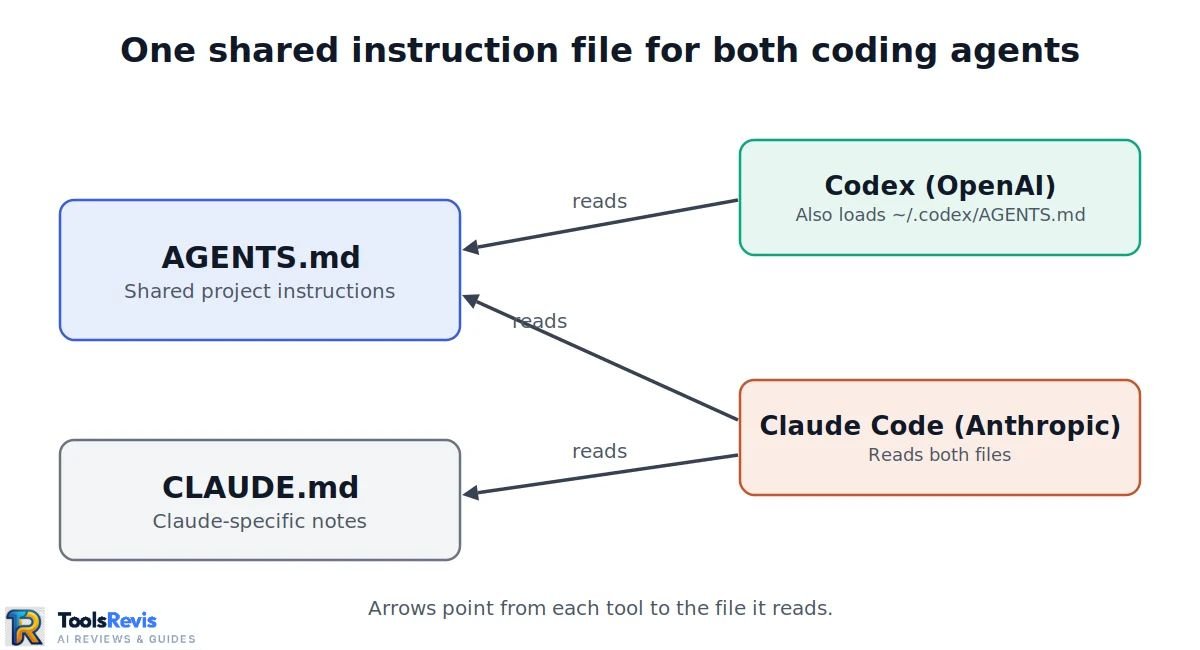
- Claude Code: It reads a CLAUDE.md file for project instructions and also reads AGENTS.md. It supports MCP and subagents, which are parallel Claude Code agents.
- Codex: AGENTS.md holds repo conventions, and Codex loads a personal file from ~/.codex/AGENTS.md too. OpenAI’s docs describe MCP for external tools and subagents for delegating work.
If you use both tools, an AGENTS.md file can serve as shared project instructions, because Claude Code reads it too. Keep any Claude-specific notes in CLAUDE.md.
Usage limits and token use in practice
No official page we found gives exact message or token limits for either tool, so this article lists no numbers. Third-party guides report that Claude’s paid plans have a rolling 5-hour session window plus weekly caps, and that Claude Code shares its allowance with regular chat . For ChatGPT, guides report that the higher Pro tiers multiply Plus usage . Pro tier prices and names conflict across sources, so they are covered in the pricing section.
Reports about which tool uses fewer tokens contradict each other, so this article does not rank them. Before committing, run the same task in both tools and watch how fast your usage meter moves.
Which fits which developer
These criteria rely on plan access and workflow, not benchmarks. We cite no benchmark scores here because none came with a primary source.
- Already use ChatGPT: Codex is available on your plan, so try it before buying anything else.
- Already pay for a Claude plan: Claude Code is the natural first test, as long as you are not on the Free plan.
- Want shared project rules across tools: Use AGENTS.md, since both tools read it.
- Run long agent sessions daily: Usage limits will matter more than features. Test on your real workload first, because limits are plan-based and have changed during 2026 .
- Prefer a community verdict: Developer opinions online are split. They are opinions, so this article does not count them as evidence.
ChatGPT vs Claude for writing and editing
ChatGPT and Claude both support drafting and editing, so the better fit depends on your workflow. ChatGPT offers Canvas, a side-by-side editor with inline suggestions. Claude pairs Projects, which store standing instructions and files, with Artifacts, which display documents beside the chat. Opinions about writing style differ and are not tested here.
- Output style: Opinions are split, and we did not test this. Some users and comparison articles say Claude’s long-form prose reads more naturally, while others prefer ChatGPT’s style (Reported opinion). Style preference is personal, so judge it with your own prompts and your own voice rather than a ranking.
- Editing workflow in ChatGPT: Canvas is a ChatGPT interface for writing and coding projects that need edits and revisions. ChatGPT typically opens it automatically for content longer than 10 lines, or when your prompt says “use canvas”. Writing shortcuts include suggesting inline edits and adjusting length, and you can download the canvas file.
- Editing workflow in Claude: Artifacts are standalone outputs, such as documents, tools, or checklists, that Claude shows in a live side panel and keeps in your sidebar . Editing usually happens by asking Claude for a revision. We did not verify whether Artifacts offer inline suggestion tools like Canvas, so do not assume they do.
- Projects in both products: A Claude Project bundles standing instructions, uploaded knowledge files, and its own chats, and every new chat in it inherits the instructions and files . Reviewers describe ChatGPT Projects as similar . For writers, this is where a style guide or past samples can live. Older guides say Claude Projects need a paid plan, but a later report says Projects and Artifacts became free, so check your plan before relying on either claim .
- Short vs long form: For short pieces like emails or captions, a normal chat reply works in either app. The workspace tools matter more for long drafts that go through several revisions. Canvas gives ChatGPT users a dedicated editor for those drafts. Claude’s Projects and Artifacts give a persistent brief plus a separate output panel .
Research, web search and long documents
For long documents, Claude’s help center states chat limits: 1M tokens on some models for paid plans, with 200K or 500K on others. ChatGPT’s chat-app limits were not verified, though its API lists 1.05M tokens. For current information, both offer web search and a deep research mode.
Context windows
A context window is how much text a model can handle at once, counting your prompt, uploaded files, and its reply. Bigger is not automatically better, because a long window only helps if the model uses the material well. The sections below cover only what the vendors state.
Claude: Anthropic’s models table lists a 1M-token window for Fable 5.1, Opus 5.5, Sonnet 5.5, and Haiku 5.5 in the API. Chat is different. Anthropic’s help center says some models support 1M tokens when chatting on all paid plans, other models support 500K, and anything else gets 200K. The model names on that page changed between versions we saw, and the versions did not name the 5.5 models. Check the page for the model you plan to use. In Claude Code, Pro users must enable usage credits to get the 1M window for Opus models. Claude Projects use retrieval, so they can work with more material than fits in one window.
ChatGPT: OpenAI’s API docs list GPT-6 Astra with a 1.05M-token window. Secondary sources give the same figure for GPT-6 Sol and Luna . We did not find an official page stating the window for the ChatGPT app, so API figures should not be assumed to apply there.
Web search and deep research
Web search lets a model pull current pages into an answer. Deep research is a longer, multi-step mode that searches repeatedly and writes a sourced report.
- ChatGPT: Deep research is a documented ChatGPT feature. Third-party reviews of OpenAI’s pricing page say the allowance is described by tier: limited on Free and Go, expanded on Plus, and maximum on Pro . Older articles give exact monthly task counts that appear outdated, so this article uses none.
- Claude: Claude’s Research feature runs a chain of searches, each guided by the last. A third-party guide says it is available on paid plans, and that web search must be turned on first . Anthropic also lists web search as a toggleable feature.
For current information, either tool can work, so start with the plan you already pay for. For both tools, run a question whose answer you already know and check the sources the report cites before trusting it on a new topic.
Image, voice and multimodal features
ChatGPT is the clear choice if you want to generate images, because Claude does not create photos or illustrations. Both can read images you upload, and both offer voice conversations. Claude can draw diagrams and charts with code in chat. OpenAI’s Sora video app was shut down in 2026.
- Image generation in ChatGPT: ChatGPT can create and edit images natively. One 2026 catalog describes the current stack as GPT Image 2, with “ChatGPT Images 2.0” as the app experience, and DALL-E 3 as legacy . Third-party guides say image generation has separate limits on Free and Go . Check your plan’s limits before relying on it.
- Image generation in Claude: Anthropic’s help center says Claude does not generate photos or illustrations the way image-generation tools do. It can build diagrams, charts, and interactive visuals in a conversation using HTML and SVG, and custom visuals in chat are in beta on Claude web and desktop. Third-party guides describe connecting outside image tools through MCP, so Claude can send prompts to them . That makes the outside tool the image generator, not Claude.
- Reading images and files: Claude can view and analyze images you upload. OpenAI’s API docs say its latest models accept text and image input. Both tools can handle screenshots, charts, and photos as input.
- Voice: Anthropic describes a voice mode in the Claude app for hands-free spoken conversations. ChatGPT also has voice mode, and guides report separate limits for it on Free and Go . We did not test the voice quality of either, so judge that on your own device.
- Video and Sora: OpenAI announced the end of the Sora app on March 24, 2026 (via OpenAI’s official Sora account). Reports say the app and sora.com closed on April 26, 2026, and the Sora API was scheduled to end on September 24, 2026 . Reports disagree on whether video generation now lives inside ChatGPT, so this article makes no claim about it. We did not verify whether Claude can generate video, so treat that as unconfirmed.
Agents, memory and projects
ChatGPT Work and Claude Cowork are each company’s agent for non-coding tasks like building documents, spreadsheets, and slides. Both products also offer memory and Projects. The main difference reported so far is access: reports say ChatGPT’s desktop app with Work is on every plan, while Cowork needs a paid Claude plan.
| ChatGPT | Claude | |
|---|---|---|
| Non-coding agent | ChatGPT Work, an agent that takes action across apps and files and keeps working on complex projects (Reported, from coverage of OpenAI’s announcement) | Claude Cowork, an agentic knowledge-work desktop app for non-developers |
| Plan access | The updated desktop app, with Chat, Work, and Codex, is reported on every plan including Free. On web and mobile, rollout started with Pro, Enterprise, and Edu, then Plus and Business . | Reported as available on paid Claude plans only |
| Memory | ChatGPT has a memory feature that lets conversations draw on past chats | Claude has a setting to generate memory from chat history. One report says memory became free for all users . |
| Projects | Project workspaces exist | Projects bundle instructions, files, and chats |
| Browser | A built-in browser in the desktop app | Claude in Chrome, a browsing agent |
A few details matter if you are choosing between them:
- Naming changed. Reports say OpenAI merged its Codex app into the main ChatGPT desktop app, with Chat, Work, and Codex in one place, and renamed the older desktop app “ChatGPT Classic” . If a guide describes Codex as a separate desktop product, it may be out of date.
- Atlas is gone. OpenAI’s Atlas browser launched in October 2025. OpenAI announced its deprecation in July 2026 and moved the browser features into the desktop app. One report gives August 9, 2026 as the end date , and a third-party summary says OpenAI’s help center now lists Atlas as retired . Do not plan around it.
- Memory is a data setting. Memory stores details from your chats, so check what each product saves before you turn it on. Privacy controls get their own section later.
- Custom GPTs are user-built ChatGPT assistants. We did not verify their current availability by plan.
We did not test either agent. Both can act on connected apps and files, so start with low-risk tasks and review what they did before relying on the results.
Reliability: hallucinations, consistency and usage limits
Both ChatGPT and Claude can produce confident answers that are wrong, and this article has no tested evidence that one is more reliable. Verify anything important. Each product also has a setting that controls whether your chats help train its models, and both limit usage by plan.
Usage limits work differently from model quality, because they depend on your plan and on what you do. Third-party guides say Claude’s paid plans use a rolling 5-hour session window plus weekly caps, and that chat and Claude Code share one allowance . For ChatGPT, the higher Pro tiers are described as multiples of Plus usage, and image generation and voice have their own limits on Free and Go . No official exact numbers were found for either product, and limits have changed during 2026. Test your real workload on the plan you intend to buy.
Why you should verify AI output
A hallucination, also called a confabulation, is output that sounds plausible but is wrong or made up. It can be a fake citation, an invented number, or a feature that does not exist. These tools write fluent text whether or not the facts are right, so fluency is not a sign of accuracy.
These habits work with either tool:
- Check specifics against a source. Names, dates, prices, quotes, and statistics should be compared with the original page, not with the chatbot’s own summary.
- Open the links it gives you. If you ask for sources, confirm that each one exists and says what the answer claims.
- Run the code. For programming help, run the tests or the script before trusting it.
- Re-check time-sensitive facts. Plans, prices, and model names changed repeatedly in 2026, so confirm them on the vendor’s current page.
- Cross-check important answers. Ask the question in a second tool, or in a fresh chat, and compare the results.
These habits apply to web search and deep research reports too, since a report with citations can still misread its sources.
Privacy and data controls
Both products let you decide whether your chats are used to improve their models. The settings differ in name and in what is documented.
ChatGPT: OpenAI’s Data Controls page includes an “Improve the model for everyone” setting. Turning it off keeps conversations in your history but stops them from being used to train ChatGPT. Temporary Chats are deleted from OpenAI’s systems after 30 days. Team, Enterprise, and Edu plans offer additional data controls, and OpenAI’s FAQ also covers controls related to ads.
Claude: Coverage of Anthropic’s consumer terms says Claude Free, Pro, and Max accounts, including Claude Code used with those accounts, have a “Help improve Claude” toggle in Privacy settings . The reports say that with the toggle off, standard 30-day retention applies, and that with it on, de-identified data may be kept for up to five years .
They also say incognito chats are never used for training, and that commercial products such as Claude for Work and Claude for Education keep separate protections . One report claims five-year retention applies even if you opt out. It conflicts with the others, so this article does not use it.
Before pasting work documents or personal details into either tool, open the privacy settings and check the current state of the toggle. Business and education plans often have different terms from personal plans. Terms can change, so use the vendor’s own privacy page as the final check.
ChatGPT vs Claude pricing
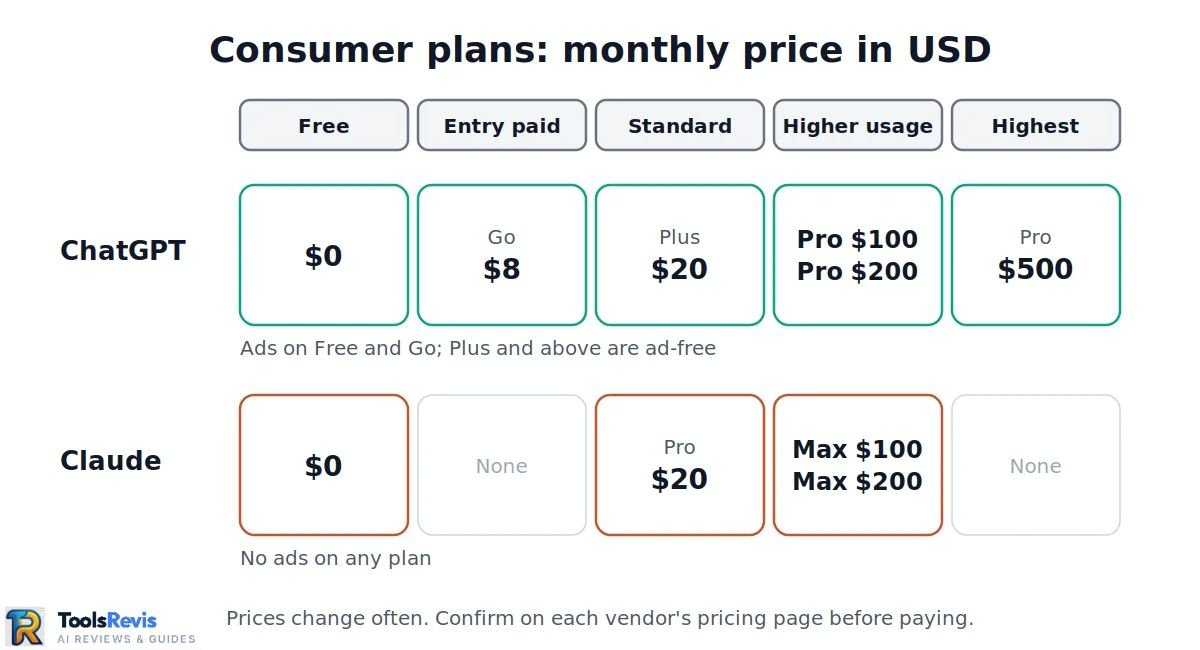
ChatGPT and Claude both start free and offer $20 paid plans: ChatGPT Plus and Claude Pro. Above that, both sell higher-usage tiers: ChatGPT Pro at $100, $200, or $500, and Claude Max at $100 or $200. ChatGPT also has an $8 Go plan with ads. Developers pay separately, per million tokens.
All prices below are US dollars and monthly unless noted. Regional prices can differ, and both companies change plans often, so confirm the number on the vendor’s pricing page before you pay.
Consumer plans
| Tier | ChatGPT | Claude |
|---|---|---|
| Free | $0 | $0 |
| Entry paid | ChatGPT Go: $8/month in the US; prices may vary by region | None between Free and Pro in the price lists we reviewed |
| Standard | Plus: $20 | Pro: $20, or $17 a month billed annually ($200 upfront) |
| Higher usage | Pro 100: $100 | Max 5x: $100 |
| Higher usage | Pro 200: $200 (as of January 2026) | Max 20x: $200 |
| Highest | Pro 500: $500 | None |
| Ads | Ads on Free and Go; Plus and above ad-free | No ads |
What the tiers add, based on third-party guides :
- ChatGPT Go gives more messages, uploads, images, and memory than Free, and may show ads.
- ChatGPT Plus is the standard paid plan. OpenAI says Codex is included across ChatGPT plans.
- ChatGPT Pro tiers add more usage. Only Pro 500 is reported to include an “Ultrafast” mode.
- Claude Pro includes Claude Code and is reported to include Projects and Research .
- Claude Max is described as 5x or 20x the usage of Pro, billed monthly only.
Be careful with usage multipliers. Older guides describe Pro 200 as 20x Plus, but newer reports say that new Pro 200 subscriptions started getting a lower allowance in late September 2026, with existing subscribers keeping the old one through October 29, 2026 . Treat any “5x” or “20x” figure as something to confirm on the current pricing page.
API pricing for developers
API pricing is separate from consumer subscriptions. You pay per token, usually quoted per 1 million tokens, with one rate for input and a higher rate for output. A subscription does not cover API use .
| Model | Input / output per 1M tokens | Source |
|---|---|---|
| Claude Fable 5.1 | $10 / $50 | Official |
| Claude Opus 5.5 | $4 / $20 | Official |
| Claude Sonnet 5.5 | $2 / $10 | Official |
| Claude Haiku 5.5 | From $0.10 / $0.50 | Official |
| GPT-6 Astra | $10 / $50 | Official |
| GPT-6.1 Sol | $2 / $10 | Official |
| GPT-6 Luna | $0.10 / $0.50 | Reported |
Standard rates are only part of the cost. Reports say OpenAI charges higher rates for requests above 272K tokens , and both companies price cached input and batch use separately. Check those rates on the official API pricing pages before you estimate a budget.
Ads on ChatGPT Free and Go
OpenAI said on January 16, 2026 that it would test ads on the Free and Go plans, and that Plus, Pro, Business, and Enterprise would stay ad-free. Third-party reports say ads began showing in February 2026, at first in certain countries . OpenAI’s data-controls FAQ also lists controls related to ads.
Anthropic has said Claude will not carry advertising, including sponsored links beside conversations (February 2026). If ads matter to you, ChatGPT’s paid tiers above Go avoid them, and Claude avoids them on every plan.
Why some people switch between ChatGPT and Claude
People switch between ChatGPT and Claude for a mix of documented and subjective reasons. The documented ones are ads on ChatGPT Free and Go, Claude’s no-ads stance, and each product’s coding tools. The rest, such as tone and usage limits, are Reported opinions, and no verified data shows that “everyone” is leaving either product.
Documented differences that can push a switch
- Ads: OpenAI announced on January 16, 2026 that it would test ads on Free and Go, with Plus, Pro, Business, and Enterprise staying ad-free. Anthropic said in February 2026 that Claude will carry no advertising. If you use a free plan and dislike ads, this is a concrete difference.
- Coding tools: Codex is included across ChatGPT plans, including Free and Go. Claude Code needs a paid Claude plan or a Console account, and the free Claude plan does not include it. A developer who prefers one agent may move to the plan that includes it.
- Image generation: Claude does not generate photos or illustrations, according to Anthropic’s help center. Someone who needs images in the same app may stay with, or return to, ChatGPT.
Reasons people give for leaving ChatGPT or moving to Claude
- Ads and trust: Third-party coverage says some users cite the ad-free stance as a reason to switch, and ties Anthropic’s February 2026 ad-free messaging to OpenAI’s ad rollout.
- Tone: In Reddit threads, some users say ChatGPT’s replies can feel overly reassuring or padded, and that Claude’s tone feels more direct. This is personal taste, and we did not test it.
- Values and privacy: Some coverage links the switching trend to concerns about company policies and government use of AI in early 2026. Sources describe the events differently, and we did not verify the details, so we do not weigh in.
- Easier moving: One report says Claude made features such as memory, Projects, and Artifacts free, partly to help new users transition.
Reasons people stay, or go back, to ChatGPT
- Claude usage limits: In Reddit discussion, some Claude Pro users say they run into usage limits. Limits are plan-based, and no official exact figures exist for either product.
- Broader toolkit: Some users prefer ChatGPT for its image generation and wider set of features.
Several blogs claim large gains after switching, such as less editing time or higher coding accuracy. We found no primary source for those figures, so we do not repeat them. The same goes for download counts and app-store rankings from newsletters, which we could not verify.
Whether any of this applies to you depends on what you actually hit. If you hit ads, limits, or an unwanted tone, test the other tool on that exact problem.
Which one should you choose?
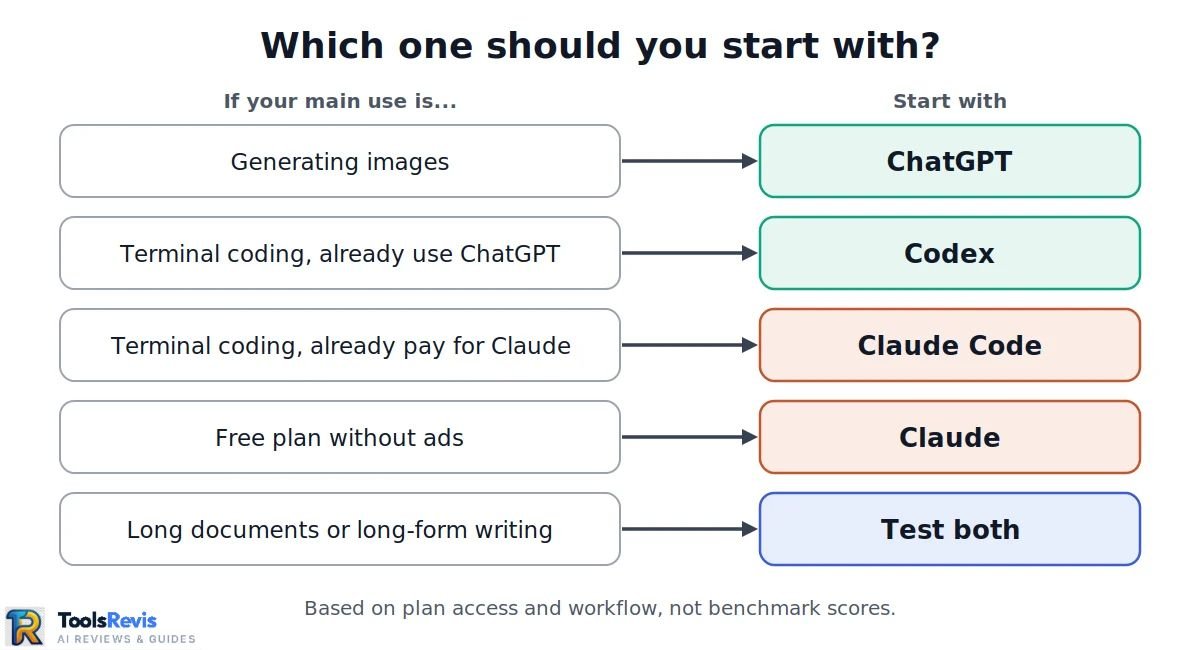
The better choice depends on your main task. Pick ChatGPT if you need image generation or want Codex included with your plan, and Claude if you want Claude Code or prefer its ad-free apps. Writers and students should compare outputs on their own work, so run one identical task in both before paying.
| If your main use is… | Start with | Why |
|---|---|---|
| Generating images | ChatGPT | Anthropic says Claude does not generate photos or illustrations. ChatGPT has native image generation . |
| Coding in the terminal, and you already use ChatGPT | Codex | Codex is included across ChatGPT plans, including Free and Go |
| Coding in the terminal, and you already pay for Claude | Claude Code | It needs a paid Claude plan or a Console account |
| Using a free plan without ads | Claude | Anthropic says Claude has no ads, while Ads may appear on ChatGPT Free and Go in eligible regions |
| Working with very long documents | Test both | Claude’s help center states 1M-token chat windows for some models on paid plans. ChatGPT’s chat-app limits were not verified. |
| Long-form writing | Test both | Opinions are split |
| Current-events research | Either | Both offer web search and a deep research mode (Reported for Claude) |
| Non-coding agent tasks | Depends on your plan | ChatGPT Work is reported on every plan in the desktop app, while Claude Cowork is reported as paid-only |
| Lowest paid price | ChatGPT Go | $8 a month, with ads (as of January 2026) |
Still not sure? Answer a few questions and get a recommendation.
Take the 1-Minute AI Picker QuizDevelopers
Choose by plan first, then test on your own code. If you already use ChatGPT, Codex costs nothing extra, so try it before buying anything else. If you already pay for Claude, do the same with Claude Code. Both read AGENTS.md, so one shared instruction file can work in either tool. We cite no benchmarks here because none came with a primary source. The comparison table in the coding section covers install commands and features.
Writers and students
For writing, opinions about tone and style are split, so the only reliable test is your own draft. Run the same piece through both and see which needs less editing. For study use, both products have features that help organize longer work: ChatGPT has Canvas, and Claude has Projects and Artifacts (see the writing section for details).
Students should also check whether their school already provides access. Some reports say universities can license ChatGPT Edu , and Anthropic offers Claude for Education. Always follow your school’s rules on AI use, and verify facts and citations before relying on them, because both tools can produce confident errors. (Reported)
Budget buyers
Start with both free plans. Paying only makes sense once you keep hitting a limit or missing a feature. If you do pay:
- ChatGPT Go costs $8 a month and may show ads.
- ChatGPT Plus and Claude Pro both cost $20 a month (Claude’s price is Reported).
- The price lists we reviewed show no Claude plan between Free and Pro .
- ChatGPT’s personal plans are reported as monthly-only, and Claude Pro has an annual option at $17 a month . A monthly plan lets you test and cancel.
For personal use, the plan rarely matters more than the limits you hit, so check the pricing section before you pay.
Should you use both?
Using both makes sense when each fills a gap the other leaves. A common pairing is ChatGPT for images and Claude Code for coding, because Claude cannot generate images. A second tool can also act as a fallback when one plan’s usage limit runs out, though exact limits are not published for either .
Two $20 plans cost $40 a month, so do not buy both until a specific gap shows up. If you use both, check the privacy settings in each, and avoid pasting the same sensitive documents into two products.
How to test both in 15 minutes
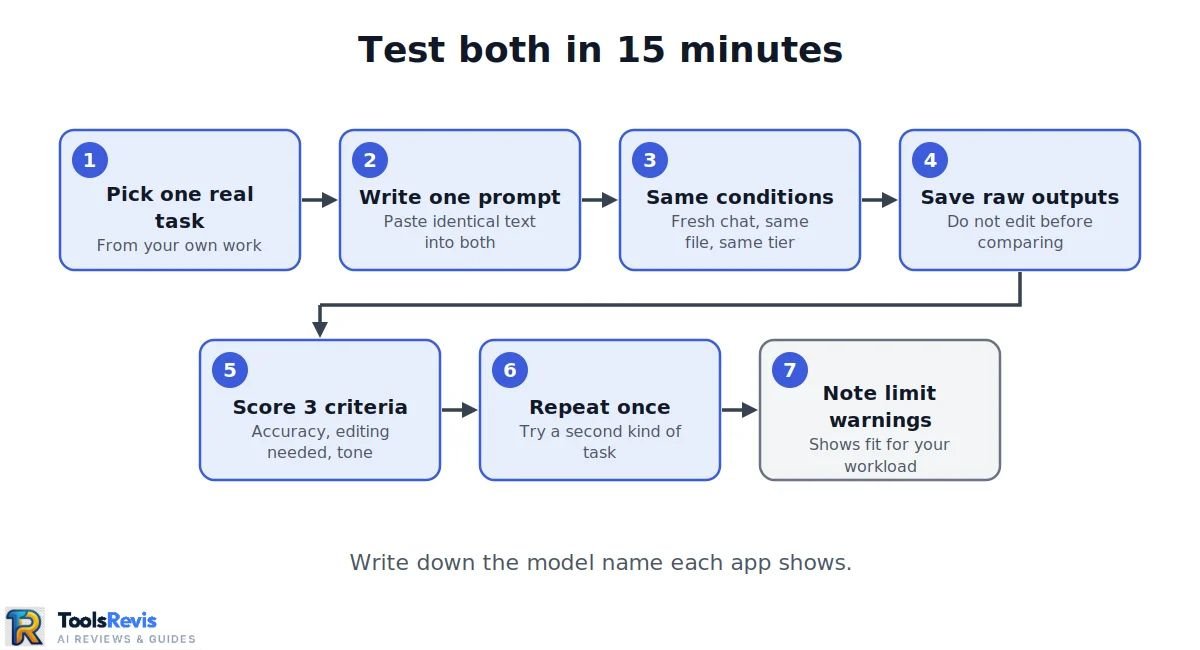
- Pick one task you really do. Choose something from your own work, such as summarizing a report, drafting an email, or fixing a small function.
- Write the prompt once. Save it in a note so you paste identical text into both tools.
- Use the same conditions. Open a fresh chat in each, attach the same file if the task needs one, and compare free with free or paid with paid. Write down the model name each app shows.
- Save the raw outputs side by side. Do not edit either one before you compare them.
- Score three things you chose in advance. Good choices are factual accuracy (check the facts yourself), how much editing you needed, and whether the tone suits you.
- Repeat with a second kind of task. If the first test was writing, try a file upload or a coding question next.
- Note any limit warnings. If either tool warns you about usage during the test, that is useful information about how it fits your workload.
So, is Claude still better than ChatGPT?
Not in every case, and the verified facts point both ways. ChatGPT can generate images and Claude cannot. Claude carries no ads, while ChatGPT Free and Go do. Each has its own coding agent. For writing quality, reasoning, and coding results, the evidence in this article is opinion, and we did not test it. The better tool is the one that handles your own task better, which the 15-minute test above will show.
FAQ
1. Is Claude Code included in Claude Pro, and is Codex included in ChatGPT Plus?
OpenAI’s help center says Codex is included across ChatGPT plans, including Plus. Anthropic’s docs say Claude Code needs a Pro, Max, Team, Enterprise, or Console account, so Claude Pro includes it and the free plan does not.
2. Do ChatGPT and Claude use my chats for training?
It depends on your settings. ChatGPT has an “Improve the model for everyone” setting, and turning it off keeps your chats out of training. Claude’s consumer plans are reported to have a “Help improve Claude” toggle, and business plans have separate terms, so check both .
3. Which is better for students?
Neither is proven better, and opinions are split . Try both free plans on your own coursework, and check whether your school already provides access. Verify facts and citations yourself, and follow your school’s AI rules.
4. Can I use ChatGPT and Claude together without paying for both?
Yes, for light use. Both have free plans, so you can run the same task in each before paying. Free plans have limits, ChatGPT Free shows ads, and Claude Code is not in Claude’s free plan.
5. Can Claude generate images or video?
No for images. Anthropic’s help center says Claude does not generate photos or illustrations, though it can build diagrams, charts, and interactive visuals with code. We found no official Anthropic video generation feature, and third-party guides say there is none .

I’m Umair Ahmad, founder of ToolsRevis. I personally test every AI tool we cover — signing up, running real workflows, checking pricing tiers, and comparing outputs — before writing a single word. My goal: cut through AI marketing hype with honest, hands-on verdicts.
Let’s achieve more together!