

Anthropic launched Claude Sonnet 5.5 on September 28, 2026, shifting Sonnet 5 to legacy status—though it remains accessible. This review focuses specifically on Sonnet 5; check Anthropic’s official documentation for details on Sonnet 5.5.
The core promise is simple: performance that nearly rivals Opus 4.8 for coding, tool integration, and computer-use tasks—at just 40% of the per-token cost. For developers and tech leaders already using Sonnet 4.6 in production, the real question isn’t whether Sonnet 5 looks better on paper. It’s whether those gains hold up in practice once you factor in effort levels, the updated tokenizer, and actual production workloads.
This review covers the benchmarks, pricing mechanics, tokenizer costs, migration steps, and what changed now that Sonnet 5.5 is out, so you can decide whether to switch, wait, or run both models side by side.
What Is Claude Sonnet 5?
Claude Sonnet 5 is Anthropic’s mid-tier model, which at launch sat between Haiku 4.5 and Opus 4.8 (the lineup today is Haiku 4.5, Sonnet 5.5, Opus 5.5, and Fable 5.1). It replaced Sonnet 4.6 as the default model at launch (since September 28, 2026 it is a legacy model, with Sonnet 5.5 as the current Sonnet). It was designed with one primary goal in mind: keeping longer, multi-step agentic tasks moving forward smoothly without getting stuck halfway through—a frequent pain point early testers noted with previous Sonnet models.
Key launch facts developers need to know:
- Release date: June 30, 2026
- API model ID: claude-sonnet-5
- Pricing: $2 per million input tokens / $10 per million output tokens (made permanent on August 10, 2026)
- Context window: 1 million tokens
- Max output: 128K tokens (up to 300K on the Batch API with the output-300k-2026-03-24 beta header)
- Reasoning: Thinking mode is turned on by default, and you can adjust the effort setting to control how deeply the model thinks. Just keep in mind that customizing standard sampling parameters (like temperature, top_p, or top_k) will trigger a 400 error.
- Effort Levels: You can choose from five different effort tiers—low, medium, high (which is the default), max, and xhigh. This setting directly controls how many reasoning tokens the model uses for each response.
- Availability: It’s the default model for both Free and Pro users on claude.ai at launch. Beyond that, it’s available across Max, Team, and Enterprise plans, inside Claude Code, via the Claude Platform API, and through AWS Bedrock, Google Vertex, and Microsoft Foundry.
- Tokenizer: Sonnet 5 comes with an updated tokenizer (much like the one Anthropic introduced with Opus 4.7). Because of this, the same piece of text can generate roughly 1.0x to 1.35x more tokens compared to Sonnet 4.6 depending on the content—a subtle shift that often impacts your final bill more than the base sticker price.
Pricing: One key detail to keep in mind is that the $2/$10 rate was initially launched as a temporary discount, but Anthropic made it permanent on August 10, 2026. So, you don’t need to worry about an unexpected price hike. Instead, your actual costs will mainly depend on the selected effort level and the higher token count from the new tokenizer.
What Is Claude Sonnet 5? Model ID, Features & Usage Guide
Claude Sonnet 5 is identified as claude-sonnet-5 and remains accessible across Anthropic’s supported platforms.
There is no downloadable Sonnet 5; it is a cloud model used via claude.ai, the apps, Claude Code, or the API.
Status: Sonnet 5 is Legacy, while Sonnet 5.5 is the current Sonnet model; retirement is not scheduled sooner than June 30, 2027.
Claude Sonnet 5 vs Sonnet 4.6 vs Opus 4.8: The Benchmark Breakdown
When Anthropic launched Claude Sonnet 5, they shared a detailed set of performance benchmarks comparing it directly to Sonnet 4.6 and the top-tier Opus 4.8. The data shows steady—and in some areas, significant—improvements over 4.6. Even more impressive is how close Sonnet 5 gets to Opus 4.8, even managing to beat it in one key benchmark.
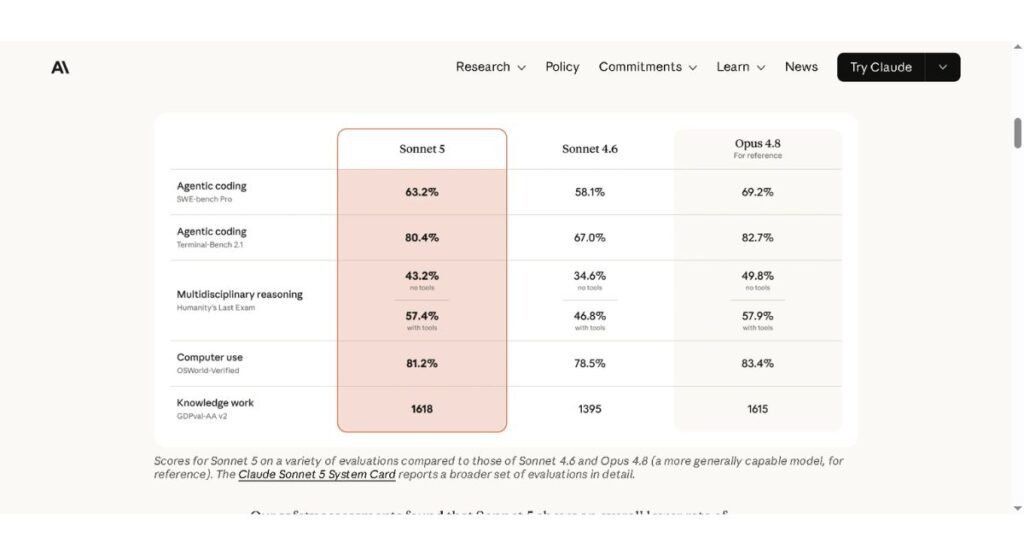
Terminal-Bench 2.1 is the standout gain: Sonnet 5 scores 80.4%, up 13.4 points from Sonnet 4.6’s 67.0% and within 2.3 points of Opus 4.8’s 82.7%, which matters for teams running CLI-heavy, shell-driven agent workflows.
GDPval-AA v2 is the one benchmark where Sonnet 5 leads: 1,618 against 1,615 for Opus 4.8, a margin small enough to treat as roughly a tie. Opus 4.8 continues to dominate the top spot in coding and complex reasoning benchmarks.
However, there is an important detail regarding evaluation transparency. Soon after the initial release, Anthropic updated its published cost-versus-performance chart for the BrowseComp benchmark. The original graphic relied on a simpler measurement methodology, which made Sonnet 5 appear significantly weaker against Opus 4.8 than it actually was. The corrected chart brings consistency by adopting the exact same setup used in Sonnet 5’s official system card—utilizing a 10-million-token budget alongside context compaction.
Anthropic noted that this adjustment aligns BrowseComp results with their standard testing framework for agentic benchmarks. Ultimately, this highlights why taking benchmark graphics at face value can be misleading; even official figures from model developers undergo revisions, making it essential to double-check the latest documentation before making comparative calls.
What Each Benchmark Measures
SWE-bench Pro: Tests an AI model’s ability to solve real software-engineering tasks from repositories; developers should care because it reflects practical coding and debugging work.
Terminal-Bench 2.1: Measures how well an AI completes tasks through a terminal environment; developers should care because many development workflows require command-line work.
Humanity’s Last Exam: Tests advanced knowledge and reasoning across challenging subjects, including tool-assisted tasks; developers should care because it indicates broader problem-solving ability.
OSWorld-Verified: Measures an AI’s ability to complete tasks by interacting with computer applications; developers should care because coding agents increasingly operate across desktop tools.
BrowseComp: Tests an AI’s ability to find and reason over information on the web; developers should care because research and information gathering are common parts of development.
GDPval-AA v2: Evaluates AI performance on professional, real-world knowledge-work tasks; developers should care because coding work often involves broader professional tasks beyond writing code.
Why Some Sonnet 4.6 Scores Look Different
Some published Sonnet 4.6 benchmark scores differ because Anthropic later restated results for two evaluations. For Humanity’s Last Exam (HLE), Anthropic updated the grader model, producing restated Sonnet 4.6 scores of 34.6% without tools and 46.8% with tools. For OSWorld-Verified, Anthropic changed the run, so Sonnet 4.6 is now listed at 78.5%. Anthropic also replaced its BrowseComp chart on June 30 because the original version used a simpler methodology.
These changes mean scores may not always be directly comparable across published tables. When comparing Sonnet 4.6 with Sonnet 5, use results from the same run, harness, and methodology whenever possible. This gives a cleaner comparison and avoids treating methodology changes as model improvements or regressions.
How Sonnet 5 Compares to the Current Claude Lineup
Here is Anthropic’s current lineup with Sonnet 5 shown for reference. Default effort and latency come from Anthropic’s model documentation.
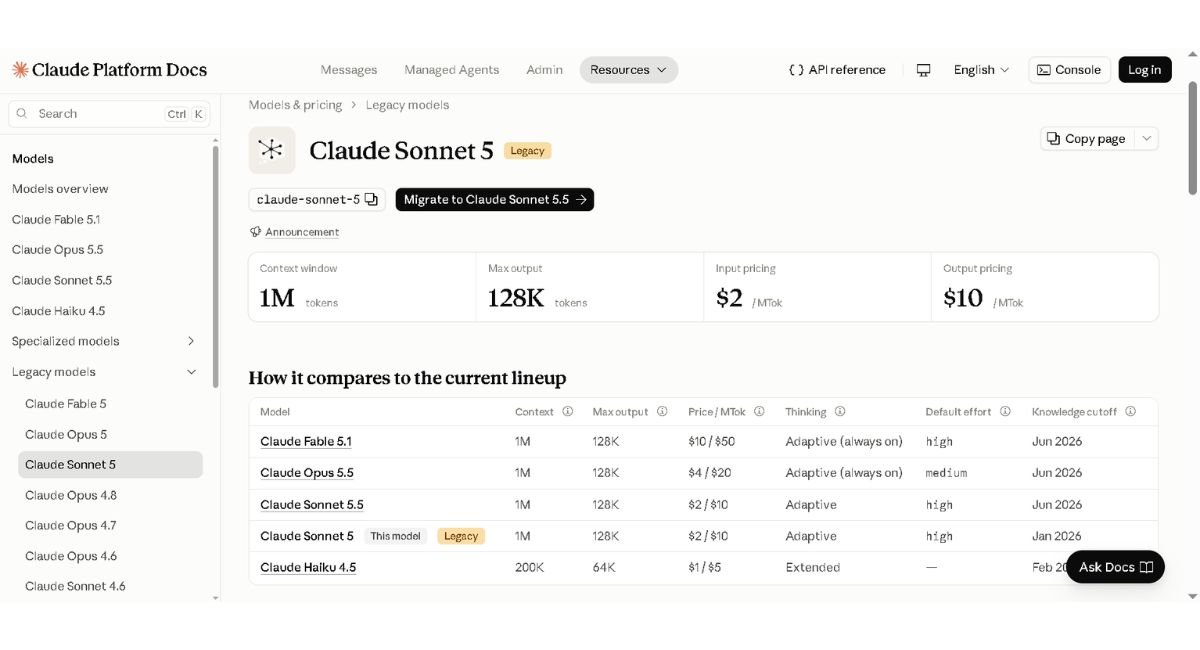
Prices are input/output per million tokens. For a separate comparison, see Claude Sonnet 5 vs GPT-5.6 Sol.
What Partners and Early Users Report
According to Cursor’s benchmark and Anthropic’s launch partners, Sonnet 5 improved on Sonnet 4.6 at real-world coding and multi-step work.
Cursor reported a 57% CursorBench score for Sonnet 5, compared with 49% for Sonnet 4.6.
Anthropic’s launch partners reported stronger follow-through on multi-step work. A Rust engineer said Sonnet 5 could reproduce a bug, implement a fix, and check that the bug returned without the fix. Another launch partner reported that Sonnet 5 completes complex tasks that earlier Sonnet models sometimes left unfinished and checks its own output.
The trade-off is that adaptive thinking is on by default, so it can take longer on trivial edits, where extended reasoning may add latency. This comes from how adaptive thinking works, not from our own benchmarks.
Community Reaction: The Cost Debate
Community reaction at launch centered on cost. On launch day, a widely viewed reply on X questioned the pricing directly.
Two things drive the bill. The updated tokenizer can turn the same text into up to 1.35x more tokens, and higher effort levels spend more output tokens. Anthropic’s own cost-performance charts show the same trade-off: Sonnet 5 offers a wider range of cost and performance options than Sonnet 4.6, and at higher effort it can match Opus 4.8 on some tasks, so the effort level you pick decides what you pay.
Pricing & Real Cost Scenarios
Sonnet 5 costs less per token than Opus 4.8 ($2/$10 versus Opus 4.8’s $5/$25 and Opus 5.5’s $4/$20), but the combination of effort levels and the new tokenizer means actual cost per task varies more than the sticker price suggests. Here’s how three common scenarios play out using the current $2/$10 pricing.
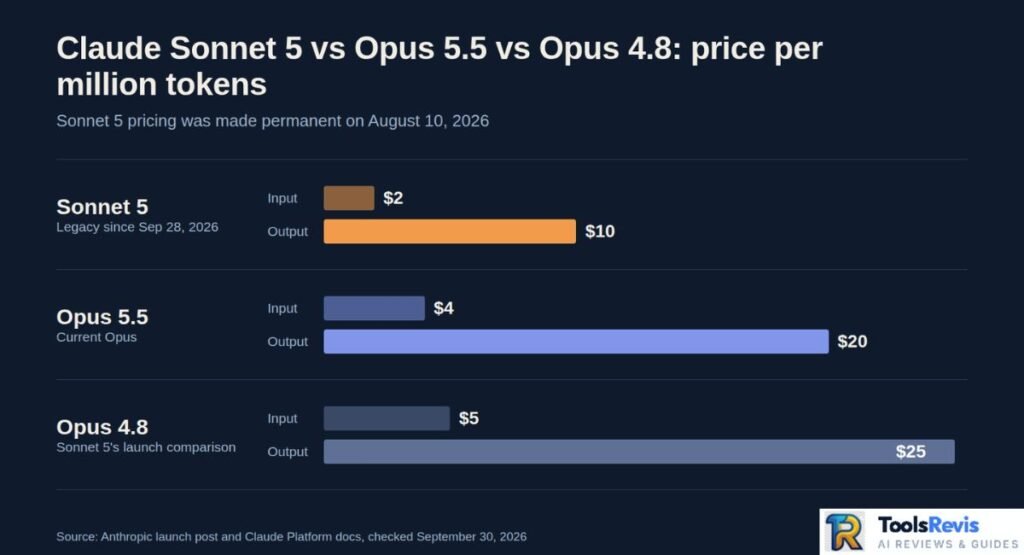
These are illustrative, not guaranteed — actual costs depend heavily on your specific prompts, MCP and tool-call overhead, and how the updated tokenizer maps your content type. The long-running agent scenario is the one to watch most closely: at xhigh effort, token consumption can climb well above what the same job costs at medium effort, so compare against Opus at a lower effort setting before standardizing on xhigh. For a deeper look at automating pull request reviews, see our guide to code review automation.
Official Claude API pricing and token costs are available in the Anthropic Pricing Documentation.
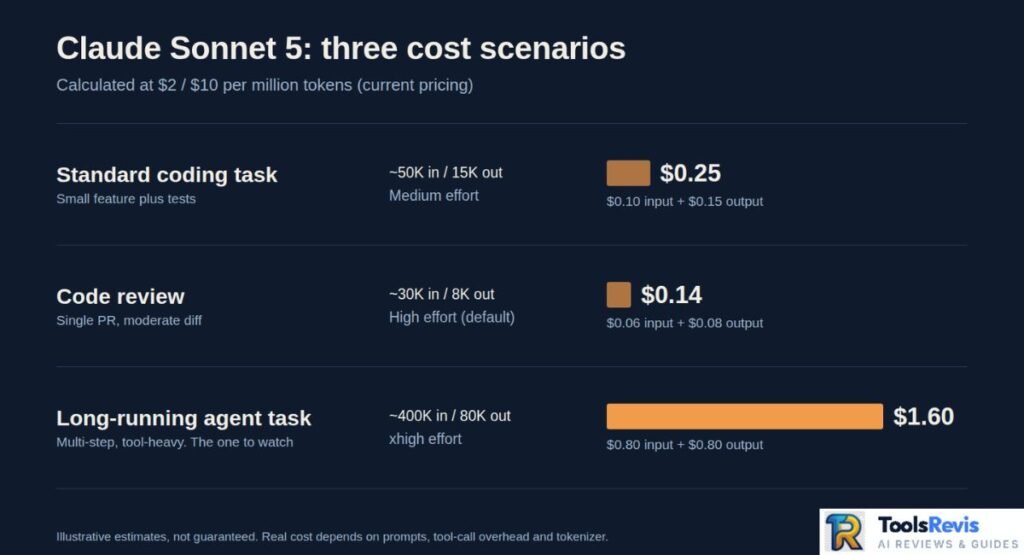
Full Claude Sonnet 5 Pricing
Caching can pay off when you repeatedly send the same system prompts or large shared context.
Why Does Sonnet 5 Feel Expensive?
Sonnet 5’s $2/$10 per MTok pricing is lower than Opus 4.8 and Opus 5.5, but the final bill can still grow because of how tokens are counted and generated.
First, the new tokenizer can turn the same text into 1.0–1.35× more tokens. Second, adaptive thinking is enabled by default with high effort, which can increase usage. At xhigh effort, the model can use many more output tokens, further increasing cost.
For our code review example:
Input: 30,000 tokens × $2 ÷ 1,000,000 = $0.06
Output: 8,000 tokens × $10 ÷ 1,000,000 = $0.08
Total: $0.14
With 1.35× tokenization:
Input: 40,500 tokens × $2 ÷ 1,000,000 = $0.081
Output: 10,800 tokens × $10 ÷ 1,000,000 = $0.108
Total: $0.189, or about $0.19
So the listed token price is only part of the cost equation.
Which Effort Level Should You Use?
Sonnet 5 supports five effort levels, with high as the default. Anthropic says medium offers much better cost efficiency, while higher effort can match Opus 4.8 on some tasks but uses more tokens.
A practical approach (our recommendation, not a measured result): start at medium for routine coding work, move to high or above only when medium falls short, and compare the cost against Opus at a lower effort setting before standardizing on xhigh. If you work in the terminal, see our guide to using Claude Code in the terminal.
Compute Your Own API Bill Instantly
Claude Sonnet 5’s new tokenizer inflation (up to 1.35x) and effort levels make manual calculations extremely tricky.
Calculate API Cost Now (Free Tool) →Migrating From Sonnet 4.6 to Sonnet 5
Moving from Sonnet 4.6 to Sonnet 5 mainly requires changing the model ID and reviewing settings that behave differently. On Sonnet 5, Anthropic’s documentation says non-default temperature, top_p, or top_k values return a 400 error.
- Swap the model ID from
claude-sonnet-4-6toclaude-sonnet-5. - Remove custom
temperature,top_p, andtop_kvalues. Do not carry non-default values into the Sonnet 5 request. - Use effort to control reasoning depth. Adaptive thinking is enabled by default, so review your chosen effort level rather than trying to control behavior through the older sampling settings.
- Re-measure cost. Sonnet 5’s tokenizer can produce 1.0–1.35× more tokens from the same text, so compare actual token usage before and after migration.
Before
message = client.messages.create(
    model="claude-sonnet-4-6",
    max_tokens=8192,
    messages=[{"role": "user", "content": prompt}]
)
After
message = client.messages.create(
    model="claude-sonnet-5",
    max_tokens=8192,
    messages=[{"role": "user", "content": prompt}]
)
If you are migrating today, also test Sonnet 5.5, and if you are comparing coding agents, see our Cline vs Claude Code comparison.
Sonnet 5 vs Sonnet 5.5: Should You Skip Straight to 5.5?
Sonnet 5.5 launched on September 28 at the same $2/$10 per million tokens as Sonnet 5.
Artificial Analysis scored Sonnet 5.5 at 56 at maximum effort, compared with 38 for Sonnet 5. That higher score came with a cost trade-off: at max effort it measured about 193K output tokens and roughly $7.60 per task, while at high effort Sonnet 5.5 scores 47 at about $1.08 per task. Artificial Analysis noted that it tested a pre-release build with a structured-output bug that Anthropic fixed before public launch.
Sonnet 5.5 also introduces breaking API changes from Sonnet 5, including forced tool use returning an error and changes to how thinking blocks work.
Should You Switch to Claude Sonnet 5?
Whether you should switch to Sonnet 5 depends primarily on your workload type, not on the benchmark table. Here’s how it breaks down by team profile. Since Sonnet 5.5 is now the current Sonnet at the same price, treat this section as guidance for Sonnet 5 and test 5.5 alongside it.
For Solo Developers
Sonnet 5 is a reasonable default switch, especially if most of your work runs through Claude Code or the Claude API for coding tasks. Set effort to low or medium as your baseline rather than accepting the high default — this keeps costs lower on routine work. Reserve xhigh for genuinely hard debugging or research-style problems.
For Enterprise Teams
Sonnet 5 is worth evaluating for agentic and multi-step workflows — CI/CD automation, cross-system tasks, and sustained coding sessions are where it shows the clearest gains over Sonnet 4.6, and where its Terminal-Bench 2.1 score (80.4%, within 2.3 points of Opus 4.8) is a testable claim. That said, Anthropic’s own charts show Sonnet 5 at higher effort can match Opus 4.8 on some tasks, so compare cost at equal accuracy rather than assuming Sonnet 5 is cheaper once you push it toward xhigh.
Run both models against your actual production workloads at comparable effort/cost points before standardizing on one tier, rather than defaulting to Sonnet 5 because it’s the new headline release. Now that Sonnet 5.5 and Opus 5.5 are both out, include them in that test.
For High-Volume/Low-Latency Teams (Who Should Wait)
If your workload is dominated by small, simple, high-frequency requests — short completions, routine formatting, low-complexity classification — the default-on adaptive thinking in Sonnet 5 can be a regression in latency and cost relative to Sonnet 4.6. Teams in this category should benchmark Sonnet 5 at its lowest effort setting against their current Sonnet 4.6 baseline before migrating, and should factor in the tokenizer’s up-to-1.35x inflation on their specific content types.
For pure throughput on simple tasks, it may be worth waiting for effort-tuning best practices to mature, or evaluating Haiku 4.5 as an alternative for that slice of the workload.
Sonnet 5.5 also adds a between_tools thinking setting that turns off up-front thinking at high effort or below, which may suit this kind of workload.
You can compare Claude Free, Pro, Max, Team, and Enterprise plans on the official Anthropic Pricing Page. For a plan-by-plan breakdown, see our Claude Pro vs Max comparison.
Frequently Asked Questions
1. Is Claude Sonnet 5 better than Opus 4.8?
On most benchmarks, Opus 4.8 still leads, especially on coding and reasoning tasks. Sonnet 5 edges it only on GDPval-AA v2 (1,618 vs 1,615) and comes within 2.3 points on Terminal-Bench 2.1. Anthropic’s newer Opus 5.5 ($4/$20) has since launched, so compare against it too if you need peak accuracy.
2. How much does Claude Sonnet 5 cost?
Claude Sonnet 5 costs $2 per million input tokens and $10 per million output tokens. This was introductory pricing at launch, but Anthropic made it permanent on August 10, 2026, so the planned $3/$15 rate never took effect. Prompt caching and the Batch API (50% discount) can lower the bill further.
3. Is Claude Sonnet 5 available?
Yes. Sonnet 5 launched on June 30, 2026 as the default model for Free and Pro plans, and it is available on Max, Team, and Enterprise plans, in Claude Code, and through the API, AWS Bedrock, Google Cloud, and Microsoft Foundry. It is now a legacy model, still available, with Sonnet 5.5 as the current Sonnet.
4. Why do some people question Claude Sonnet 5’s cost?
The per-token price of $2/$10 looks low, but the bill depends on the updated tokenizer, which can produce up to 1.35x more tokens, and on the effort level, since higher effort spends more output tokens. Comparing cost at equal accuracy against Opus is the fairest test.
5. What is the difference between Claude Sonnet 4.6 and Sonnet 5?
Sonnet 5 adds adaptive thinking (on by default) with five selectable effort levels, an updated tokenizer, and substantial gains on agentic coding, terminal, and computer-use benchmarks. It also returns a 400 error for non-default temperature, top_p, or top_k values.
6. Does Claude Sonnet 5 support a 1 million token context window?
Yes, Sonnet 5 ships with a 1M-token context window and a 128K max output, and up to 300K on the Batch API with a beta header.
7. Should I migrate my Sonnet 4.6 workloads to Sonnet 5 or Sonnet 5.5?
If your workload benefits from agentic, multi-step tasks, migrating is reasonable, and there is no price deadline because the $2/$10 rate is permanent. Since Sonnet 5.5 is now the current Sonnet at the same price, test both before choosing, and re-measure cost because of the tokenizer’s up-to-1.35x token inflation.
8. Why is Claude Sonnet 5 so expensive?
Claude Sonnet 5 is not unusually expensive per token; its listed price is $2 input and $10 output per million tokens. Costs can rise because its tokenizer may produce 1.0–1.35× more tokens, high effort is the default, and xhigh can use substantially more output tokens.
9. What is the Claude Sonnet 5 model ID?
The Claude Sonnet 5 model ID is claude-sonnet-5. The same model uses platform-specific identifiers, including anthropic.claude-sonnet-5 on Amazon Bedrock, while Google Cloud, Microsoft Foundry, and Claude Platform on AWS use claude-sonnet-5.
10. Can I download Claude Sonnet 5?
No, Claude Sonnet 5 is a cloud model rather than downloadable software. You can access it through Claude, Claude Code, or supported developer platforms using its API model ID. Availability and access can vary by platform and account, so check the relevant service before integrating it.
11. What can Opus 5.5 do?
Opus 5.5 is Anthropic’s flagship-tier model, priced at $4 input and $20 output per million tokens, with a 1M-token context window and a default effort of medium. OpenRouter’s model listing describes it as strong at multi-step changes in large codebases, code review and bug finding, and reading dense charts and screenshots.

I’m Umair Ahmad, founder of ToolsRevis. I personally test every AI tool we cover — signing up, running real workflows, checking pricing tiers, and comparing outputs — before writing a single word. My goal: cut through AI marketing hype with honest, hands-on verdicts.
Let’s achieve more together!