

Anthropic released Claude Sonnet 5 on June 30, 2026, positioning it as the most agentic Sonnet model the company has shipped to date.
Quick Answer: Claude Sonnet 5, released June 30, 2026, is Anthropic’s most agentic Sonnet model, priced at $2/$10 per million tokens (intro, through Aug 31) then $3/$15. It nears Opus 4.8 on coding and agentic benchmarks. Most teams should switch for coding and agent workflows; wait if you need low-latency, simple-task throughput.
The pitch is straightforward: near-Opus 4.8 performance on coding, tool use, and computer-use tasks, at a fraction of Opus 4.8’s price. For developers and technical decision-makers currently running Sonnet 4.6 in production, the question isn’t whether Sonnet 5 is an upgrade on paper — it’s whether the upgrade holds up once effort levels, tokenizer changes, and real workloads enter the picture.
Most existing reviews of this launch focus on benchmark scores alone and skip the details that actually determine your bill and your migration risk — tokenizer inflation, effort-tier cost mechanics, and real migration cost. This review closes that gap: it walks through the benchmarks, the pricing mechanics, hands-on coding performance, what the developer community is actually saying, and a practical framework for deciding whether to switch now, wait, or run both models side by side.
What Is Claude Sonnet 5?
Claude Sonnet 5 is Anthropic’s mid-tier model, sitting between Haiku 4.5 and the flagship Opus 4.8 in the Claude lineup. It replaces Sonnet 4.6 as the default model across Anthropic’s consumer and developer surfaces, and it’s built around a single design goal: finishing longer, multi-step agentic tasks without stalling halfway through — a pattern Anthropic explicitly called out as a weakness in earlier Sonnet models.
Key launch facts developers need to know:
- Release date: June 30, 2026
- API model ID: claude-sonnet-5
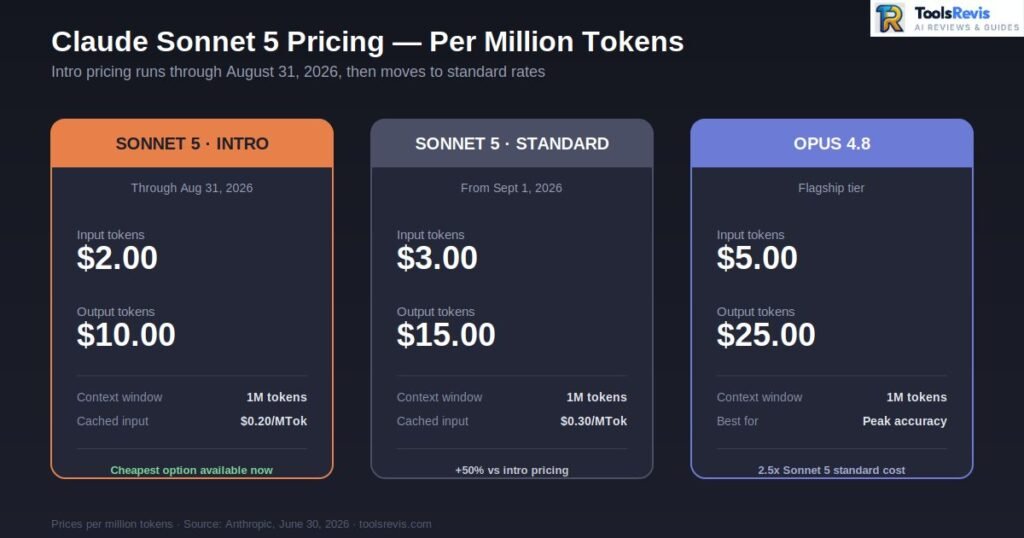
- Introductory pricing: $2 per million input tokens / $10 per million output tokens, through August 31, 2026
- Standard pricing (from September 1, 2026): $3 per million input tokens / $15 per million output tokens
- Context window: 1 million tokens
- Max output: 128K tokens (raisable via a batch-API beta header)
- Reasoning: Adaptive thinking is on by default — there is no way to disable it. Manual extended-thinking parameters (budget_tokens) and non-default sampling parameters (temperature, top_p, top_k) now return API errors.
- Effort levels: Five selectable tiers — low, medium, high (default), max, and xhigh — that control how many reasoning tokens the model spends per turn.
- Availability: Default model for Free and Pro plans on claude.ai; also available on Max, Team, and Enterprise plans, in Claude Code, on the Claude Platform API, and through AWS Bedrock, Google Vertex, and Microsoft Foundry.
- Tokenizer: Sonnet 5 uses an updated tokenizer (shared with Opus 4.7 and 4.8). The same input text can map to roughly 1.0x to 1.35x more tokens than it did under Sonnet 4.6, depending on content type — a detail that matters more than the headline price once you look at real invoices.
One structural point worth flagging up front: Anthropic set introductory pricing specifically to make the migration from Sonnet 4.6 “roughly cost-neutral” once the tokenizer inflation is factored in. That framing is accurate for the July–August window.
It changes on September 1, when the per-token rate rises 50% on the same traffic that’s already running through a token-hungrier tokenizer — worth modeling before you commit budget to a migration plan built on July numbers.
Claude Sonnet 5 vs Sonnet 4.6 vs Opus 4.8 — Benchmark Comparison
Anthropic published a dense benchmark set at launch, comparing Sonnet 5 against both its direct predecessor and the flagship Opus 4.8. The results show consistent, sometimes large, gains over Sonnet 4.6, and a genuinely narrowed gap with Opus 4.8 — with one benchmark where Sonnet 5 actually leads.
| Benchmark | Sonnet 4.6 | Sonnet 5 | Opus 4.8 |
| SWE-bench Pro (agentic coding) | [BENCHMARK SCORE] | 63.2% | 69.2% |
| Terminal-Bench 2.1 | [BENCHMARK SCORE] | 80.4% | 74.6% |
| OSWorld-Verified (computer use) | [BENCHMARK SCORE] | 81.2% | 83.4% |
| BrowseComp (agentic search) | [BENCHMARK SCORE] | 84.7% | [BENCHMARK SCORE] |
| GDPval-AA v2 (knowledge work, Elo) | [BENCHMARK SCORE] | 1,618 | 1,615 |
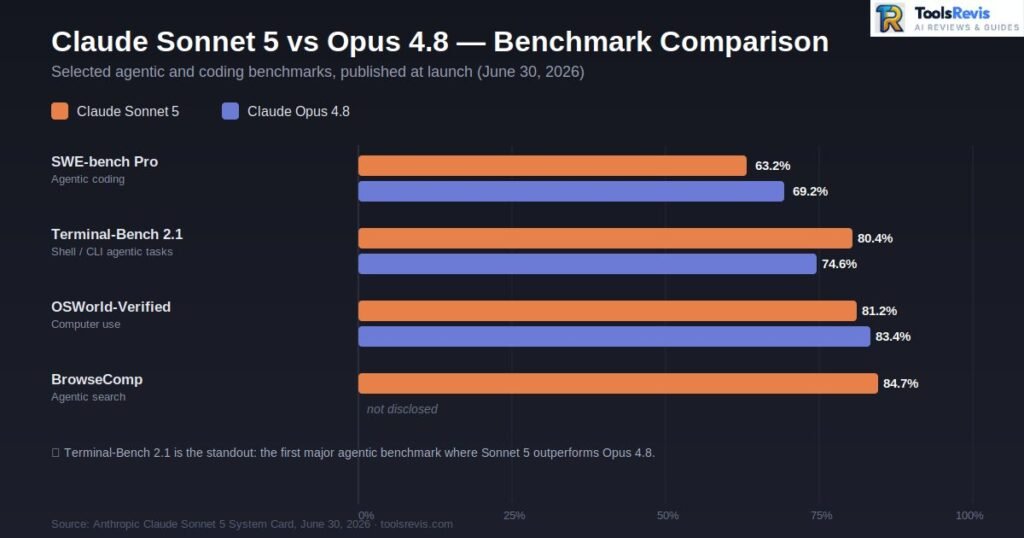
Terminal-Bench 2.1 is the standout: this is the first time a mid-tier Sonnet model has beaten its own Opus sibling on a major agentic benchmark, which is a notable claim for teams running CLI-heavy, shell-driven agent workflows.
GDPval-AA v2 is a similar story on a smaller scale — Sonnet 5 edges out Opus 4.8 on general knowledge-work tasks, even though Opus retains the lead on the hardest coding and reasoning benchmarks overall.
A transparency note worth including in any serious review: shortly after launch, Anthropic revised its own published cost-performance chart for the BrowseComp evaluation. The original chart used a simpler methodology and made Sonnet 5 look like it lagged Opus 4.8 more substantially than the replacement chart, which used the same 10-million-token-budget, compaction-enabled methodology as the Sonnet 5 system card.
Anthropic says the new chart is more consistent with how it evaluates other agentic benchmarks. Whether or not the revision was purely methodological, it’s a good reminder that benchmark charts — even from the model maker itself — get updated, and it’s worth checking you’re citing the current version before drawing conclusions.
Real-World Coding Performance
Sonnet 5 is measurably better than Sonnet 4.6 at real-world coding tasks, particularly in test-first workflows and code review quality. Benchmarks aside, hands-on use across coding-focused teams surfaces a consistent pattern.
Sonnet 5 is noticeably better at test-first workflows — it’s more likely to write or update tests before touching implementation code, and its code review comments read as more decisive and less hedged than Sonnet 4.6’s, which tended toward a “thoughtful colleague” tone that hedged its findings even when it caught real bugs.
The tradeoff shows up on the other end of task complexity. Because adaptive thinking is always on, Sonnet 5 spends reasoning tokens even on small, simple edits — a one-line config change or a routine formatting fix now runs through the same self-checking loop as a multi-file refactor.
In practice, that means Sonnet 5 is measurably slower than Sonnet 4.6 on trivial tasks, even though it’s faster to a correct result on tasks that require real multi-step planning. Teams running high volumes of small, low-complexity requests report that the always-on thinking behavior is the single biggest adjustment required when migrating — and the effort parameter (dropping to “low”) is the main lever available to offset it.
What Developers Are Saying (Reddit & Hacker News Reaction)
Community reaction to Sonnet 5 has been more mixed than Anthropic’s launch framing suggests, and several recurring themes are worth summarizing neutrally for anyone evaluating the model.
Effort-tier pricing reads as an upsell to some developers. The introduction of five selectable effort levels — low, medium, high, max, xhigh — replaces what was previously a binary on/off extended-thinking toggle.
A number of developers have described this shift skeptically, framing it as a mechanism that makes it easy to end up paying for reasoning depth you didn’t intend to use, particularly since high is the default rather than low.
There’s confusion about when to reach for Sonnet 5 versus Opus 4.8 at low effort settings. Because Opus 4.8 also supports variable effort, and because Sonnet 5 at low effort and Opus 4.8 at low effort can land in similar cost-and-capability territory on some tasks, several developers have said the decision tree between the two models is less obvious than Anthropic’s default-model messaging implies.
One frequently repeated question on Hacker News: if you’re going to tune effort levels anyway, why not just tune Opus down instead of Sonnet up?
Reaction to the model rewriting its own plan mid-task is split. Some developers report that Sonnet 5’s tendency to reassess and revise its plan partway through a long agentic run genuinely improves outcomes on complex, multi-step jobs — catching errors that earlier models would have carried through to the end.
Others find the same behavior frustrating on tasks that don’t need it, describing a second-guessing pattern that adds latency and token spend without a corresponding accuracy gain on simpler work.
A significant strand of community discussion has questioned the release’s purpose more fundamentally. Multiple highly-upvoted Reddit threads reported that Sonnet 4.6 running at a lower effort setting outperformed Sonnet 5 at medium effort on certain agentic search tasks, and that Opus 4.8 at medium effort beat Sonnet 5 at its highest (“xhigh”) effort tier on both cost and capability for some workloads.
This lines up with guidance that has since become common among practitioners: before reaching for Sonnet 5’s xhigh setting to match flagship-level accuracy, it’s often cheaper to escalate to Opus 4.8 at a lower effort level instead, since pushing Sonnet 5 to its ceiling doesn’t reliably beat Opus 4.8 on a cost basis.
Some of the broader commentary frames the release as a competitive-positioning move rather than a clear capability leap. With rival models such as GLM 5.2 posting increasingly competitive scores on coding benchmarks at substantially lower per-token prices, part of the community conversation has centered on whether Sonnet 5’s naming and version cadence is partly a response to competitor release patterns rather than a standalone step-change in capability.
This is a matter of interpretation rather than a settled fact, and reasonable observers land on different sides of it — but it’s a strand of the conversation worth being aware of before treating “Sonnet 5” as an automatic upgrade decision.
Pricing & Real Cost Scenarios
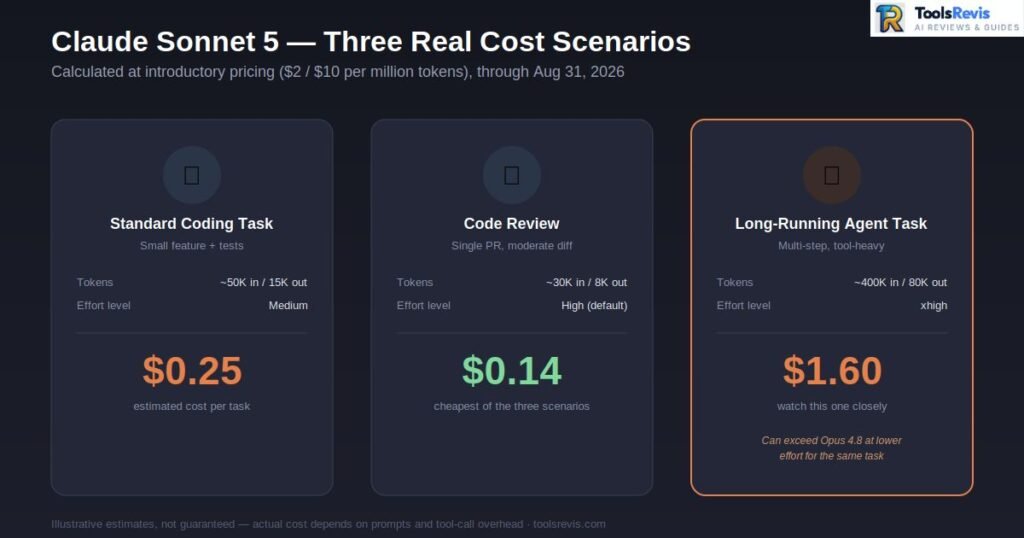
Sonnet 5 costs less per token than Opus 4.8 — $2/$10 intro or $3/$15 standard, versus Opus 4.8’s $5/$25 — but the combination of effort levels and the new tokenizer means actual cost per task varies more than the sticker price suggests. Here’s how three common scenarios play out using the intro pricing ($2/$10) in effect through August 31, 2026.
| Scenario | Estimated Input/Output Tokens | Effort Level | Estimated Cost (Intro Pricing) |
| Standard coding task (e.g., implement a small feature + tests) | ~50K input / 15K output | Medium | ~$0.10 input + $0.15 output ≈ $0.25 |
| Code review (single PR, moderate diff) | ~30K input / 8K output | High (default) | ~$0.06 input + $0.08 output ≈ $0.14 |
| Long-running agent task (multi-step, tool-heavy) | ~400K input / 80K output | xhigh | ~$0.80 input + $0.80 output ≈ $1.60 |
These are illustrative, not guaranteed — actual costs depend heavily on your specific prompts, tool-call overhead, and how the updated tokenizer maps your content type. The long-running agent scenario is the one to watch most closely: at xhigh effort, token consumption can climb enough that a Sonnet 5 task costs more than the equivalent job run on Opus 4.8 at a lower effort setting, which is the scenario the community skepticism above is largely about.
After September 1, all three scenarios get roughly 50% more expensive at the same effort levels, before accounting for any tokenizer-driven inflation already baked into your usage. Official Claude API pricing and token costs are available in the Anthropic Pricing Documentation.
Compute Your Own API Bill Instantly
Claude Sonnet 5’s new tokenizer inflation (up to 1.35x) and effort levels make manual calculations extremely tricky.
Should You Switch to Claude Sonnet 5?
Whether you should switch to Sonnet 5 depends primarily on your workload type, not on the benchmark table. Here’s how it breaks down by team profile.
For Solo Developers
Sonnet 5 is a reasonable default switch, especially if most of your work runs through Claude Code or the Claude API for coding tasks. Set effort to low or medium as your baseline rather than accepting the high default — this alone captures most of the benchmark gains over Sonnet 4.6 without paying for reasoning depth you don’t need on routine work.
Reserve xhigh for genuinely hard debugging or research-style problems, and budget for the September 1 price step-up if you’re planning to rely on it long-term.
For Enterprise Teams
Sonnet 5 is worth evaluating for agentic and multi-step workflows — CI/CD automation, cross-system tasks, and sustained coding sessions are where it shows the clearest gains over Sonnet 4.6, and where the Terminal-Bench 2.1 lead over Opus 4.8 is a genuine, testable claim. That said, some users found Opus 4.8 at medium effort more cost-effective than Sonnet 5 at its highest effort tier for certain hard tasks — so don’t assume Sonnet 5 is automatically the more economical choice once you’re pushing it toward xhigh.
Run both models against your actual production workloads at comparable effort/cost points before standardizing on one tier, rather than defaulting to Sonnet 5 because it’s the new headline release.
For High-Volume/Low-Latency Teams (Who Should Wait)
If your workload is dominated by small, simple, high-frequency requests — short completions, routine formatting, low-complexity classification — the always-on adaptive thinking in Sonnet 5 is a real regression in latency and cost relative to Sonnet 4.6, even at low effort. Teams in this category should benchmark Sonnet 5 at its lowest effort setting against their current Sonnet 4.6 baseline before migrating, and should factor in the tokenizer’s up-to-1.35x inflation on their specific content types.
For pure throughput on simple tasks, it may be worth waiting for effort-tuning best practices to mature, or evaluating Haiku 4.5 as an alternative for that slice of the workload.
You can also compare Claude Free, Pro, Max, Team, and Enterprise plans on the official Anthropic Pricing Page.
Frequently Asked Questions
1. Is Claude Sonnet 5 better than Opus 4.8?
On most benchmarks, Opus 4.8 still leads, especially on the hardest coding and reasoning tasks. Sonnet 5 beats Opus 4.8 on Terminal-Bench 2.1 and edges it on GDPval-AA v2, but Opus remains the stronger choice for peak accuracy.
2. How much does Claude Sonnet 5 cost?
Introductory pricing is $2 per million input tokens and $10 per million output tokens through August 31, 2026. Standard pricing after that is $3/$15 per million tokens.
3. Is Claude Sonnet 5 available for free users?
Yes. Sonnet 5 is the default model for Free and Pro plans on claude.ai, and it’s also available on Max, Team, and Enterprise plans.
4. Why are some developers skeptical of Claude Sonnet 5?
Skepticism centers on effort-tier pricing feeling like an upsell, confusion over choosing between Sonnet 5 and Opus 4.8 at comparable effort levels, and community reports that Sonnet 5 at its highest effort tier doesn’t always beat Opus 4.8 on cost or capability.
5. What is the difference between Claude Sonnet 4.6 and Sonnet 5?
Sonnet 5 adds always-on adaptive thinking with five selectable effort levels, a 1M-token context window, an updated tokenizer, and substantial gains on agentic coding, terminal, and computer-use benchmarks. It also removes manual extended-thinking controls and custom sampling parameters, which now return API errors.
6. Does Claude Sonnet 5 support a 1 million token context window?
Yes, Sonnet 5 ships with a 1M-token context window and a 128K max output, which can be raised further through a batch-API beta header.
7. Should I migrate my Sonnet 4.6 workloads to Sonnet 5 before September 1?
If your workload benefits from agentic, multi-step task completion, migrating during the intro pricing window is reasonable — but model the September 1 price increase and the tokenizer’s token inflation against your actual traffic before treating the current pricing as permanent.
Ready to Take Action? Try Our Free AI & Business Utilities
If you want to scale your workflow and automate your digital growth, check out our suite of free advanced tools. No sign-ups, no credit cards required:
1. Calculate Your Cloud Storage Costs
Managing cloud expenses can be challenging, especially when storage usage, requests, and data transfers continue to grow. Our Amazon S3 Cost Calculator helps you estimate your expected AWS S3 monthly and yearly costs based on storage size, S3 storage class, region, requests, and data transfer requirements.
2. Find the Right AI Tool
Not sure which AI solution fits your needs? Simply describe your goal, and our AI-powered recommendation tool will identify the most suitable option for your specific task in just a few seconds. It’s completely free and requires no sign-up.

I’m Umair Ahmad, founder of ToolsRevis. I personally test every AI tool we cover — signing up, running real workflows, checking pricing tiers, and comparing outputs — before writing a single word. My goal: cut through AI marketing hype with honest, hands-on verdicts.
Let’s achieve more together!