
Introduction: How AI Is Transforming Real Estate Marketing
Between chasing cold leads, drafting listing copy at midnight, and triple-checking MLS compliance before a submission deadline, most agents aren’t short on hustle — they’re short on hours. An effective AI setup goes beyond saving time—it prevents missed follow-ups and keeps potential clients from slipping through the cracks.
Quick Answer: The best AI tools for real estate agents in 2026 combine lead nurturing, listing automation, and transaction management. Top picks include [Tool 1] for AI-powered lead follow-up, [Tool 2] for automated listing descriptions and CMA reports, and [Tool 3] for predictive analytics on buyer intent. Most platforms integrate directly with MLS and CRM systems like Follow Up Boss or kvCORE, cutting manual data entry by 60–80%. Pricing ranges from $30/month for solo agents to $300+/month for brokerage-wide deployments.
Bottom line: these tools work best as a co-pilot for outreach and admin — not a replacement for human judgment on contracts, disclosures, or Fair Housing–sensitive communication.
Why Adoption of AI Tools for Realtors Is Surging
Three forces are pushing agents toward AI faster than any previous tech shift in the industry:
- Lead volume without lead capacity.Platforms such as Zillow and Realtor.com produce far more incoming leads than an individual agent can manage on their own. AI response tools now handle the first 3-5 touchpoints automatically, so hot leads don’t go cold waiting for a callback.
- Content demand outpacing bandwidth. Every listing needs a description, social captions, a video script, and email copy. Agents producing this manually spend 5-8 hours per listing on content alone — AI compresses that to under 30 minutes.
- Commission compression forces efficiency.In the wake of recent NAR settlement updates, shrinking commission margins mean agents can rarely justify hiring dedicated ISAs or transaction coordinators. AI tools fill that gap at a fraction of the cost.
Key Benefits: Time, Nurturing, and Closing Speed
Saving Time
Automated CMA generation, listing description drafts, and email sequences remove the repetitive admin work that eats 15-20 hours of an agent’s week — time that converts directly into more showings and more calls.
Nurturing Leads
AI-driven drip campaigns and chatbots respond within seconds of an inquiry — the single biggest factor in lead conversion. Intent-based lead segmentation helps sales teams separate casual visitors from high-intent buyers, allowing them to apply personalized effort where it yields the highest return.
Closing Deals Faster
Predictive analytics flag which leads are most likely to transact in the next 30-60 days, and AI-assisted transaction coordination tools catch missing signatures, expired contingencies, and disclosure gaps before they delay closing.
Reality Check: “Co-Pilot, Not Autopilot”
Here’s what most “best AI tools” roundups won’t tell you straight: every tool on this list requires a human in the loop before anything goes to a client or the MLS.
AI-generated listing descriptions have been caught inventing square footage, misstating school district boundaries, or drifting into Fair Housing–risky language without meaning to. Inaccurate details in an MLS listing go beyond mere embarrassment—they create legal compliance risks that endanger the agent’s license, not the AI provider’s. (Full Fair Housing guidance is covered in detail later in this guide.)
Top-performing agents view AI-generated content as an initial starting point rather than a finished piece:
- Every listing description gets a human fact-check against the actual MLS data sheet before publishing.
- Every AI-drafted client communication gets scanned for Fair Housing language before it’s sent.
- Every automated CMA gets a sanity check against recent comps an agent personally knows.
Used this way, AI doesn’t replace an agent’s judgment — it protects their time so that judgment gets applied where it counts.
Common Problems Real Estate Agents Mention Online
Many discussions on Reddit and Quora highlight the same frustrations when adopting AI tools:
- “I signed up for four AI tools but still spend hours following up with leads.”
- “ChatGPT generated a property description containing inaccurate listing information.”
- “My CRM automation stopped working after an integration update.”
- “I’m paying for AI features that I never actually use.”
- “I don’t know whether I need one all-in-one platform or several specialized tools.”
These experiences show why choosing the right AI stack—and reviewing every AI-generated output—is more important than simply buying more software.
How to Select the Best AI Tools on a Budget
Choosing the right AI tools means selecting software that solves your biggest workflow bottleneck while fitting your budget and existing CRM. Most agents don’t have a tool problem — they have a stacking problem. Agents often jump on every new AI subscription featured in flashy email demos, only to end up paying for multiple tools with overlapping lead-nurturing features. Here is how to evaluate your actual workflow requirements before making any financial commitment.
Critical Decision Factors
Before evaluating any tool, run it through these five filters:
- Integration depth, not just compatibility. In reality, many ‘CRM integrations’ are just flimsy third-party workarounds that can fail without any notice. Ask specifically whether it has a native, direct API integration with your existing CRM and MLS feed.
- Data ownership. Who owns the lead data and conversation history if you cancel? Insist on getting these details in written form rather than discussing them over a sales call.
- Actual time-to-value. A tool that takes three weeks to configure isn’t saving you time in Q1 — it’s costing you.
- Support responsiveness. Real estate doesn’t pause for a 48-hour support ticket queue. Check reviews specifically for support speed.
- Per-seat vs. team pricing. Brokerage-wide tools often have far better per-agent economics than five agents each buying individual licenses.
Real Estate Agent AI Spending Trends in 2026
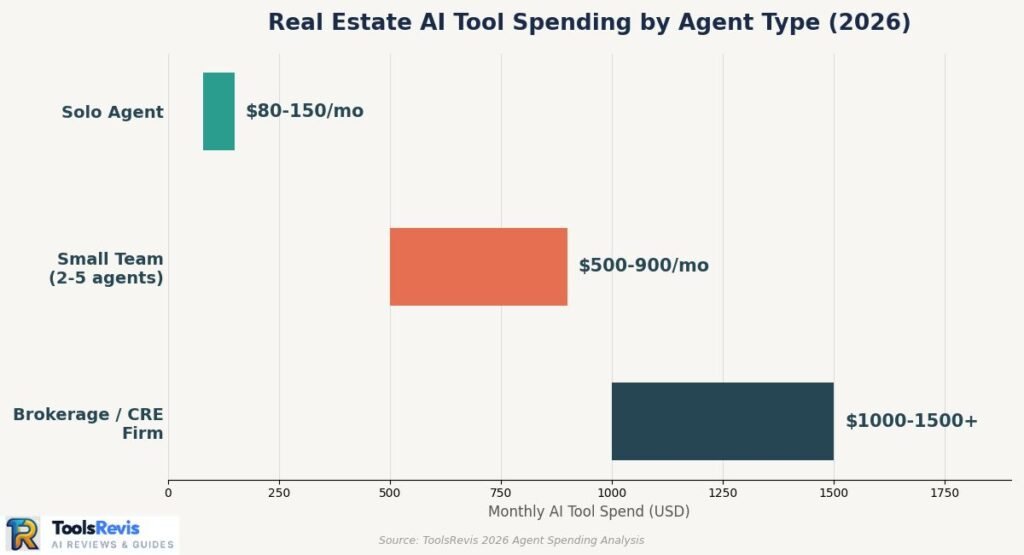
Spending on AI tools has shifted noticeably over the past 18 months. Solo agents in 2024 were mostly experimenting with free tiers of ChatGPT — by 2026, the average solo agent budget for AI tools sits between $80-150/month, spread across a CRM automation tool, a writing assistant, and one content or transcription tool.
Small teams (2-5 agents) are now budgeting $500-900/month collectively, largely driven by shared CRM licensing and database reactivation tools. Brokerages and CRE firms are the fastest-growing spend segment — enterprise AI contracts (portfolio analytics, lease abstraction, site-selection data) frequently exceed $1,000-1,500/month, but the ROI case is easier to justify at scale since one saved analyst-hour often outweighs the subscription cost.
The clearest trend: agents are consolidating. Instead of five $30-50/month niche tools, most are moving toward 2-3 tools that cover 80% of their workflow — a direct reaction to subscription fatigue and unclear ROI tracking from 2024-2025.
Stack Approach vs. All-in-One AI Agent
There are two philosophies, and both are valid depending on your business size:
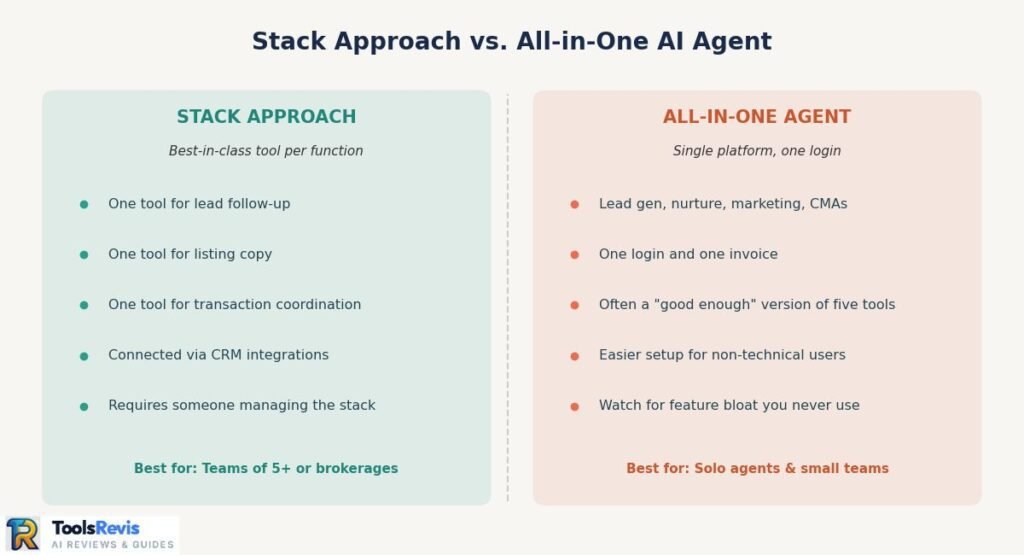
The Stack Approach — best-in-class tools for each function (one for lead follow-up, one for listing copy, one for transaction coordination), connected through your CRM. More flexible, but requires someone (you, or an ops person) managing the integrations.
The All-in-One Agent — a single platform attempting lead gen, nurturing, marketing, and CMA generation together. Better for solo agents who want one login and one invoice, but you’re often getting a “good enough” version of five different tools rather than the best version of any one.
Rule of thumb: Solo agents and small teams → all-in-one. Teams of 5+ or brokerages → stack approach, because the volume justifies specialized tools and someone’s job can be managing the stack.
The Mistake of Buying a “Do-Everything” Tool
The biggest wasted spend we see in tool audits: agents paying $250-400/month for a platform advertised as “your AI real estate assistant” that does lead scoring, content, CMAs, and voice calls — and using maybe 20% of the features.
Two problems compound here:
- Mediocrity by design. A tool built to do everything rarely does any single function as well as a specialized competitor priced at a third of the cost.
- Switching cost trap. Once your lead data, templates, and automations live inside one all-in-one platform, migrating out becomes painful — which is exactly the lock-in the vendor is counting on.
Before signing an annual contract, ask: if I only used this for its single best feature, would it still be worth the price? If the answer is no, you’re paying for a bundle you don’t need.
Data Privacy & Client Info Safeguards
Real estate AI tools touch some of the most sensitive data a client will share — financial pre-approval details, SSNs for certain transaction platforms, home access codes, and personal circumstances (divorce, relocation, financial hardship) disclosed during lead conversations.
Non-negotiables before adopting any tool:
- SOC 2 Type II compliance at minimum — this should be publicly stated or available on request.
- Clear data retention and deletion policy, especially for leads who don’t convert.
- No training on your client data without explicit opt-in — some AI vendors default to using conversation data to improve their models unless you disable it.
- State-specific compliance — some states have stricter real estate data-handling requirements than federal baseline.
If a vendor is cagey about any of these in a sales call, treat that as a red flag, not a follow-up question for later.
Top Categorized AI Tools for Real Estate Professionals
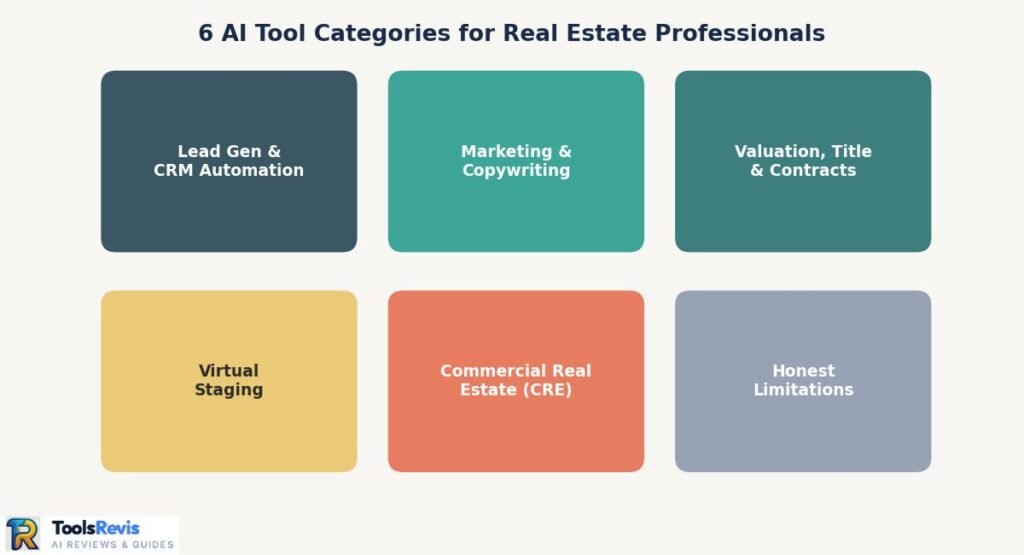
Rather than ranking 11 tools in a flat list, it’s more useful to audit them by function — because the “best” tool depends entirely on which bottleneck is actually costing you deals.
1. Lead Gen & CRM Automation
This category has matured the fastest, and it’s where AI delivers the clearest ROI.
- Database reactivation is the standout use case: AI tools scan your existing (often neglected) CRM database and auto-launch personalized re-engagement sequences to leads that went cold 6-18 months ago. Agents routinely find 3-5 transaction-ready leads sitting dormant in a database they assumed was dead.
- AI voice receptionists now handle inbound calls after hours, qualify the caller (buyer vs. seller, timeline, budget range), and book showings directly into your calendar — without the lead ever knowing they spoke to AI.
- Social listening tools monitor local Facebook groups, Nextdoor, and Instagram for “thinking of selling” or “just got a job offer in [city]” type signals, surfacing warm leads before they hit Zillow.
Auditor’s note: This is the category most worth paying a premium for. Lead response speed correlates directly with conversion, and this is the one function AI demonstrably does better and faster than a human.
2. Marketing & Copywriting
- Automated listing description generation from MLS data fields (bed/bath/sqft/features)
- Social media caption and carousel generation from listing photos
- Email drip sequences segmented by buyer/seller intent
- Video script generation for listing walkthroughs and market update content
Auditor’s note: High time-savings, low risk — as long as every output gets fact-checked against source data before publishing (see the Fair Housing warning above).
3. Title Search, Valuation & Contracts
- AI-assisted title search tools flag liens, easements, and ownership discrepancies faster than manual review
- Automated CMA and valuation tools pull comps and generate pricing recommendations in minutes instead of hours
- Contract review tools scan for missing signatures, expired contingency dates, and non-standard clauses
Valuation caution: AI valuation tools are directionally useful but frequently miss hyperlocal factors — a busy street, a bad school zone boundary two blocks off, recent unpermitted renovations. Treat every AI-generated valuation as a starting point for your own comp analysis, never as the number you present to a seller. An agent who hands a client an unreviewed AI valuation and gets it wrong by 8% owns that mistake, not the software.
4. Virtual Staging
- Static AI staging (furniture and decor added to empty room photos) is now table-stakes and priced under $20/room in most tools
- Interactive staging is the 2026 differentiator: buyers can swap furniture styles, wall colors, and flooring options in real time on a listing page, increasing time-on-listing and engagement metrics that some MLS platforms now factor into search ranking
Auditor’s note: Always disclose virtually staged photos per MLS and, in many states, legal requirement. Buyers discovering undisclosed staging after a showing is a trust problem you don’t want.
5. Commercial Real Estate (CRE)
CRE has distinct needs from residential, and tools built for one rarely serve the other well:
- AI-driven lease abstraction (pulling key terms from complex commercial leases in minutes instead of hours)
- Tenant and demographic analysis for site selection
- Automated financial modeling for cap rate and NOI projections across a portfolio
Auditor’s note: CRE tools generally cost more and have longer sales cycles, but the time saved on lease abstraction alone — work that used to require a paralegal or junior associate — often justifies the spend for brokerages handling multiple commercial deals simultaneously.
6. Honest Limitations: Where AI Still Falls Short in Real Estate
Every roundup talks about what AI can do. Here’s what it still can’t — or shouldn’t be trusted to do — in 2026.
Deal sourcing has the worst AI ROI of any category. Off-market deal data, distressed property leads, and public records are either stale, heavily scraped by competitors, or locked behind paywalled platforms like CoStar. AI can summarize this data more attractively, but it can’t fix the underlying data quality problem — an agent chasing “AI-powered deal sourcing” is often just paying for a nicer-looking version of the same outdated list everyone else has.
Cold outreach at scale breaks on deliverability, not copy quality. AI can write a perfectly personalized cold email in seconds, but the moment that email goes out at volume from a generic or unwarmed domain, it lands in spam — regardless of how good the writing is. This is an infrastructure problem (domain reputation, sending limits, authentication records), and no AI writing tool solves it. Agents scaling outreach need proper email deliverability setup first; the AI copy is the easy part.
Autonomous AI agents carry real security and operational risk. Tools that get broad access to your CRM, email, and calendar to “run” your business autonomously are powerful — but they’re also a bigger attack surface and a bigger point of failure if something goes wrong (a bad automation deleting records, an AI agent responding to a client incorrectly with no human review). The more autonomy a tool has, the more scrutiny it deserves before giving it access to sensitive client or transaction data.
The takeaway: AI is strongest at compressing time on tasks with clear, structured inputs — content drafting, transcription, follow-up sequencing. It’s weakest wherever the underlying data is bad or the risk of an unreviewed mistake is high.
Detailed Reviews: 11 AI Tools for Real Estate Agents (2026)
1. ChatGPT Pro / Claude
- Overview: General-purpose AI assistants used by agents for drafting listing copy, client emails, CMA summaries, and social content. ChatGPT runs on OpenAI’s GPT-5.x model family, while Claude (Anthropic) is often preferred for longer documents and more careful, nuanced writing.
- Key Features:
- Instant first-draft generation for listing descriptions, email sequences, and social captions
- Long-context handling for summarizing contracts, disclosures, or inspection reports (Claude in particular handles long documents well)
- Custom instructions/projects to maintain a consistent brand voice across all client-facing content
- Pricing: ChatGPT Plus starts at $20/month (Pro tiers run $100–$200/month for heavier use); Claude’s paid plans start at a comparable entry price, with higher tiers for teams needing more usage.
- Pros & Cons:
- Fastest way to eliminate blank-page paralysis on listing copy and client comms
- Extremely flexible — one subscription covers dozens of writing tasks
- No real estate-specific training — every fact (address, sqft, school zone) needs manual verification
- Zero MLS/CRM integration; everything is copy-paste unless you build custom automation
- Best For: Solo agents and small teams who want an all-purpose writing and brainstorming assistant, provided every output gets fact-checked before publishing.
2. Follow Up Boss / kvCORE (now BoldTrail)
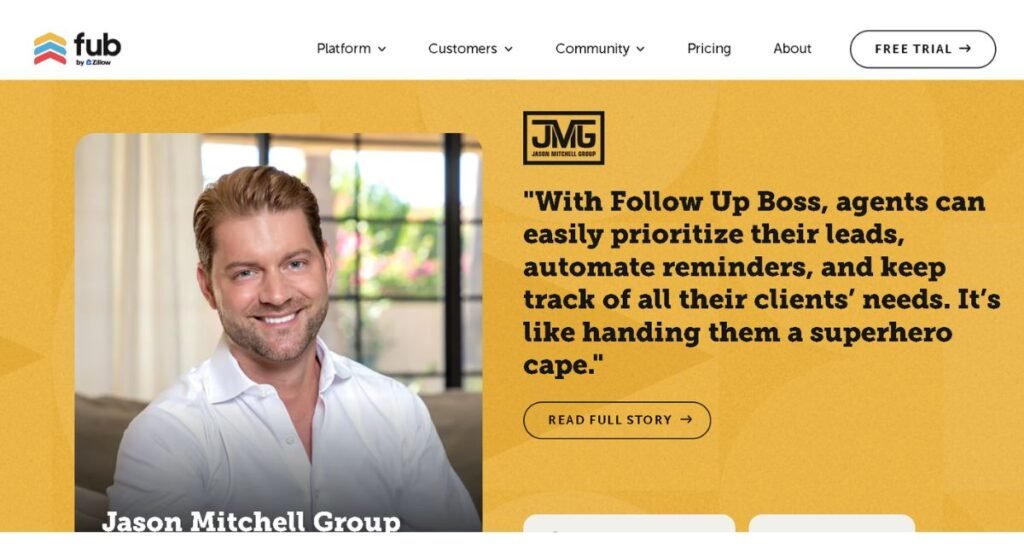
- Overview: Follow Up Boss is a real estate-specific CRM built around Smart Lists, automated Action Plans, and lead-source tracking. kvCORE — now transitioning to the BoldTrail brand under Inside Real Estate — is a heavier all-in-one platform combining an IDX website, AI-driven nurture campaigns, and brokerage-level lead distribution (“ponds”).
- Key Features:
- Automated drip sequences and lead routing based on lead-source and behavior
- AI-assisted “smart campaigns” (kvCORE/BoldTrail) that adjust messaging based on how a lead engages with your site
- Native dialer and texting add-ons for logging every call and message against a contact record
- Pricing: Follow Up Boss starts at $69 per user per month on the Grow plan, with a free 14-day trial; Pro runs a flat $499/month for up to 10 users, and Platform runs $1,000/month for up to 30 users. kvCORE/BoldTrail doesn’t publish fixed pricing — third-party estimates put it starting around $499/month, scaling with team size and negotiated terms.
- Pros & Cons:
- Purpose-built for real estate follow-up cadence, not a generic sales CRM bent into shape
- kvCORE’s behavioral tracking and pond system genuinely help brokerages route leads fairly
- Dialer and advanced calling features are paid add-ons on both platforms, so the sticker price understates real cost
- kvCORE’s brokerage-oriented depth can feel like overkill — and overpriced — for a solo agent
- Best For: Follow Up Boss for individual agents and small teams who want tight lead-response automation; kvCORE/BoldTrail for brokerages that want website, CRM, and lead distribution unified under one roof.
3. BoxBrownie / Restb.ai

- Overview: BoxBrownie is a human-edited photo enhancement and virtual staging service for listing photos. Restb.ai is a computer-vision API that powers automated image tagging, room classification, and condition scoring — usually embedded inside an MLS or valuation platform rather than sold directly to individual agents.
- Key Features:
- BoxBrownie: virtual staging, day-to-dusk exterior conversion, and item removal with human designer review
- Restb.ai: automatic room-type tagging, feature detection (hardwood floors, natural light, appliance brands), and property condition scoring at MLS scale
- Both integrate into listing and appraisal workflows rather than requiring a separate app
- Pricing: BoxBrownie’s virtual staging runs about $30 per image — a typical 5-8 room listing costs $150-$240 for staging alone, plus separate charges for photo enhancement and item removal. Restb.ai doesn’t sell direct-to-agent subscriptions; it’s licensed at the MLS or platform level, reaching over 1 million agents through 26+ partner MLSs — agents typically get it “for free” as part of their MLS’s toolset.
- Pros & Cons:
- BoxBrownie’s human touch still outperforms pure AI staging on unusual room layouts or angles
- Restb.ai’s tagging saves real time on manual listing data entry and improves searchability
- BoxBrownie’s per-image pricing adds up fast on multi-room listings — budget-conscious agents may skip rooms they shouldn’t
- Neither tool is a direct one-off subscription for solo agents comparing pure AI staging apps on cost
- Best For: BoxBrownie for agents who want polished, human-reviewed staging on a handful of listings per month; Restb.ai isn’t something you “buy” as an agent — check whether your MLS already includes it.
4. OpusClip / InVideo AI
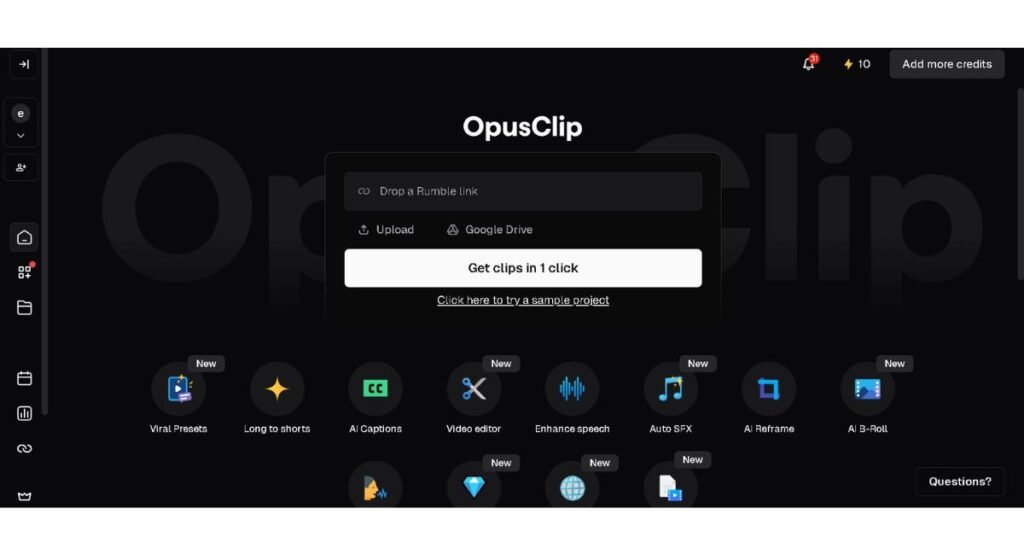
- Overview: Both are AI video repurposing tools that turn long-form content (listing walkthroughs, market update videos) into short, captioned clips for TikTok, Reels, and Shorts. OpusClip specializes in clipping existing footage; InVideo AI leans more toward generating video content from scripts or prompts.
- Key Features:
- Automatic identification of “clip-worthy” moments from a longer video
- Auto-reframing for vertical/square formats plus animated, multilingual captions
- Social scheduling and direct publishing from inside the tool
- Pricing: OpusClip offers a free tier with 60 credits/month (watermarked, 3-day export window), Starter at $15/month, Pro at $29/month (or $14.50/month billed annually), and custom Business pricing.
- Pros & Cons:
- Turns one listing walkthrough into a week’s worth of social content in minutes
- Free tier is genuinely usable for testing before committing
- Credit-based billing (1 credit = 1 minute of source footage processed) can bite volume users fast
- Free tier’s 3-day export expiry and watermark make it unusable for regular publishing
- Best For: Agents already filming listing walkthroughs or market updates who want to multiply that footage into short-form content without hiring an editor.
5. Fireflies.ai / Otter.ai
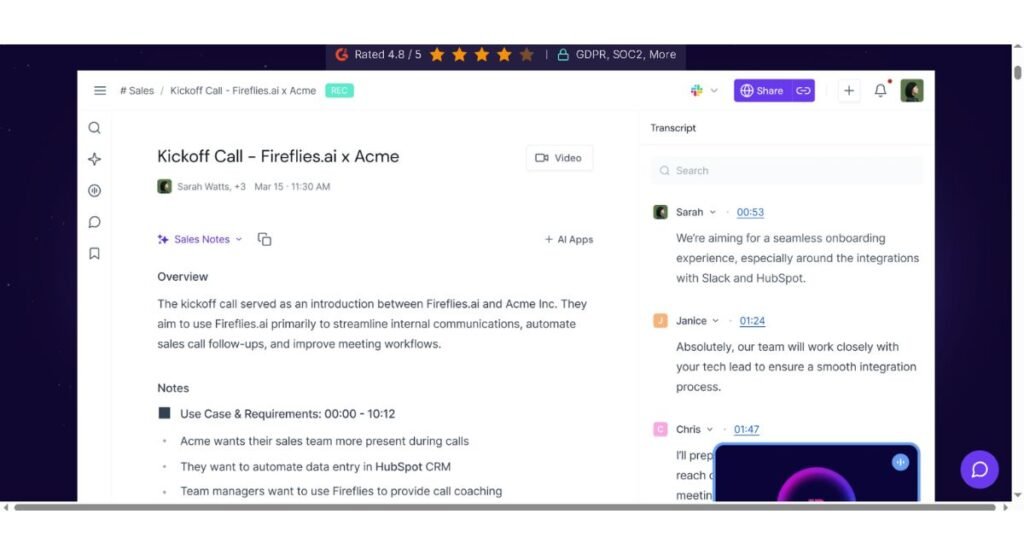
- Overview: AI meeting assistants that join calls (Zoom, Google Meet, phone) to transcribe, summarize, and push notes into a CRM — useful for capturing buyer consultations, listing appointments, and negotiation calls.
- Key Features:
- Automatic transcription and searchable meeting archive
- AI-generated summaries, action items, and topic tracking
- CRM integrations (Fireflies has the deeper Salesforce/HubSpot connections; Otter leans simpler and cheaper)
- Pricing: Fireflies.ai starts free, then $10/user/month (Pro, annual billing) and $19/user/month (Business, annual billing). Otter’s entry-level paid plans typically undercut Fireflies on price but cap free usage more tightly.
- Pros & Cons:
- Eliminates the “was I actually listening or taking notes” tension during client conversations
- CRM auto-logging saves real admin time after back-to-back showings
- Transcription accuracy drops with crosstalk or noisy environments (open houses, cars)
- Advanced AI features run on credit systems that can generate surprise overage charges
- Best For: Agents and teams who want every buyer/seller consultation automatically logged and searchable without manual note-taking.
6. Placer.ai
- Overview: A location intelligence platform that analyzes anonymized foot traffic data to reveal how people move through and around a property — built primarily for retail site selection but widely used in commercial real estate.
- Key Features:
- True Trade Area analysis showing where a property’s actual customer base comes from
- Competitive benchmarking against similar locations or tenants
- Predictive analytics for site performance before signing a lease
- Pricing: Enterprise subscriptions start around $50,000 per year, positioning it firmly as a brokerage/institutional tool rather than an individual-agent subscription.
- Pros & Cons:
- Genuinely hard-to-replicate data for retail and mixed-use site selection decisions
- Strong for justifying lease terms or valuations with hard traffic numbers
- Price point puts it out of reach for individual agents or small teams
- Steep learning curve on filters and report customization
- Best For: CRE brokerages and retail-focused teams doing site selection or lease negotiation — not a fit for residential solo agents.
7. Sabato AI / Ylopo
- Overview: Both provide AI voice technology for real estate lead engagement. Sabato AI is an AI voice assistant for real estate agencies that responds 24/7, qualifies leads, and books showings. Ylopo pairs AI-driven digital advertising with its “raiya” AI voice and text assistant for lead nurture.
- Key Features:
- Sabato: 24/7 AI phone answering, lead qualification, and showing bookings, with call summaries and next-step checklists emailed after every call
- Ylopo: AI Voice calls leads and live-transfers successful connections to the agent, continuing outreach for up to 90 days, paired with dynamic Facebook/Google remarketing ads
- Both log call outcomes and notes directly to your CRM
- Pricing: Sabato AI doesn’t publish public per-seat pricing — it’s sold as a managed service with custom quotes. Ylopo pricing starts around $395/month for the base platform plus a recommended minimum $500/month in ad spend, with total investment often landing around $1,000+/month once managed ad spend is included.
- Pros & Cons:
- Genuinely fills the “nobody answers after 6pm” gap that costs agents warm leads
- Ylopo’s ad-plus-AI-follow-up combo is a real end-to-end funnel, not just a chatbot bolt-on
- Neither is cheap once ad spend and setup fees are factored in
- Both require real script/CRM setup work upfront — this isn’t a plug-and-play five-minute install
- Best For: Sabato AI for teams that want a dedicated AI receptionist handling overflow and after-hours calls; Ylopo for agents who want lead generation and AI follow-up bundled into one paid funnel.
8. HouseSigma (paired with independent AVM tools)
- Overview: HouseSigma is a Canadian real estate technology platform that uses AI to estimate home values in real time, giving buyers one-click automated valuations and nearby sold comparables. For US-market comparisons, pair it with a verified AVM like HouseCanary.
- Key Features:
- AI-driven estimates using comparative sales analysis and market trend data
- Sold history, market insights, and sold-comparable searches within listings
- Full-service brokerage connection for users who want an agent after browsing data
- Pricing: Free for consumers and agents to browse; HouseSigma is an app/website, not a paid SaaS subscription.
- Pros & Cons:
- Free, fast, and genuinely useful for a quick sanity-check on pricing conversations
- Deep historical sold data (back to 2003 in GTA) supports credible client conversations
- Coverage is limited primarily to Ontario and British Columbia — not useful outside those markets
- Like any AVM, it can’t account for condition, upgrades, or offer-strategy nuances
- Best For: Agents in the GTA or BC markets who want a free, client-friendly valuation reference — always paired with the agent’s own comp analysis, never presented as the final number.
9. Structurely
- Overview: A conversational AI assistant that texts and qualifies leads over natural, human-like dialogue, functioning like an AI inside sales agent (ISA) that works a lead for months rather than days.
- Key Features:
- Engages leads over SMS, asks qualifying questions, books appointments, and keeps working a lead for up to a year if neededPlugs into most
- major real estate CRMs rather than replacing them
- Natural-language conversation flow designed to avoid feeling like a scripted bot
- Pricing: Reported figures vary by source — some place entry pricing lower, while others cite pricing from roughly $500/month. Confirm current tiers directly with Structurely before budgeting.
- Pros & Cons:
- Strong fit for reactivating a large, neglected lead database without hiring an ISA
- Long nurture window (up to a year) suits real estate’s naturally long buyer timelines
- Pricing isn’t fully transparent publicly — expect a sales call before you get a firm number
- Like all conversational AI, still needs a human handoff once a lead gets into serious negotiation territory
- Best For: Agents or teams with a large cold database and no ISA to work it — Structurely reactivates leads you’d otherwise write off.
10. Roofr AI
- Overview: An AI-assisted satellite roof measurement and proposal platform built primarily for roofing contractors — relevant to real estate agents mainly as a fast way to pull repair-cost estimates before listing a home with roof issues, or to help buyers budget for post-inspection repairs.
- Key Features:
- Embeddable instant estimator that generates ballpark roofing estimates from satellite imagery and AI-powered measurements
- Measurement reports delivered in as little as a few hours, starting at $13 each
- Proposal builder and e-signature tools for fast contractor quotes
- Pricing: Starter is free (pay-per-report), Essentials runs $249/month, and Scale runs $349/month, with add-ons like Measure+ and the Instant Estimator widget priced separately.
- Pros & Cons:
- Useful for getting a fast, ballpark repair-cost number to share with a seller or buyer without waiting on a contractor site visit
- Free per-report option means no subscription commitment for occasional use
- As of mid-2026, Roofr has no AI phone-answering or AI text-generation features — its “AI” is limited to satellite measurement, not a broader assistant
- Satellite coverage gaps affect an estimated 50% of roofs, requiring manual DIY measurement as a fallback
- Best For: Agents who regularly deal with pre-listing roof condition questions and want a fast, low-cost ballpark number to guide pricing or repair-credit conversations — not a lead-gen or marketing tool.
11. Notion AI + n8n
- Overview: Not a real estate-specific tool, but a powerful combination for agents who write their own automations: Notion AI handles content drafting and workspace organization, while n8n is a no-code/low-code automation platform that connects your CRM, email, and other tools into custom workflows.
- Key Features:
- Notion Agent handles multi-step tasks, AI Meeting Notes, and workspace-wide AI search
- n8n’s 500+ integration catalog lets agents build custom automations (e.g., “new Zillow lead → auto-add to CRM → trigger welcome email”) without hiring a developer
- n8n offers a fully free, self-hosted Community Edition with unlimited executions
- Native AI node support for Claude, Gemini, and vector databases for building custom AI-powered workflows
- Pricing: Notion AI is bundled into the Business plan at $20/user/month (annual billing), up from Plus at $10/user/month with no AI included. n8n Cloud runs roughly €24/month for the entry tier, or free indefinitely if self-hosted.
- Pros & Cons:
- Extremely flexible — this pairing lets a tech-comfortable agent build the exact workflow other tools charge $300+/month for
- n8n’s free self-hosted option is a genuine zero-cost path for agents willing to handle basic setup
- Requires real time investment to learn and configure — this is a “build it yourself” solution, not plug-and-play
- Notion’s AI pricing restructure now requires the full Business tier just to get AI features, raising the effective entry cost
- Best For: Tech-comfortable agents or small teams who want a custom, low-cost automation stack instead of renting an expensive all-in-one platform.
Want to compare these AI tools side by side? Use our AI Real Estate Tools Comparison Tool below to filter platforms by use case, pricing, CRM integrations, team size, and best-fit scenarios. It helps you quickly find the right tool stack before reading the detailed reviews.
How to Use AI Responsibly (Fair Housing Compliance & Legal Risks)
Fair Housing compliance means reviewing every AI-generated property description to ensure it contains no discriminatory or misleading language. AI doesn’t know real estate law. It knows patterns in text. That distinction is where agents get into trouble.
Where Fair Housing Risk Actually Hides in AI Copy
The Fair Housing Act prohibits discrimination based on race, color, religion, sex, national origin, familial status, and disability. Most agents assume the risk is obvious — nobody’s asking AI to write something overtly discriminatory. The real risk is subtler:
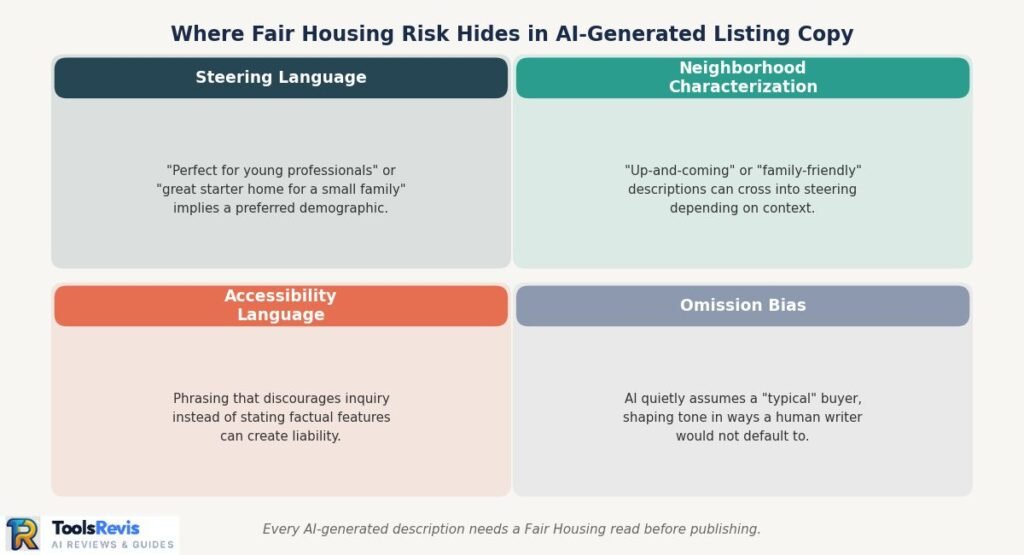
- Steering language. Phrases like “perfect for young professionals” or “great starter home for a small family” imply a preferred demographic, even unintentionally. AI models trained on decades of real estate copy will reproduce this pattern because it’s common in the training data — not because it “knows” it’s a violation.
- Neighborhood characterization. Describing an area as “up-and-coming,” “family-friendly,” or referencing specific school quality can cross into steering, depending on context and phrasing.
- Accessibility language. Describing a home as “not wheelchair accessible” in a way that discourages inquiry, rather than simply stating factual features, can create liability.
- Omission bias. AI models sometimes generate confident-sounding copy that quietly assumes a “typical” buyer, subtly shaping tone in ways a human writer wouldn’t default to without noticing.
None of this means avoid AI for listing copy. It means every piece of AI-generated copy gets a Fair Housing read before publishing — the same way you’d proofread for typos.
MLS Data Verification Checklist
Before any AI-generated content goes into an MLS listing or gets sent to a client, run it through this checklist:
- Square footage and lot size — cross-check against the actual MLS data sheet or public tax record, never trust AI-inferred numbers from a photo or partial description.
- Bed/bath count — verify against permitted records, especially for finished basements or converted spaces that may not legally count.
- School district and boundaries — confirm via the district’s official zoning tool, not AI’s general knowledge, which can be outdated or simply wrong at the address level.
- HOA fees and special assessments — these change frequently and AI has no way to know the current figure.
- Demographic or steering language — read every description specifically for the patterns above before it goes live.
- Staged photo disclosure — confirm every virtually staged image is labeled as such, per your state’s and MLS’s disclosure rules.
- Price and comps — never publish an AI-suggested valuation without your own comp analysis backing it up.
The rule of thumb: treat AI as a fast first-draft writer, not a fact-checker or a compliance officer. The agent’s license is on the line either way — the software vendor doesn’t share that liability.
Step-by-Step Guide: Building Your $100/Month AI Tech Stack
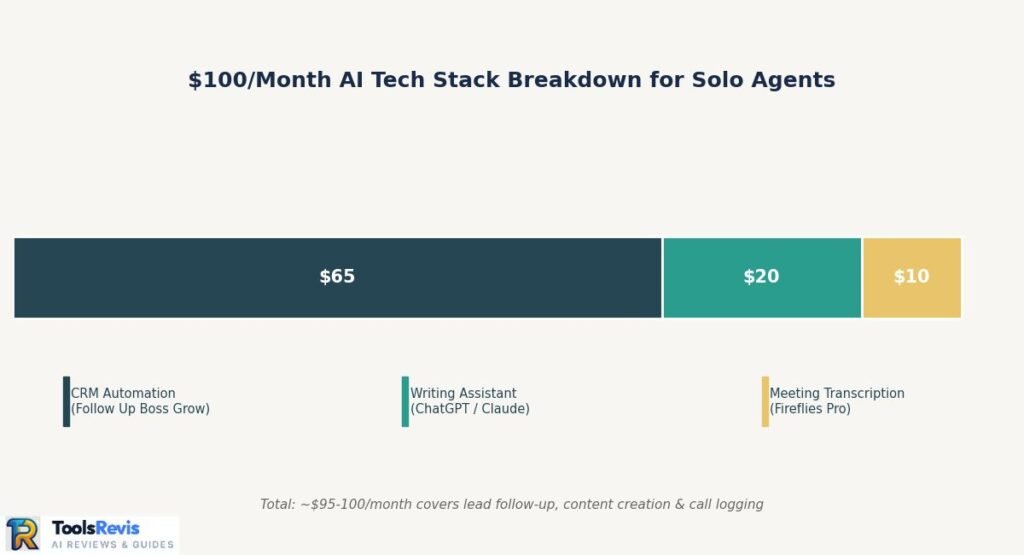
An AI tool stack is a combination of complementary AI tools that automate different parts of a real estate agent’s workflow. You don’t need eleven tools. Most agents get 80% of the value from two or three, chosen deliberately instead of accumulated impulsively.
Step 1: Pick Your 2-3 Tools Based on Your Actual Bottleneck
Don’t buy tools because they exist — buy them because they fix a specific, named problem:
- Bottleneck: “I have leads but no time to follow up.” → One conversational AI or CRM automation tool (e.g., Follow Up Boss Grow at ~$58-69/month).
- Bottleneck: “Content takes forever.” → One writing assistant (ChatGPT Plus or Claude, ~$20/month) plus a video repurposing tool if you’re producing walkthroughs (OpusClip Starter, $15/month).
- Bottleneck: “I lose track of client conversations.” → One meeting assistant (Fireflies Pro, $10/user/month).
A realistic $100/month stack: CRM automation ($60-70) + writing assistant ($20) + meeting transcription ($10) covers lead follow-up, content creation, and conversation logging — the three highest-leverage functions for a solo agent.
Step 2: Set Up Daily Operations (Not Just Accounts)
Signing up isn’t the work. Integration is. Block time to:
- Connect your CRM to your actual lead sources (Zillow, Realtor.com, your website) so leads flow in automatically instead of requiring manual entry.
- Build 2-3 templates in your writing assistant for the content you produce weekly (listing descriptions, follow-up emails, social captions) so you’re not re-prompting from scratch every time.
- Turn on meeting transcription for every client call by default, not selectively — the value compounds only if it’s consistent.
Step 3: Avoid “Productivity Theater”
Productivity theater is when a tool makes you feel efficient without actually changing an outcome — more dashboards, more automations, more subscriptions, same number of closed deals. Signs you’ve fallen into it:
- You’re customizing workflows more than you’re using them.
- You can’t name which specific tool led to a specific closed deal or saved hour in the last 30 days.
- You’re paying for features (voice AI, predictive analytics, advanced reporting) you haven’t touched since onboarding.
The test: every 90 days, ask whether each tool in your stack earned its subscription cost through actual time saved or leads converted. If you can’t answer specifically, cut it — don’t renew on autopilot.
Read Next
- ChatGPT Plus vs Claude Pro : Compare the two most popular AI assistants for writing listing descriptions, emails, and client communication.
- Jasper AI Review : See whether Jasper AI is a better choice than ChatGPT for creating high-volume real estate marketing content.
- Best AI Search Visibility Tools : Learn which AI SEO tools can help real estate businesses improve Google visibility and attract more leads.
Frequently Asked Questions
Category 1: AI Lead Generation & Real Estate Basics
How can a real estate agent use AI?
Agents use AI mainly for three things: automating lead follow-up, speeding up content creation like listing copy and emails, and transcribing client calls into CRM notes. Most start with one function before expanding.
How to use AI as a real estate agent to grow business?
Focus AI on the two highest-leverage areas: faster lead response and reactivating cold leads sitting in your CRM. Both directly recover deals that would otherwise be lost.
How to use AI for real estate agents in daily workflows?
AI drafts listing descriptions and emails, a transcription tool logs client calls automatically, and CRM automation runs follow-ups in the background — while the agent reviews everything before it goes out.
How to use AI to generate real estate leads automatically?
Social listening tools flag “thinking of selling” signals on Facebook/Nextdoor, while AI chatbots qualify website visitors 24/7. These catch leads that manual prospecting alone would miss.
What are the tools helpful in real estate lead generation?
AI-powered CRMs (Follow Up Boss, kvCORE/BoldTrail) for lead routing, conversational AI/ISA tools (Structurely) for database reactivation, and AI voice receptionists (Sabato AI, Ylopo) for after-hours calls.
Do realtors use ChatGPT?
Yes, ChatGPT and Claude are among the most widely used AI tools by agents, mainly for listing descriptions and client emails. Neither has real estate-specific training, so facts still need manual verification.
Which CRM does Keller Williams use?
Keller Williams uses its own proprietary platform called Command, which includes built-in CRM and lead-routing tools. Many agents still layer tools like Follow Up Boss or ChatGPT on top of it.
How much does a realtor make off of a $300,000 house?
At a typical 5-6% total commission split between both agents, gross commission per side is roughly $7,500-$9,000. After brokerage splits, fees, and taxes, actual take-home is usually well below that.
Category 2: General AI Adoption
Do I really need AI tools as a real estate agent in 2026?
Not strictly, but AI now handles repetitive admin like follow-up and first-draft copy that otherwise eats 15-20 hours a week. That freed time goes toward client-facing work that actually closes deals.
Will AI replace real estate agents?
No. AI handles volume and repetition well but can’t negotiate, read a room during a showing, or carry the legal liability of a transaction.
How much time can AI actually save me per week?
Agents using a focused 2-3 tool stack typically report saving 8-15 hours weekly, mostly on listing copy, follow-up, and admin logging.
Is AI-generated listing content bad for SEO?
Not inherently, but generic AI copy without local detail or a distinct voice tends to underperform human-edited content in rankings and buyer engagement.
Category 3: Tool Selection & Cost
What’s the cheapest way to start using AI as an agent?
A single writing assistant like ChatGPT or Claude at around $20/month, paired with your CRM’s free-tier automations, covers most high-value use cases before any extra spend.
Should I buy an all-in-one platform or a stack of specialized tools?
Depends on team size — see the “Stack Approach vs. All-in-One AI Agent” section above for the full breakdown and reasoning.
How do I know if I’m overpaying for AI tools?
If you can’t name a specific saved hour or converted lead tied to a tool in the last 90 days, you’re very likely paying for features you don’t use.
Are free AI tools good enough for real estate work?
Free tiers are fine for testing, but most hit real limits like watermarks or message caps once you rely on them for regular client-facing work.
Category 4: Legal & Compliance
Can AI-generated listing copy violate the Fair Housing Act?
Yes, AI models can reproduce subtle steering language or demographic assumptions from training data. Every AI-generated description needs a Fair Housing read before publishing.
Who is liable if an AI tool makes a factual error in an MLS listing?
The listing agent, not the software vendor. Errors in square footage, school zones, or pricing that reach the MLS remain the agent’s professional responsibility.
Do I need to disclose AI-generated or AI-staged content to clients?
Virtually staged photos generally require disclosure under most state and MLS rules. AI-written copy itself usually doesn’t, but factual accuracy is still the agent’s job.
Is it safe to share client data with AI tools?
Only with tools that confirm SOC 2 compliance and a clear data retention policy. Sensitive details like financials or access codes warrant checking before adoption, not after.
Final Verdict: Which AI Tools Should You Choose?
| Agent Type | Recommended Stack | Approx. Monthly Cost | Primary Use Case |
| Solo Agent | Follow Up Boss (Grow) + ChatGPT/Claude + Fireflies (Pro) | ~$90-100/month | Lead follow-up, listing copy, client call logging |
| Small Team (2-5 agents) | kvCORE/BoldTrail or Follow Up Boss (Pro) + Structurely + OpusClip | ~$700-900/month | Team-wide lead distribution, database reactivation, content repurposing |
| CRE Broker / Large Brokerage | Placer.ai + Restb.ai (via MLS/platform) + dedicated CRM (kvCORE/BoldTrail) | $1,000+/month, often enterprise-quoted | Site selection data, portfolio-scale listing intelligence, brokerage lead management |

I’m Umair Ahmad, founder of ToolsRevis. I personally test every AI tool we cover — signing up, running real workflows, checking pricing tiers, and comparing outputs — before writing a single word. My goal: cut through AI marketing hype with honest, hands-on verdicts.
Let’s achieve more together!