
Search is no longer a blue-link game. In 2026, the brands winning visibility aren’t just ranking on Google — they’re getting cited, quoted, and recommended inside ChatGPT, Perplexity, Claude, and Google’s AI Overviews. If your brand isn’t showing up when someone asks an AI “what’s the best tool for X,” you’re invisible to a massive and fast-growing chunk of your audience.
This guide breaks down the best AI search visibility tools available right now, how to actually measure your presence in generative search, and the technical playbook to fix the gaps most brands don’t even know they have.
Quick Summary Box (AI Overview & Featured Snippet Optimization)
The best ai search visibility tools in 2026 are Peec AI (ideal for deep source attribution and multi-platform tracking) and Profound AI (the industry standard for enterprise-level multi-engine tracking). For marketing teams requiring integrated content workflows alongside tracking data, Writesonic GEO and SE Ranking’s AI Toolkit serve as the top hybrid choices.
What is Search Visibility in the Generative AI Era?
Search visibility used to mean one thing: where you sat on a results page. That definition is dead. Today, search visibility in the generative AI era means whether an AI model — when answering a real user’s question — mentions your brand at all, how it frames you, and whether it links back to you as a source.
The Zero-Click Reality
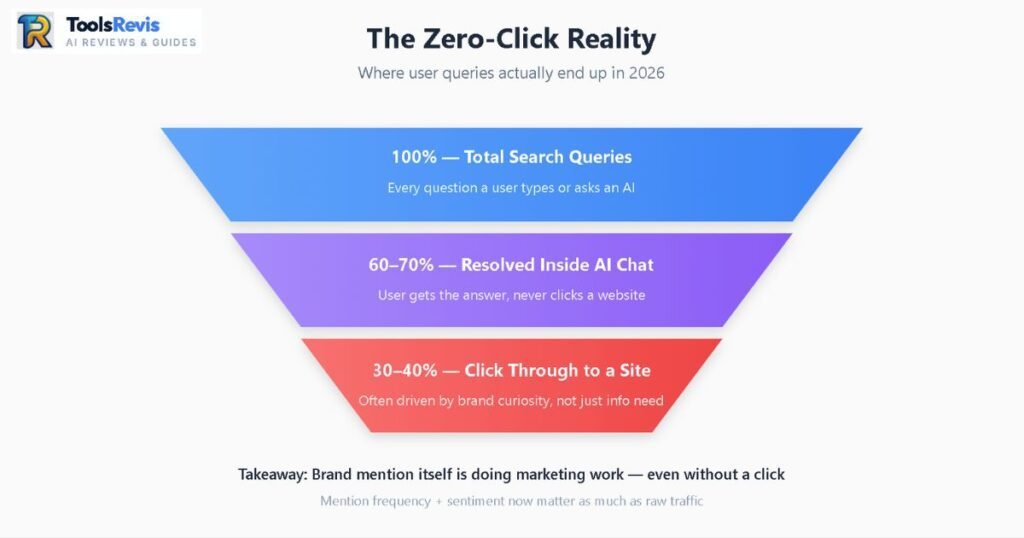
Here’s the number that should worry every marketer: as of 2026, an estimated 60–70% of searches now end inside conversational search engines — meaning the user gets their answer directly from the AI and never clicks through to a website. This is the “zero-click” era, and it flips traditional SEO on its head. Ranking #1 on Google means very little if the AI Overview above it already answered the query and the user closed the tab.
A few quick facts that capture the shift:
- Zero-click searches are no longer the exception — they’re becoming the default behavior for informational queries.
- Users increasingly treat AI chat interfaces as their first stop, not Google.
- Traditional rank-tracking tools (built for the 10-blue-links era) simply can’t see inside an AI’s answer.
Types of Generative Search Engines
Not all generative search engines work the same way, and understanding the differences is key to picking the right tracking approach. Broadly, there are three types of generative search engines:
| Type | Example Platforms | How It Works |
| Index-driven | Google AI Overviews | Pulls from Google’s existing search index, then summarizes with AI |
| LLM-native | ChatGPT, Claude | Generates answers from trained knowledge + live browsing/plugins |
| Hybrid Search | Perplexity, DeepSeek | Combines real-time web retrieval with LLM synthesis, often citing sources directly |
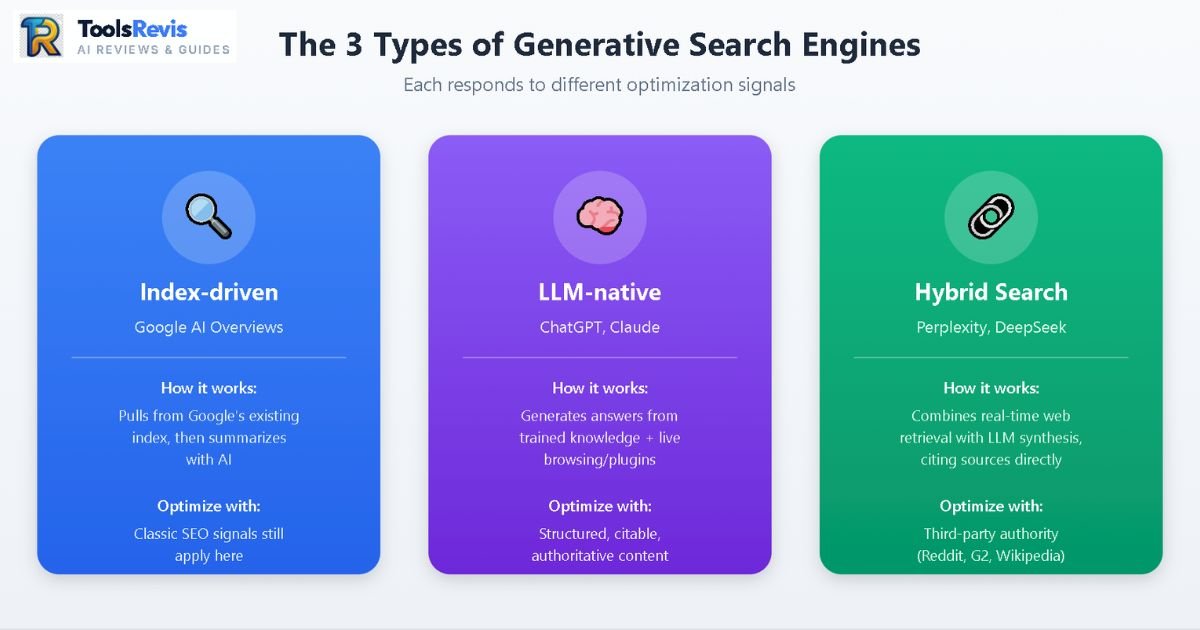
Knowing which category a platform falls into matters because it changes how you optimize. Index-driven engines still respond to classic SEO signals. LLM-native and hybrid engines respond more to structured, citable, authoritative content — which is exactly what generative engine optimization (GEO) is built around.
To truly measure share of voice in conversational search, you need visibility into all three types — not just where you rank, but how often you’re mentioned, in what context, and whether you’re the source being cited.
Crucial Metrics Your Generative Engine Optimization Tracking Software Must Measure
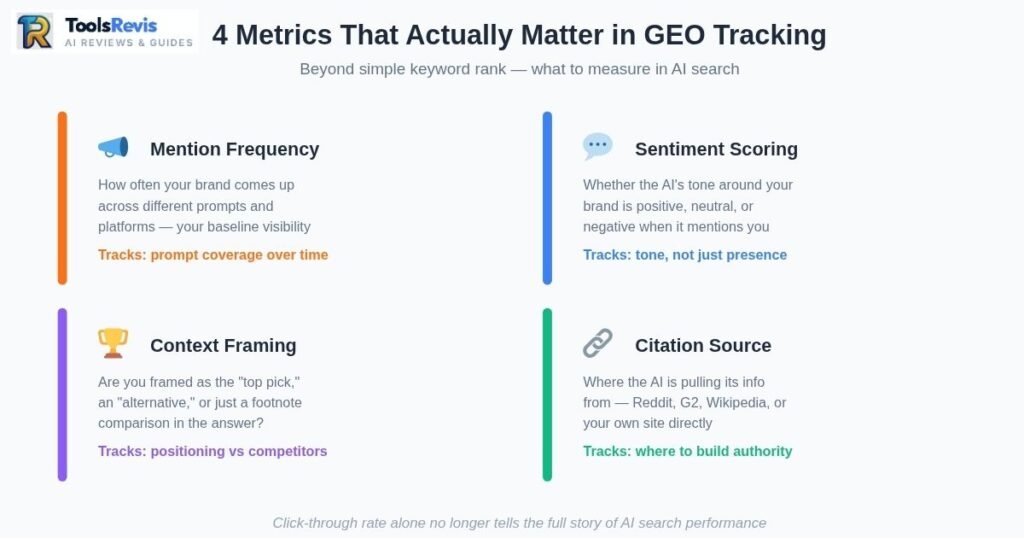
Not every metric that mattered in traditional SEO carries over to AI search. If you’re evaluating a generative engine optimization tracking software, here are the numbers that actually move the needle in 2026.
Brand Mentions & Sentiment Analysis
Getting mentioned by an AI model is only half the story. The real question is: is the AI recommending you in a positive light, or subtly framing you as second-best?
Modern GEO tools now track:
- Mention frequency — how often your brand comes up across different prompts and platforms
- Sentiment scoring — whether the tone around your brand is positive, neutral, or negative
- Context framing — are you the “top pick,” an “alternative,” or a footnote comparison?
This matters because AI models often summarize competitor comparisons in ways that quietly favor one brand over another — and if you’re not tracking sentiment, you won’t even know it’s happening.
Perplexity Source Attribution Metrics
One of the most underrated perplexity source attribution metrics is tracking where your competitors are getting cited from. Perplexity, being a hybrid search engine, pulls heavily from:
- Reddit threads and community discussions
- G2 and Capterra-style review platforms
- Wikipedia and Wikipedia-adjacent sources
- Niche industry blogs with strong topical authority
If a competitor is consistently cited from Reddit or G2 and you’re not, that’s a direct, actionable gap — one you can close by actively building presence on those exact platforms.
The Attribution Dilemma
Here’s a problem almost nobody talks about: how to track LLM citations for brands when your analytics stack wasn’t built for this. When a user clicks through from an AI-generated answer, Google Analytics frequently misclassifies that traffic as “Direct Traffic” — because there’s no traditional referrer URL attached the way there would be from a search results page.
This creates a blind spot where:
- Real AI-driven traffic gets bucketed as “Direct,” inflating that channel artificially
- Marketers underestimate how much value LLM citations are actually driving
- Attribution reports understate the ROI of GEO efforts, making it harder to get budget approved
Purpose-built GEO tracking tools solve this by monitoring citations directly at the source — inside the AI platforms themselves — rather than relying on downstream analytics that were never designed to see this kind of traffic.
Best AI Search Visibility Tools (Tested & Reviewed)
There’s no shortage of tools claiming to be the “best AI search visibility tool” in 2026 — but most reviews are written by the vendors themselves. Here’s a direct, unbiased breakdown based on real product data, pricing structures, and actual feature sets.
Peec AI: Best for Multi-Platform Citation Tracking
Peec AI, founded in Berlin in early 2025, has quickly become one of the most talked-about names in GEO tracking — and for good reason. The platform has raised a $20 million Series A led by Kleiner Perkins and counts DocuSign, Wix, and U.S. Bank among its customers. Superlines
Pros:
- Clean, intuitive UI that doesn’t require an analyst to interpret
- Powerful source analysis showing exactly which URLs AI models are scraping
- Strong regional prompt reporting, with unlimited countries and languages at every pricing tier — a genuine differentiator most competitors don’t offer Metaflow
- MCP server integration for dev teams who want to pull data programmatically
- Runs prompts through live browser sessions daily rather than relying only on API calls Superlines
Cons:
- Content creation workflow is missing — it’s built primarily for measuring AI visibility, not turning insights into direct execution Tim Soulo’s Blog
- Lacks SOC 2 Type II and HIPAA certifications as of early 2026, which can be a dealbreaker for enterprise procurement Superlines
- Capped at 100 prompts and 9,000 AI answers per month on its core plans, with Claude, Gemini, and AI Mode tracking pushed into enterprise add-ons Peec
Peec AI is best suited for budget-conscious marketers, in-house growth teams, and agencies who want clean competitive tracking without the enterprise services overhead.

Profound AI: The Enterprise Standard
If Peec AI is the nimble challenger, Profound is the category heavyweight. The company has raised $155 million at a $1 billion valuation and counts Fortune 500 clients among its customers. Search Influence
Pros:
- SOC 2 Type II certified, with HIPAA compliance also in place — critical for enterprise security reviews Scalenut
- Tracks over 10 AI engines with real-time monitoring and dedicated CSM support Scalenut
- Conversation Explorer allows custom prompt configuration across more than 1.5 billion real user prompts Scalenut
- Built-in content workflows, agent analytics, and shopping/product visibility tracking go well beyond simple monitoring Tim Soulo’s Blog
- Recognized as a G2 Winter 2026 AEO Leader, with a customer roster reportedly including Ramp, Figma, Target, and Walmart Search Influence
Cons:
- Heavily expensive — enterprise contracts are estimated to typically fall between $30,000 and $100,000+ annually, putting it out of reach for most SMBs Search Influence
- Onboarding is sales-led and can take one to three weeks before usable data appears Superlines
- Overkill for teams without a dedicated analyst to act on the data — the platform is genuinely built for the “decide and execute” stage, not first-time monitoring
Profound is the clear pick for large-scale enterprise brand monitoring, but smaller teams may find themselves paying for depth they can’t yet use.

Writesonic GEO & SE Ranking: The Hybrid Leaders
Not every team needs a pure monitoring tool — some need visibility data connected directly to a content production pipeline. This is where Writesonic and SE Ranking step in.
Writesonic’s Professional plan includes GEO tracking across six engines — ChatGPT, Perplexity, Google AI Overviews, Gemini, Claude, and Copilot — alongside a full content and SEO suite. It bundles AI-generated articles, sentiment analysis, and site audits, positioning itself as a replacement for multiple standalone tools at a fraction of the combined cost. PeecPeec
SE Ranking takes a similar hybrid approach: it offers daily updates for tracked keywords, blending traditional SEO rank tracking with newer AI-visibility features — a natural fit for teams who don’t want to abandon their existing SEO stack while adding GEO capability. DerivateX
The appeal here is simple: instead of juggling a separate monitoring dashboard and a separate content tool, these platforms connect what you’re missing directly to what you can produce.

Peec AI vs XFunnel AI Comparison: Which One to Choose?
The verdict: XFunnel leans enterprise and services-heavy — a fit for brands that want a dedicated GEO partner running the strategy for them. Peec AI is the clean, self-serve SaaS option — better for teams that want direct control over their own monitoring without an ongoing services contract.
The Technical Playbook: Best Tools for Optimizing AI Search Visibility
Tracking your visibility is only half the battle. The biggest challenge isn’t creating content—it’s optimizing it so AI models consider it credible enough to reference and cite, which is where many brands miss the mark.
ChatGPT User Intent Optimization Guide
One of the most common mistakes brands make is assuming that AI-powered search works the same way as traditional Google search. It’s not the same game. AI models — especially LLM-native ones like ChatGPT and Claude — process informational and transactional user intents completely differently than traditional search engines do.
Here’s the core difference:
- Traditional search engines match keywords to indexed pages and rank based on backlinks, domain authority, and on-page signals.
- LLM-native engines don’t “rank” pages — they synthesize an answer from what they’ve learned or retrieved, then decide (in real time) whether your brand deserves a mention inside that synthesized answer.
This means keyword stuffing and backlink farming, tactics that still move the needle in classic SEO, do almost nothing for GEO. Instead, ChatGPT-style models respond to:
- Direct, unambiguous answers to specific questions (not vague marketing copy)
- Clear entity definitions — who you are, what you do, who you serve, stated plainly
- Comparative context — content that positions you against alternatives in a factual, structured way
- Consistency across the web — if your brand is described differently on your site, G2, Reddit, and Wikipedia, the model has conflicting signals and may default to a competitor with a cleaner footprint
The practical takeaway: write content the way you’d want an AI to summarize it, not the way you’d want Google to rank it.

How to Increase Google Search Visibility Using GEO
Even Google’s own AI Overviews — an index-driven generative engine — respond to a different set of signals than the traditional 10-blue-links algorithm. If you want to increase your visibility here, focus on three pillars:
1. Structural Clarity
AI models extract information more easily from content that’s cleanly structured. This means:
- Using descriptive H2/H3 headings that mirror actual user questions
- Keeping paragraphs short and scannable (2–4 sentences)
- Using tables and bullet points for comparative or list-based information — exactly the format models pull into summarized answers
2. Credibility Markers
AI models are trained to weigh trust signals heavily. Boost these by:
- Citing original data, studies, or first-party research wherever possible
- Including author bios with real expertise (E-E-A-T still matters, arguably more now)
- Getting mentioned on high-authority third-party platforms (Reddit, G2, Wikipedia, niche forums) since models often pull citation context from these sources rather than your own site
3. RAG-Friendly Content Templates
Most hybrid and LLM-native engines use some form of Retrieval-Augmented Generation (RAG) — pulling relevant chunks of content to ground their answers. To make your content easy to retrieve and quote:
- Answer the core question in the first 1–2 sentences of a section, then elaborate below
- Avoid hiding the main answer behind lengthy introductions or unnecessary filler content.
- Use consistent terminology throughout your site instead of “creative” synonym variation — models trained on semantic matching reward consistency, not variety
Get these three pillars right, and you’re optimizing for both classic Google visibility and the AI Overview layer sitting on top of it — a two-for-one that most brands are still sleeping on.

Advanced GEO Challenges: Escaping the Synthetic Query Trap
As GEO tracking matures, brands are running into a problem most SEO tools were never built to handle: the data itself starts lying to you.Here’s how to identify the issue and correct it effectively:
How to Fix Synthetic Query Trap in SEO
The synthetic query trap happens when the prompts being used to test your AI visibility don’t reflect how real users actually talk to AI models. Many GEO tools — especially cheaper or automated ones — rely on a fixed library of “sample” prompts to check whether your brand gets mentioned. The problem is:
- These sample prompts are often artificially generated, not pulled from real user behavior
- They tend to be generic (“best software for X”) rather than the messy, specific, conversational way real people actually ask AI models questions (“what’s a good alternative to X that doesn’t need a huge budget”)
- This creates artificial search volume patterns that don’t match reality — so you end up optimizing for questions almost nobody is actually asking
How to fix it:
- Anchor your prompt library in real behavior. Pull actual customer questions from support tickets, sales calls, Reddit threads, and community forums instead of relying purely on tool-generated prompt lists.
- Prioritize prompt volume data over prompt variety. A tool that shows you how often a real prompt is being asked matters more than one that shows you a huge list of rarely-used variations.
- Cross-check across multiple tracking tools. If your GEO tracker and your actual analytics data disagree wildly, the synthetic query trap is likely inflating (or deflating) what you’re seeing.
- Re-audit your prompt set quarterly. Real user language shifts fast, especially in the AI space. A prompt library built in January can be stale by June.
Getting this right is the difference between an accurate picture of your AI visibility — and a beautifully designed dashboard reporting numbers that don’t mean anything.
Google AI Overviews Conversion Rate Benchmarks
Here’s the uncomfortable truth many brands haven’t fully absorbed yet: showing up in an AI Overview doesn’t guarantee a click. In many cases, the AI Overview is the answer, and the user never scrolls further.
Some benchmark realities worth knowing:
- Zero-click behavior is now the norm for a large share of informational queries hitting AI Overviews
- Google’s AI Mode results in notably fewer clicks than standard AI Overviews, since AI Mode tends to fully resolve the user’s query within the conversational interface itself
- Even when a click does happen, it’s often driven by brand curiosity rather than pure informational need — meaning your brand mention itself (not just the click) is doing real marketing work, even without traffic to show for it
This is exactly why relying on click-through rate alone to measure GEO success is a mistake. Mention frequency, sentiment, and citation share now matter just as much as — sometimes more than — raw traffic numbers, because a huge portion of the value is happening before any click occurs.
Pros and Cons of Automated AI Visibility Checkers
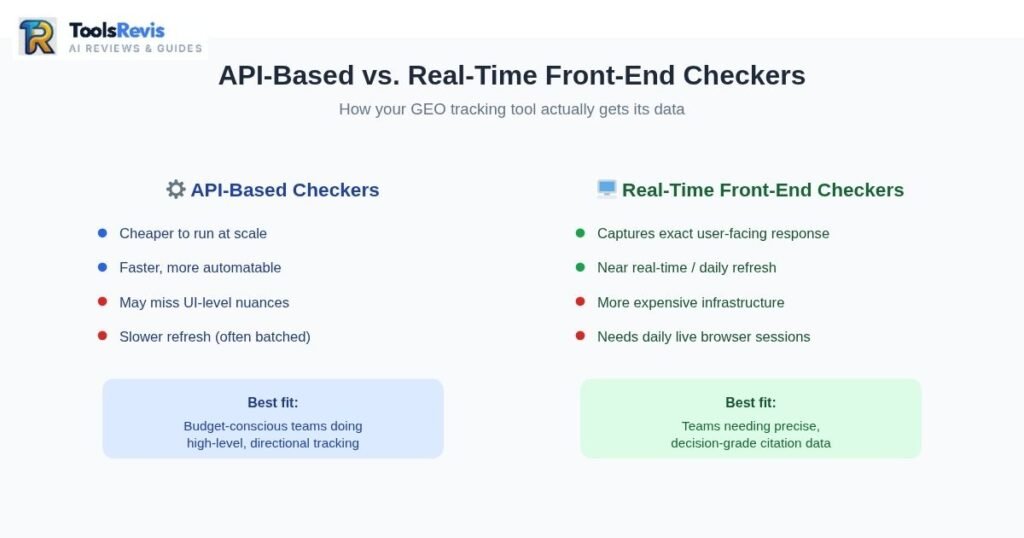
Not every visibility tool works the same way under the hood, and the method matters more than most buyers realize. Broadly, automated checkers fall into two camps: those that query AI models via API calls, and those that simulate real front-end user sessions. Here’s how they stack up.
Factor | API-Based Checkers | Real-Time Front-End Checkers |
| Accuracy | Can miss nuances — API responses sometimes differ from what a real user sees in the actual chat interface | More accurate, since they capture the exact response a real user would get, including UI-level citations and formatting |
| Cost | Generally cheaper to run at scale, since API calls are lighter and more automatable | More expensive — running live browser sessions daily across multiple engines requires more infrastructure |
| Refresh Rate | Varies widely; some tools batch-process to save cost, leading to slower updates | Often near real-time or daily, since the whole point is mirroring live user behavior |
| Best Fit | Budget-conscious teams doing high-level, directional tracking | Teams that need precise, decision-grade data on exact citations and phrasing |
Pros of Automated AI Visibility Checkers
- Speed and scale — you can track hundreds of prompts across multiple engines far faster than any manual process
- Consistency — automated checks remove human bias from testing, so you’re comparing apples to apples over time
- Historical trend data — most tools log results over time, letting you spot whether your visibility is improving, stagnant, or slipping
- Competitive benchmarking — many platforms let you track competitors alongside yourself, which is nearly impossible to do manually at any real scale
Cons of Automated AI Visibility Checkers
- Citation volatility — AI platforms can show significant month-to-month drift in citations, meaning a single snapshot can be misleading; continuous monitoring matters more than one-off checks
- API vs. real interface mismatch — tools relying purely on API outputs may not reflect what a real user actually sees, especially since front-end interfaces sometimes apply additional filtering or formatting logic
- Cost creep at scale — as you add more engines, more languages, and more prompt volume, pricing on many platforms scales up quickly, sometimes doubling for just a few extra engines
- No built-in strategy — even the most sophisticated visibility checker only tells you where the gaps are. None of them automatically fix your content, build your citation footprint, or write your GEO strategy for you
The bottom line: automated visibility checkers are essential for measurement, but they’re not a substitute for a content and authority-building strategy. The real-time, front-end-style tools tend to cost more but deliver noticeably better accuracy — worth the premium if you’re making real budget decisions based on the data.
FAQs: Insights from the World’s Top Generative Engine Optimization Experts
1. What is Generative Engine Optimization (GEO)?
GEO is the practice of optimizing content so AI models like ChatGPT, Claude, and Gemini cite or mention your brand in their generated answers, rather than optimizing purely for traditional search rankings.
2. How is GEO different from SEO?
SEO targets ranking in a list of links; GEO targets earning a direct mention inside an AI-synthesized answer. Backlinks and keyword density matter less — clarity, structure, and entity consistency matter more.
3. Which AI engines should brands track first?
Most experts recommend starting with ChatGPT, Google AI Overviews, and Perplexity, since they currently drive the largest share of AI-influenced search traffic, then expanding to Gemini, Claude, and Copilot.
4. Do backlinks still matter for AI visibility?
Yes, but differently. Backlinks help build the third-party credibility signals (G2, Reddit, Wikipedia) that AI models pull citation context from, rather than directly boosting rank the way they do in classic SEO.
5. How often should GEO prompt libraries be updated?
Quarterly at minimum. Real user language and query patterns shift quickly, and a stale prompt set can lead to inaccurate visibility tracking.
6. Is a low click-through rate a sign of GEO failure?
Not necessarily. Zero-click behavior is now common in AI Overviews and AI Mode, so mention frequency and citation share are often better success metrics than raw clicks.
7. Should small businesses invest in enterprise GEO tools like Profound?
Usually not at first. Enterprise tools are built for teams with dedicated analysts to act on deep data; smaller teams often get more value from lighter, self-serve tools first.
8. What’s the single biggest content mistake brands make in GEO?
Writing for search engine ranking instead of AI summarization — burying direct answers under long intros instead of answering the core question in the first sentence or two.
9. Can one tool handle both tracking and content optimization?
Some hybrid platforms (like Writesonic or SE Ranking) combine both, but most dedicated tracking tools focus purely on measurement and leave execution to the brand’s own content team.
10. How do brands know if their GEO data is trustworthy?
Cross-check results across more than one tracking tool. If numbers diverge sharply, it’s often a sign of the synthetic query trap distorting one data source.
Ready to Take Action? Try Our Free Tools
Now that you understand these GEO strategies, it’s time to apply them. The free tools below can help you turn these insights into practical results.
1. Find the Right AI Tool
Not sure which AI solution fits your needs? Simply describe your goal, and our AI-powered recommendation tool will identify the most suitable option for your specific task in just a few seconds. It’s completely free and requires no sign-up.
2. Analyze Your AI Search Visibility
Want to know how AI search platforms may present your brand? Use our AI Overview Preview tool to see how your content could appear in Google’s AI-generated summaries. This gives you a clear starting point before investing in advanced GEO solutions.
3. Strengthen Your Content and Brand
Build stronger content with these free AI resources:
- AI Bio Generator: Create a professional bio or personal introduction for LinkedIn, portfolios, or business profiles.
- Video Script Generator: Produce well-structured scripts for YouTube, TikTok, and other video platforms in minutes.
- Keyword Cluster Generator: Organize related search terms into topic clusters to improve your SEO and content planning.
4. Improve Your Website and Code
If you’re a developer, marketer, or website owner, these tools can help optimize your projects.
- Code Optimizer: Analyze your code and receive recommendations to improve readability, efficiency, and overall performance.
- Privacy Compliance Checker: Scan your website for potential GDPR, CCPA, and other privacy compliance issues to identify areas that may need attention.
Need more developer-focused resources? Explore our complete guide to the Best AI Tools for Developers.
5. Estimate Your AI Software Budget
Planning your AI toolkit doesn’t have to be complicated. Our AI Tool Stack Calculator estimates the tools and budget your team may need based on your business size, goals, and workflow—delivering a personalized recommendation in just a few minutes.
If you’re responsible for product planning and operations, you may also find our Best AI Tools for Product Managers guide helpful.

I’m Umair Ahmad, founder of ToolsRevis. I personally test every AI tool we cover — signing up, running real workflows, checking pricing tiers, and comparing outputs — before writing a single word. My goal: cut through AI marketing hype with honest, hands-on verdicts.
Let’s achieve more together!