
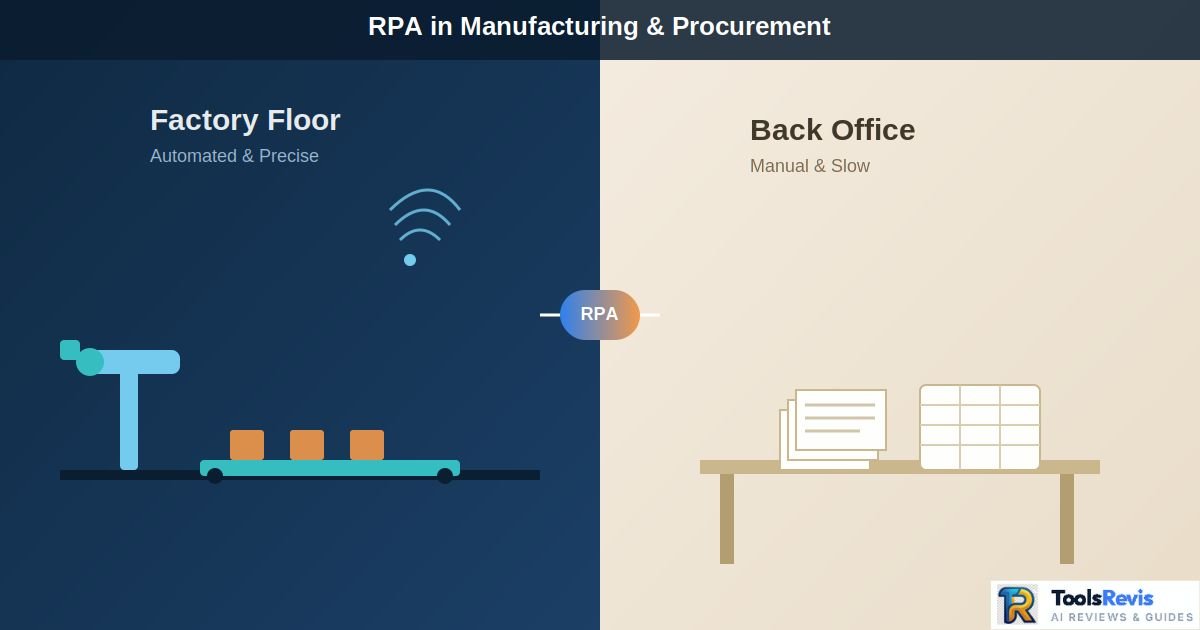
Quick Answer Box: What is RPA used for in manufacturing and procurement?
RPA in manufacturing and procurement automates high-volume, rule-based tasks such as purchase order processing, invoice three-way matching, inventory reconciliation, and BOM updates. Software bots extract data from ERPs like SAP and Oracle, eliminate manual entry errors, and accelerate procure-to-pay cycles across the shop floor and back office.
| Process | RPA Benefit |
| Purchase Orders | Faster Processing |
| Invoice Matching | Fewer Errors |
| Inventory Reconciliation | Better Accuracy |
| BOM Updates | Real-Time Sync |
| Compliance Logging | Automated Audit Trail |
Introduction
Walk onto the shop floor of a modern manufacturing plant and you’ll see the future in motion: IoT sensors streaming real-time telemetry from CNC machines, predictive maintenance algorithms flagging bearing wear before failure, and robotic arms executing sub-millimeter precision welds without human intervention. Digital twins simulate entire production lines before a single part is milled. This is Industry 4.0, and it’s operating exactly as promised.
Walk fifty feet into the procurement and finance back office, and you land in a different decade entirely. Purchase requisitions move through email threads. A buyer manually re-keys the same vendor line items from a PDF invoice into SAP because the EDI integration was never built for that supplierEmployees are still forced to manually verify Bills of Materials across three separate spreadsheets simply because the ERP software does not integrate with the shop floor’s MES. Compliance logging for audit trails happens in a shared Excel file that one person maintains, badly, between other tasks.
Today’s manufacturing industries face a major contradiction: while physical shop floor production is highly automated and precise, the administrative, financial, and documentation workflows supporting it are still heavily reliant on manual processes. Robotic Process Automation (RPA) exists precisely to close this gap — not by replacing the robots on the floor, but by building a digital workforce for the office processes those robots depend on.
Where does RPA fit in with other emerging technologies?
In the grand scheme of robotic process automation Industry 4.0, RPA acts as the administrative connective tissue. While AI drives predictive insights and IoT gathers floor data, RPA automates the operational execution layer, ensuring that system updates match the speed of digital workflows.
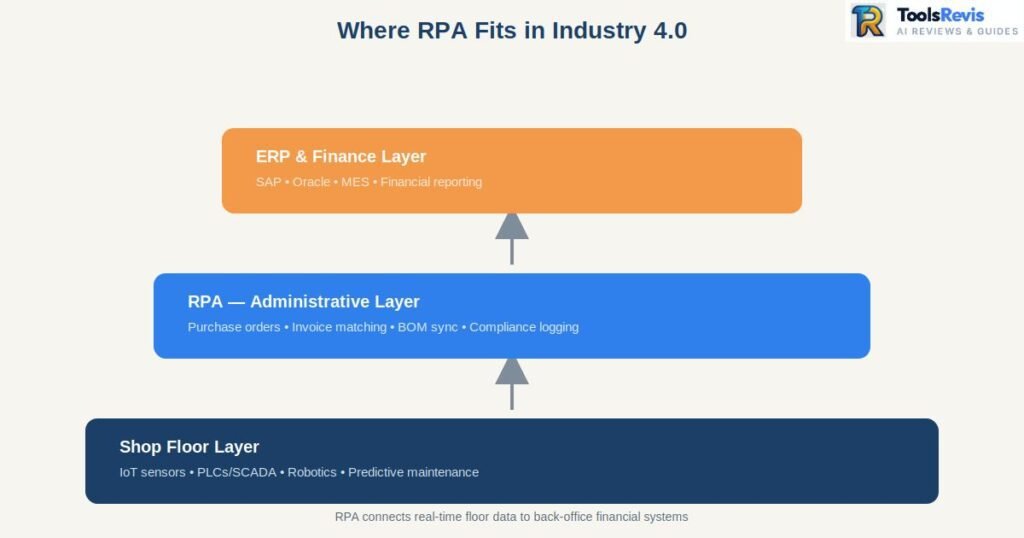
Driving Operational Efficiency: Robotic Process Automation in Manufacturing Industry
Robotic process automation (RPA) in manufacturing automates repetitive back-office tasks such as purchase order processing, invoice matching, inventory reconciliation, BOM updates, and ERP data synchronization.
Traditionally, factory automation has been defined by physical shop-floor technologies, such as PLCs, SCADA networks, and industrial robotics. RPA extends that automation logic into the transactional layer that surrounds production — the purchase orders, work orders, quality documentation, and financial reconciliations that determine whether the plant actually runs on schedule and on budget.
Understanding where RPA fits requires separating two automation domains that are often conflated: automating manufacturing processes on the factory floor (physical, sensor-driven, real-time) versus automation manufacturing process layers that support them (data-driven, rule-based, transactional). RPA belongs firmly in the second category, and that’s exactly where most manufacturers are leaking margin.
Where RPA Delivers Measurable ROI
The highest-value RPA deployments in the rpa manufacturing space cluster around a handful of repetitive, high-volume, and error-prone processes:
- Purchase order creation and approval routing: Bots pull requisition data from procurement portals, validate it against budget thresholds, and auto-generate POs in the ERP without a buyer touching a keyboard.
- Three-way invoice matching: Bots cross-reference the PO, goods receipt note, and vendor invoice line-by-line, flagging discrepancies above a defined tolerance for human review instead of forcing AP staff to manually check every line.
- BOM synchronization: When engineering revises a Bill of Materials, bots propagate the change across ERP, MES, and procurement systems simultaneously, closing the version-control gap that causes costly production-line stoppages.
- Inventory and stock reconciliation: Bots compare physical warehouse counts against ERP inventory records nightly, auto-flagging variances that would otherwise surface only during a quarterly audit.
- ERP sync across disconnected systems: In plants running SAP for finance and a separate MES or legacy system for shop-floor operations, bots act as the connective tissue, pushing and pulling data on a schedule so neither system drifts out of sync.
- Compliance logging and audit trail generation: Bots automatically timestamp, log, and archive every transaction touchpoint (a hard requirement in regulated sub-sectors), removing the risk of a manually maintained log having gaps.
Industry-Specific Applications: Where the Use Cases Diverge
RPA applications vary by manufacturing sector because each industry has different compliance, documentation, and supply chain requirements.
The specific shape of robotic process automation manufacturing operations changes significantly by vertical, and this is where generic automation advice tends to fail practitioners:
- RPA in car manufacturing: Dominated by supply chain complexity. A single vehicle program can involve thousands of tier-1 and tier-2 suppliers, each generating separate purchase orders, ASN (Advanced Shipping Notice) documents, and quality certificates. In these scenarios, bots are commonly used to match supplier shipping notices (ASNs) with physical dock receipts, automatically sync dealership warranty claims with the manufacturer’s quality databases, and process the constant flow of engineering updates that impact bills of materials (BOMs) across different vehicle models.
- Robotic Process Automation (RPA) in the pharmaceutical industry is driven primarily by strict regulatory compliance rather than sheer production volume. Batch record review, deviation logging, and Certificate of Analysis (CoA) generation all require exhaustive compliance logging that satisfies FDA 21 CFR Part 11 requirements. Bots in this vertical are configured less for speed and more for auditability — every action a bot takes must itself be logged, timestamped, and traceable.
The Problem Nobody Warns You About: Dirty Data Breaks Standard Bots
Dirty or unstructured data is one of the biggest reasons RPA projects fail in manufacturing because traditional bots rely on fixed document formats.
Here’s where most first-time RPA deployments quietly fail, and it rarely shows up in vendor demos. Standard rule-based RPA bots are built on rigid, screen-scraping or fixed-field logic — they expect input documents to look the same every time. Manufacturing and procurement documents almost never do.
A standard bot configured to extract invoice data from a fixed PDF template will crash, silently fail, or misextract data the moment it encounters:
- A supplier invoice with a different layout than the one the bot was trained on.
- A handwritten shop floor sheet or quality inspection form.
- A scanned PDF where the OCR layer is degraded or missing entirely.
- A purchase order with merged cells, rotated text, or inconsistent table structures.
This is one of the most consistently raised frustrations among RPA practitioners in manufacturing and procurement forums: teams build a bot that works flawlessly on a clean sample data set during proof-of-concept, deploy it into production, and watch it break within weeks because real-world documents — especially from smaller or overseas suppliers — are inconsistent, unstructured, or partially handwritten.
The Fix: Intelligent Document Processing (IDP) sits upstream of the RPA bot and uses machine learning-based extraction — rather than fixed-template matching — to read unstructured and semi-structured documents regardless of layout. IDP models are trained to recognize field types contextually, so they generalize across hundreds of supplier invoice formats instead of requiring a separate template for each one. When IDP is paired with RPA, the combined system tolerates the messy, real-world document variability that breaks standard bots outright.
RPA Case Studies in Manufacturing: What the Data Shows
Manufacturing RPA case studies consistently report faster invoice processing, fewer manual errors, and significant reductions in processing time.
Documented rpa case studies in manufacturing consistently point to a few repeatable outcomes: 70% to 90% reduction in manual data entry time for invoice processing, AP cycle times cut from days to hours, and near-elimination of duplicate payment errors caused by manual three-way matching.
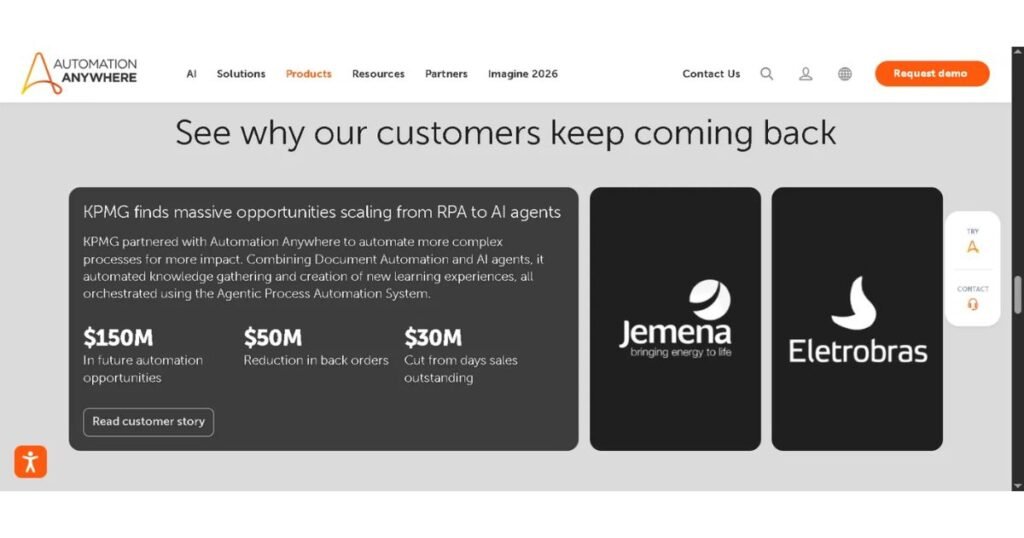
Examples of rpa in manufacturing that appear most frequently in case study literature include automated goods-receipt reconciliation in automotive tier-1 suppliers, batch record compliance logging in pharma plants, and BOM-to-ERP synchronization in discrete manufacturing environments running parallel legacy and cloud ERP systems during a phased migration.
The Business Value: Key Benefits of RPA in Manufacturing
The primary benefits of RPA in manufacturing include lower operating costs, faster processing, improved data accuracy, and continuous 24/7 workflow execution.
RPA manufacturing deployments are typically justified on paper with a straightforward efficiency argument, but the real business case runs deeper than headcount reduction.
RPA vs. Traditional Automation: A Different Layer Entirely
RPA differs from traditional automation because it works through the user interface instead of requiring direct system integrations or APIs.
Traditional automation — PLCs, SCADA, and system-to-system API integrations — works by directly wiring one system’s data layer to another. It’s fast and robust, but it’s also expensive to build and brittle to change. RPA takes a fundamentally different approach, operating at the UI layer — the same screens, forms, and applications a human employee would use.
| Factor | Traditional Automation (API/System Integration) | RPA |
| Implementation Speed | Weeks to months (developer-heavy) | Days to weeks (configuration-heavy) |
| Cost | High — custom development, API licensing | Lower — reuses existing system UIs |
| Legacy Compatibility | Often requires vendor API access | Works with any UI, including legacy/green-screen apps |
| Flexibility to Change | Slow — requires re-development | Faster — bots reconfigured, not rebuilt |
| Best Suited For | Core, stable, high-throughput system logic | Variable, rules-based, cross-system workflows |
This table highlights the core trade-offs in the rpa vs traditional automation debate, illustrating why RPA has spread so quickly through manufacturing back offices to bridge disconnected legacy software.
Where RPA Efficiency Actually Shows Up
RPA improves operational efficiency by reducing manual work, accelerating processing times, and minimizing human errors across manufacturing workflows.
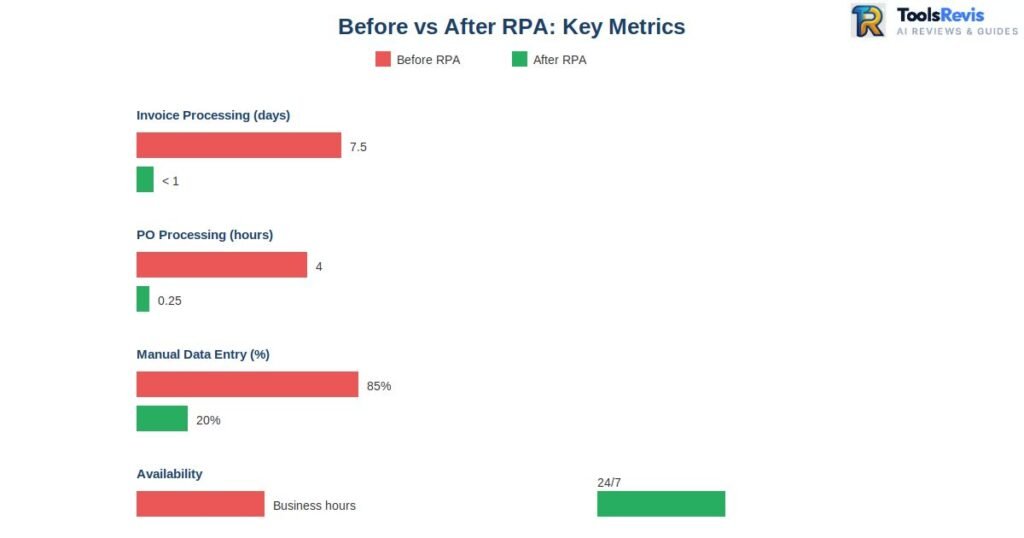
The efficiency gains from benefits of robotic process automation rollouts aren’t abstract:
| Performance Metric | Before RPA | After RPA |
| Invoice Processing Time | 5–10 days | Under 24 hours |
| Manual Data Entry | High | 60–80% Reduction |
| Data Entry Errors | Frequent | Near Zero |
| Purchase Order Processing | Several Hours | Minutes |
| Processing Availability | Business Hours Only | 24/7 |
| Three-Way Matching | Manual | Fully Automated |
| Employee Productivity | Limited by Manual Tasks | Focused on Higher-Value Work |
- 60% to 80% reduction in manual data entry time for repetitive tasks like PO creation, invoice logging, and inventory updates.
- Cycle time reductions of up to 70% on processes like invoice-to-payment and requisition-to-order.
- Near-zero transcription error rates on bot-handled fields, drastically boosting overall rpa efficiency.
- 24/7 processing capacity, which matters disproportionately given the volume of overnight shift-handoff data.
RPA Challenges in Manufacturing Process Optimization
RPA challenges in manufacturing include process instability, UI changes after software updates, governance gaps, poor document quality, and ongoing bot maintenance requirements.
It’s worth being direct about where things go wrong, since this is where most failed deployments originate. The recurring rpa challenges in manufacturing process optimization include:
- Process Instability: Bots automate a process exactly as it exists today; if the underlying process is inefficient, RPA scales that inefficiency.
- UI Fragility: Because bots operate at the screen layer, a vendor UI update or ERP patch can break a bot overnight.
- Governance Gaps: Without a clear center of excellence, business units deploy bots independently, creating an unmanaged “bot sprawl” that IT can’t audit.
Streamlining the Supply Chain: Robotic Process Automation in Procurement
RPA streamlines procurement by automating purchase requests, approval workflows, purchase order creation, and invoice processing. If manufacturing floor automation gets the attention, procurement robotics process automation is where the financial case is easiest to prove — because procurement is almost entirely document-driven, rules-based, and high-volume.
From Manual Requisition to Automated Purchasing System
A traditional procurement cycle involves multiple approval hops, each adding days of latency. An automated purchasing system compresses this by letting bots pull approved requisitions directly from procurement portals, validate them against budget codes, and auto-generate the PO in the ERP.
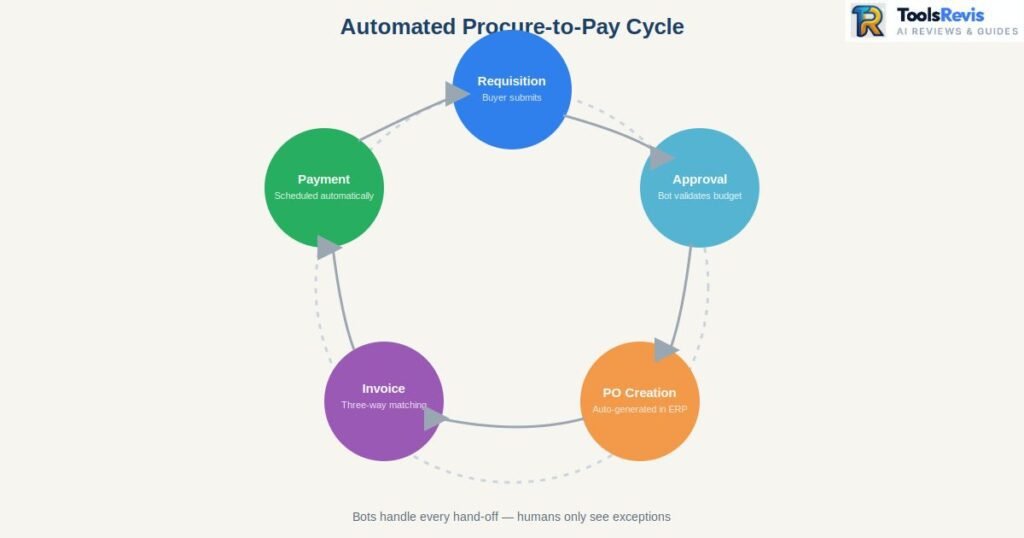
The benefits of automated purchasing system deployments compound quickly: procurement teams commonly see PO cycle times drop from multiple days to under an hour for standard, pre-approved purchases, freeing buyers to focus on strategic sourcing.
RPA for AP: The Mechanics of the Robotic Three-Way Match
The single highest-ROI use case in rpa for ap is the three-way match — the process of verifying that a Purchase Order, Goods Receipt Note, and Vendor Invoice all agree before a payment is released. A robotic three-way match automates each step, bringing robotic process automation in ap workflows to full maturity.
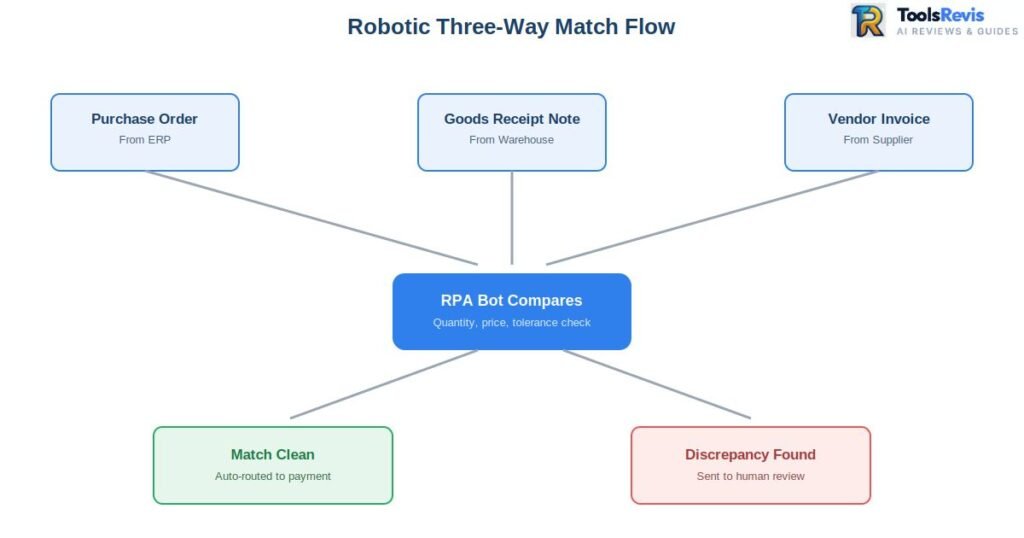
Bots extract incoming invoice data, retrieve corresponding PO numbers from the ERP, compare quantities/pricing against a configurable tolerance threshold, and route clean data straight to payment scheduling while moving exceptions to a human queue.
Procurement Automation Benefits, Quantified
Procurement automation improves purchasing speed, reduces processing costs, minimizes payment errors, and increases operational efficiency. Manufacturers running rpa for procurement at scale report:
- Up to 80% straight-through processing of invoices with no human touch required.
- AP cycle times cut from 5-10 days to under 24 hours for matched, standard invoices.
- Significant reduction in duplicate and erroneous payments.
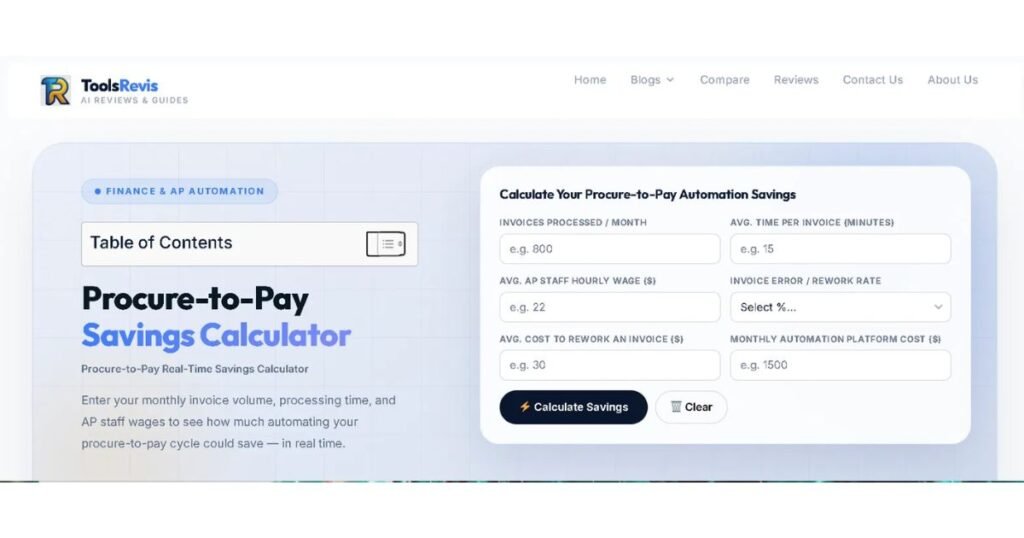
Want to estimate your own savings?
Use our free P2P Savings Calculator to estimate how much time and money your procurement team could save by automating purchase-to-pay workflows.
Beyond Factories: Cross-Industry Intelligent Automation Use Cases
RPA is widely used beyond manufacturing in industries such as utilities, energy, retail, logistics, and healthcare to automate repetitive administrative tasks. While manufacturing and procurement remain RPA’s highest-volume deployment ground, the same document-heavy, rules-based logic transfers directly to adjacent industries running comparable back-office friction.
RPA Use Cases in Utilities and the Energy Market
Oil & gas and utilities operators run intense compliance environments. RPA use cases in utilities and rpa oil and gas operations typically center on:
- Meter-to-cash automation: Bots extract consumption data from smart meter feeds and reconcile it against billing systems.
- Regulatory compliance reporting: Bots auto-populate and submit standardized regulatory filings.
- Asset maintenance work order processing: Bots cross-reference SCADA-flagged maintenance alerts against field technician scheduling systems.
RPA in Retail and Manufacturing Supply Chains
The line between retail and manufacturing supply chains has blurred considerably. RPA in retail and manufacturing networks commonly addresses demand forecasting data consolidation, returns and reverse logistics reconciliation, and cross-docking coordination.
RPA Use Cases in the Marine Market
The maritime logistics sector represents a smaller but increasingly relevant niche for global distribution. RPA use cases in marine market workflows include bill of lading extraction, customs documentation processing, and vessel scheduling reconciliation against inbound inventory planning systems.
Critical Pitfalls: Why 30-50% of RPA Implementations Initially Fail
Most RPA implementations fail because of poor process design, weak governance, lack of exception handling, and inadequate change management. Industry data consistently shows that a substantial share of RPA programs fail to scale past the pilot stage. RPA adoption in manufacturing faces unique friction because it sits at the intersection of IT governance, operations, and finance — three functions with historically poor coordination.
The most common root causes include:
- Change Management Flaws: Employees whose tasks are being automated are rarely brought into the design process, leading to resistance.
- Lack of Human-in-the-Loop (HITL) Workflows: Bots deployed with no exception-handling path fail hard the moment they encounter a scenario outside their rules.
- Underestimating Maintenance Overhead: Bots operating at the UI layer require ongoing maintenance as source systems update; organizations that treat RPA as “build once, forget” see rising failure rates within the first year.
Top RPA Tools for Industrial Automation Processes
The leading RPA platforms for manufacturing include UiPath, Automation Anywhere, and Microsoft Power Automate, each offering different strengths for enterprise automation. Selecting from among the tools helpful in RPA manufacturing processes depends heavily on existing infrastructure, budget, and the complexity of document variability the organization needs to handle.
UiPath vs. Automation Anywhere vs. Microsoft Power Automate
- UiPath: Strongest ERP/SAP connectors, robust built-in Document Understanding module. Best fit for large enterprise manufacturers with complex SAP/Oracle environments.

- Automation Anywhere: Cloud-native architecture, strong AI-powered IQ Bot for unstructured documents. Best fit for cloud-first organizations prioritizing scalability.
- Microsoft Power Automate: Deepest integration with Microsoft 365/Dynamics ecosystems, lower entry cost. Best fit for mid-market manufacturers seeking faster time-to-value without a dedicated automation team.
For manufacturers evaluating best rpa solutions for manufacturing supply chain optimization, the deciding factor is usually less about raw bot capability and more about how well the platform’s document-processing layer handles the specific mix of clean and unstructured data flowing through their supplier network.
Conclusion
The gap between highly automated factory floors and manually operated back offices represents one of the largest sources of inefficiency in modern manufacturing. RPA closes that gap not by replacing physical automation, but by extending automation logic into the transactional layer — purchase orders, invoices, BOM updates, and compliance logs — that keeps production running on schedule and on budget.
Read Next
- What Is Robotic Process Automation? Learn the fundamentals of RPA, how software bots work, and where they’re used across industries.
- Robotic Process Automation in Accounts Payable Discover how RPA automates invoice processing, three-way matching, and AP workflows.
Frequently Asked Questions
1. What is the difference between RPA and traditional automation?
Traditional automation connects systems directly at the data layer using custom APIs and needs developer resources to build. RPA works at the UI layer instead, mimicking human actions on-screen — faster and cheaper to deploy, especially on legacy systems without modern APIs.
2. What are common manufacturing industry data entry use cases for RPA?
Common use cases include purchase order creation, invoice line-item entry into ERP systems, BOM updates across engineering and MES platforms, inventory reconciliation, and compliance log entry. Bots eliminate manual re-keying between disconnected systems like SAP and shop-floor MES.
3. What are the benefits of combining RPA and AI in manufacturing?
Combining rpa and ai in manufacturing — especially Intelligent Document Processing — lets bots handle unstructured inputs like irregular invoices or handwritten shop sheets that standard bots crash on. It also enables smarter exception handling, such as flagging anomalous invoice patterns before they become costly errors.
4. How does RPA improve procurement in manufacturing?
RPA improves procurement by automating purchase requisitions, approval workflows, purchase order creation, invoice validation, and supplier data updates. This reduces manual work, shortens procurement cycles, and minimizes processing errors.
5.Can RPA work with SAP and Oracle ERP systems?
Yes. Modern RPA platforms such as UiPath, Automation Anywhere, and Microsoft Power Automate integrate with SAP, Oracle, Microsoft Dynamics, and many legacy ERP systems by interacting with user interfaces or APIs when available.
6. What is the difference between RPA and Intelligent Document Processing (IDP)?
RPA automates repetitive business processes, while Intelligent Document Processing (IDP) extracts and understands information from structured and unstructured documents using AI and OCR. Together, they automate complete document workflows.
7. Is RPA suitable for small and medium-sized manufacturers?
Yes. Small and medium-sized manufacturers can use RPA to automate invoice processing, inventory updates, purchase order management, and reporting without making major changes to their existing software systems.
8. What processes should manufacturers automate first with RPA?
Manufacturers should begin with repetitive, rule-based processes such as purchase order processing, invoice matching, inventory reconciliation, supplier onboarding, compliance reporting, and ERP data entry because these deliver the fastest return on investment.
Related Automation Tools
RPA ROI Calculator
Estimate your expected return on investment before implementing Robotic Process Automation.
Support Bot ROI Calculator
Measure how much your business could save by automating customer support operations.
PDF Invoice Data Extractor
Extract invoice data from PDF files instantly without manual data entry.

I’m Umair Ahmad, founder of ToolsRevis. I personally test every AI tool we cover — signing up, running real workflows, checking pricing tiers, and comparing outputs — before writing a single word. My goal: cut through AI marketing hype with honest, hands-on verdicts.
Let’s achieve more together!